Chicken Fricassee with Lemon and Rosemary

lchickplatedsmall

Although my family preferred to dine at home for Italian food, we would on occasion patronize a local neighborhood restaurant in Brooklyn named Michael’s. This past summer, after a visit to our parents’ graves, my brother and I, prompted by nostalgia, thought we would return there with our spouses for lunch.

When we entered, we were amazed at how little the place had changed; the son of the original proprietor still remembered us even after a 25 year absence; it was still elegant, with white tablecloths, polished stemware, and attentive waiters dressed in dark suits and ties. Even the menu was as I remembered it, allowing my brother and me to pick out parents’ favorite dishes as well as ours.

Mine was always their lemon chicken on the bone, a fricassee with small bone-in pieces of chicken, perfectly browned and napped in an intensely flavored lemon sauce and always served, even today, with sautéed string beans and a potato croquette.

Last night, I tried to re-create this dish—but only with a modicum of success. I based my recipe on a recipe from Marcella Hazan’s Essentials of Classic Italian Cooking. However, I used a chicken cut into 16 pieces as opposed to the 8 called for by the recipe and I did not follow the original recipe’s directions for cooking the breast meat for a shorter time than the dark. After browning, I cooked the entire batch of chicken for close to 50 minutes. Consequently, some of the pieces of white meat were not as moist as I would have liked them to be. Finally, the amount of sauce I wound up with was considerably less than I had expected, despite using more wine and lemon juice than was called for.

Nevertheless, the final dish was more than edible and both of us went back for seconds. The flavor of the sauce was extremely close to what I was aiming for and the dark meat was both moist and flavorful. Before long, I shall attempt this dish again and hopefully will have more success—perhaps another visit to Michael’s in Brooklyn will help.

Fricasseed Chicken with Rosemary and Lemon Juice
Adapted from Essentials of Italian Cooking

3 pound chicken, cut into 16 pieces
2 tablespoons extra virgin olive oil
1 tablespoon unsalted butter
4 2-inch sprigs fresh rosemary
3 garlic cloves, lightly smashed
Salt
Fresh-ground black pepper
1/3 cup dry white wine
4 tablespoons fresh squeezed lemon
Grated zest of 1 lemon

Wash with cold water and thoroughly pat dry the chicken

Choose a lidded sauté pan large enough enough to eventually accommodate the chicken in a single layer without overlapping.

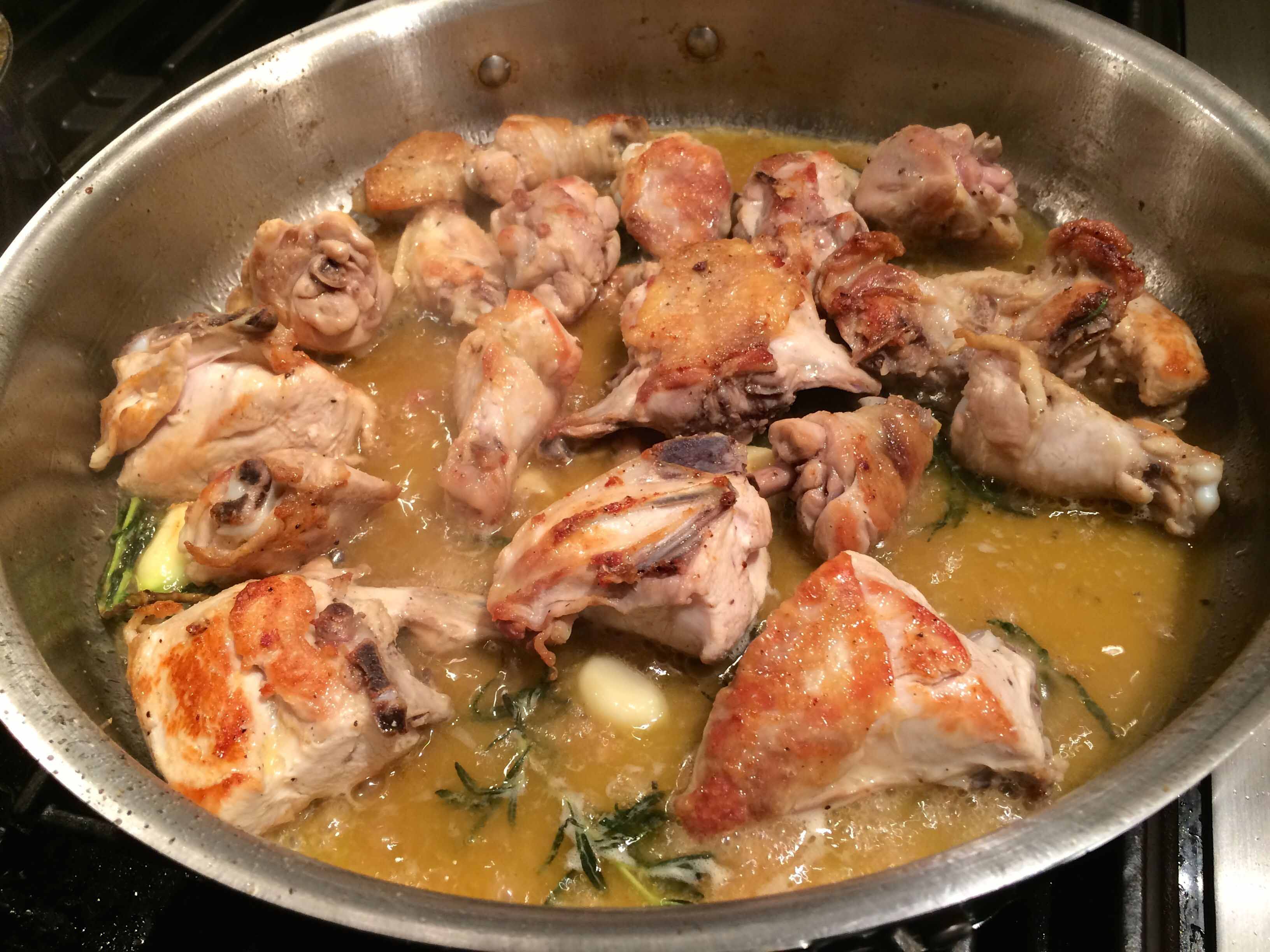
Place oil and butter in the pan over medium-high heat. When the butter foam subsides, put in the chicken skin-side down. Brown the chicken well on both sides. Add the rosemary, garlic, salt and pepper. Cook for 2 to 3 minutes, turning the chicken from time to time. (At this point, Hazan says to remove the breasts and set aside. I left all the meat in the pan.)
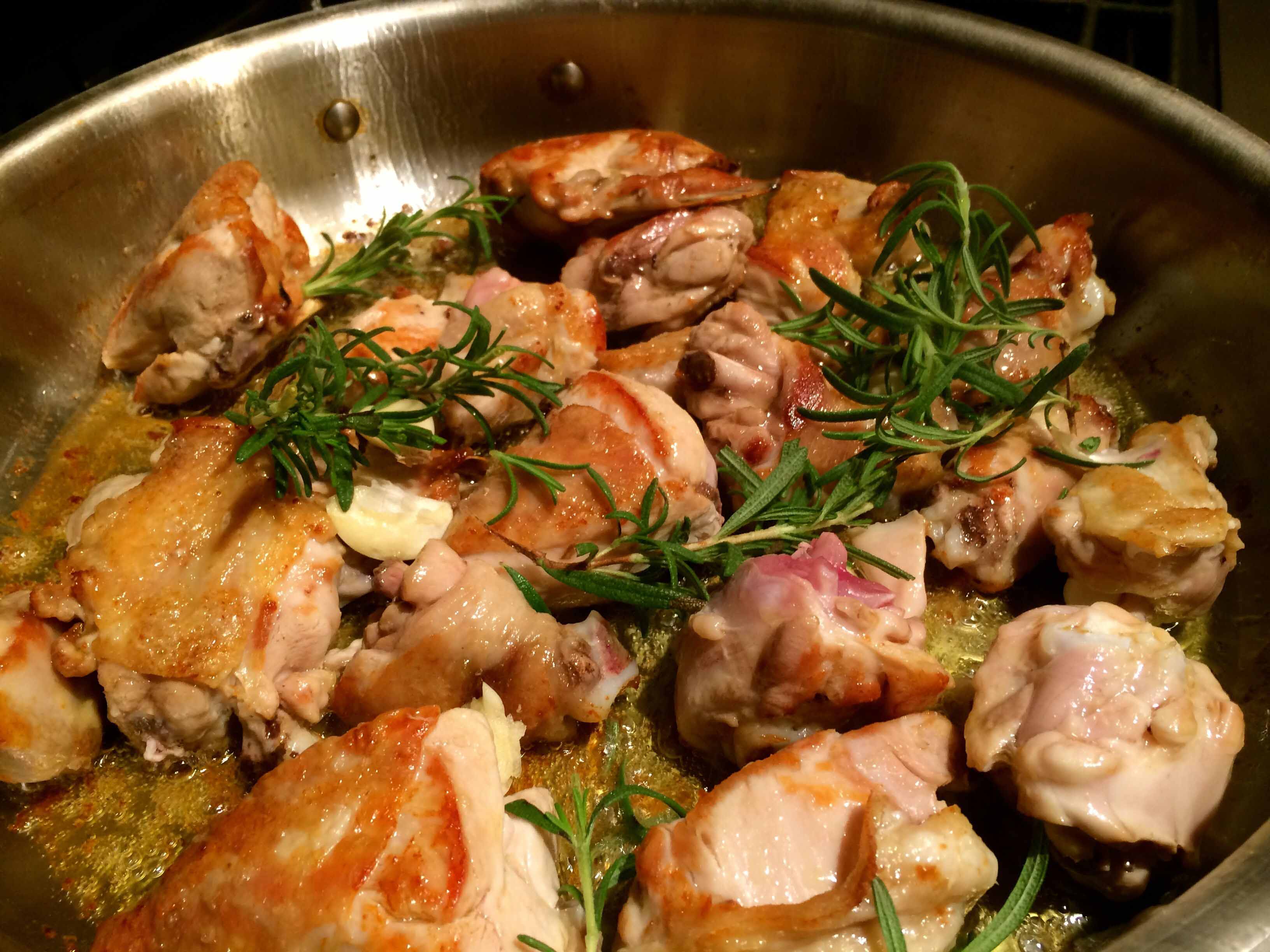
Chicken with the rosemary and garlic

Add the wine, and bring it to a brisk simmer of about 20 seconds. Then lower the heat to cook the chicken at a very low simmer. Place the lid on the pan, leaving it slightly ajar. Cook for 40 minutes (Hazan calls for returning the white meat to the pan at this point), occasionally turning the pieces to ensure even cooking. Cook for at least 10 minutes more, until the thigh meat is tender. While the chicken is cooking, check the liquid in the pan. If too low, add 2 to 3 tablespoons of water.
lchicklemonsmall
After adding the lemon juice and zest

When the chicken is done, remove from heat and transfer the pieces to a warm serving platter, using a slotted spoon. Tip the pan and spoon off all but a little bit of the fat.

Add the lemon juice and zest to the pan and place over medium-low heat to deglaze the pan, using a wooden spoon to scrape loose any brown bits on the bottom and the sides of the pan. Pour the pan juices over the chicken and serve at once.

We served the chicken with a simp couscous and steamed green beans.

Wine Pairing: Sangiovese, Sauvignon Blanc
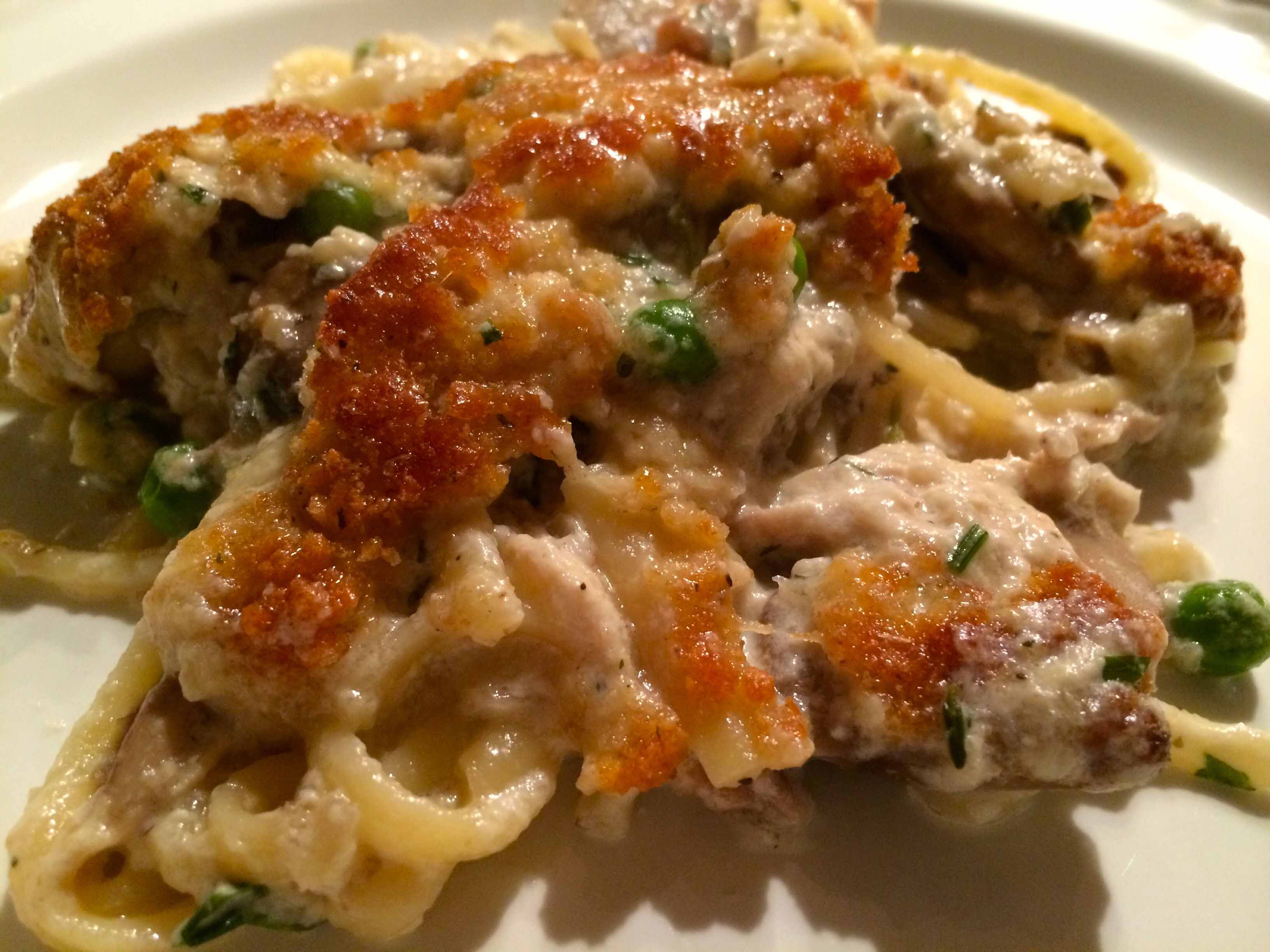
Chicken Tetrazzini

ctet4small

Last week, I was saddened by the death of one of the Met’s divas, Licia Albanese. She was 105 when she died, a long life indeed. Yet her longevity does not diminish the sense of loss I feel. She was, after all, the first soprano in the first opera I ever heard at the Metropolitan Opera. It was at the old house, and she was singing the role of Violetta in Verdi’s La Traviata. Granted, her voice was not in its prime; and probably nearing 50, she may have been a little too old for the role of a Parisian courtesan. Nevertheless, she commanded the Met’s stage with a presence that only true divas possess.

Now, you might be asking, what does this have to do with food? Well, last night I prepared Chicken Tetrazzini, a dish named for another great diva of the past, Luisa Tetrazzini, who actually made her famous debut in 1907 at London’s Covent Garden as Violetta.

Most sources date the origin of the dish, perhaps originally prepared with turkey, between 1908 -1910 and attribute its creation to Ernest Arbogast, who was chef at the Palace Hotel in San Francisco, a city where Tetrazzini resided for quite some time.

Last night, as we sat down to dinner, we raised a glass to Licia Albanese and were reminded to be grateful for the exceptional sopranos we have today who follow in her footsteps at the Met.

My recipe for Chicken Tetrazzini is from the Food Network’s Giada de Laurentiis. Although the list of ingredients is rather long, it’s a relatively simple dish to prepare. It’s also decadently rich with loads of butter, cream, and cheese. But like all indulgent fare, it can be enjoyed guilt free—when consumed in moderation.

Rather than using the recipe’s called for skinless breasts, I skipped the cooking and used the meat I pulled from 1/2 of a left-over rotisserie chicken. I think you could do the same with leftover turkey.

Chicken Tetrazzini Adapted from Giada de Laurentiis

Ingredients

9 tablespoons butter
2 tablespoons olive oil
4 boneless skinless chicken breasts (I substituted the meat from a half of a rotisserie chicken.)
2 1/4 teaspoons salt
1 1/4 teaspoons freshly ground black pepper
1 pound white mushrooms, sliced
1 large onion, finely chopped
5 cloves garlic, minced
1 tablespoon chopped fresh thyme leaves
1/2 cup dry white wine
1/3 cup all-purpose flour
4 cups whole milk, room temperature
1 cup heavy whipping cream, room temperature
1 cup chicken broth
1/8 teaspoon ground nutmeg (I used at least a 1/4 teaspoon.)
12 ounces linguine
3/4 cup frozen peas
1/4 cup chopped fresh Italian parsley leaves
1 cup grated Parmesan
1/4 cup dried Italian-style breadcrumbs

Directions

Preheat the oven to 450 degrees F.

Spread 1 tablespoon of butter over a 13 by 9 by 2-inch baking dish. (I did not grease the baking dish and nothing stuck to it.)

Melt 1 tablespoon each of butter and oil in a deep large nonstick frying pan over medium-high heat. Sprinkle the chicken with 1/2 teaspoon each of salt and pepper. Add the chicken to the hot pan and cook until pale golden and just cooked through, about 4 minutes per side. Transfer the chicken to a plate to cool slightly. Coarsely shred the chicken into bite-size pieces and into a large bowl. (As I mentioned earlier, you can make this dish with leftover chicken or turkey pulled or shredded into bite-size pieces.)

The shredded chicken

Meanwhile, add 1 tablespoon each of butter and oil to the same pan. Add the mushrooms and sauté over medium-high heat until the liquid from the mushrooms evaporates and the mushrooms become pale golden, about 1-2 minutes. Add the onion, garlic, and thyme, and sauté until the onion is translucent, about 8 minutes. Add the wine and simmer until it evaporates, about 2 minutes. Transfer the mushroom mixture to the bowl with the chicken. (It took me much longer to brown the mushrooms, at least 10 minutes. I also cooked the onions for about 6 minutes before adding the garlic to cook for the final 2 minutes.)

The mushrooms, onion, garlic, and thyme

Melt 3 more tablespoons butter in the same pan over medium-low heat. Add the flour and whisk for 2 minutes. Whisk in the milk, cream, broth, nutmeg, remaining 1 3/4 teaspoons salt, and remaining 3/4 teaspoon pepper. Increase the heat to high. Cover and bring to a boil. Simmer, uncovered, until the sauce thickens slightly, whisking often, about 10 minutes. (I added a 1/4 of the cheese (1/4 cup) to the sauce during the last two minutes of cooking.)

Bring a large pot of salted water to a boil. Add the linguine and cook until it is tender but still firm to the bite, stirring occasionally, about 9 minutes. Drain. Add the linguine, sauce, peas, and parsley to the chicken mixture. Toss until the sauce coats the pasta and the mixture is well blended. (The linguine should be cooked a minute or two less than the package’s recommended time for al dente. Remember the pasta will continue to cook during baking.)

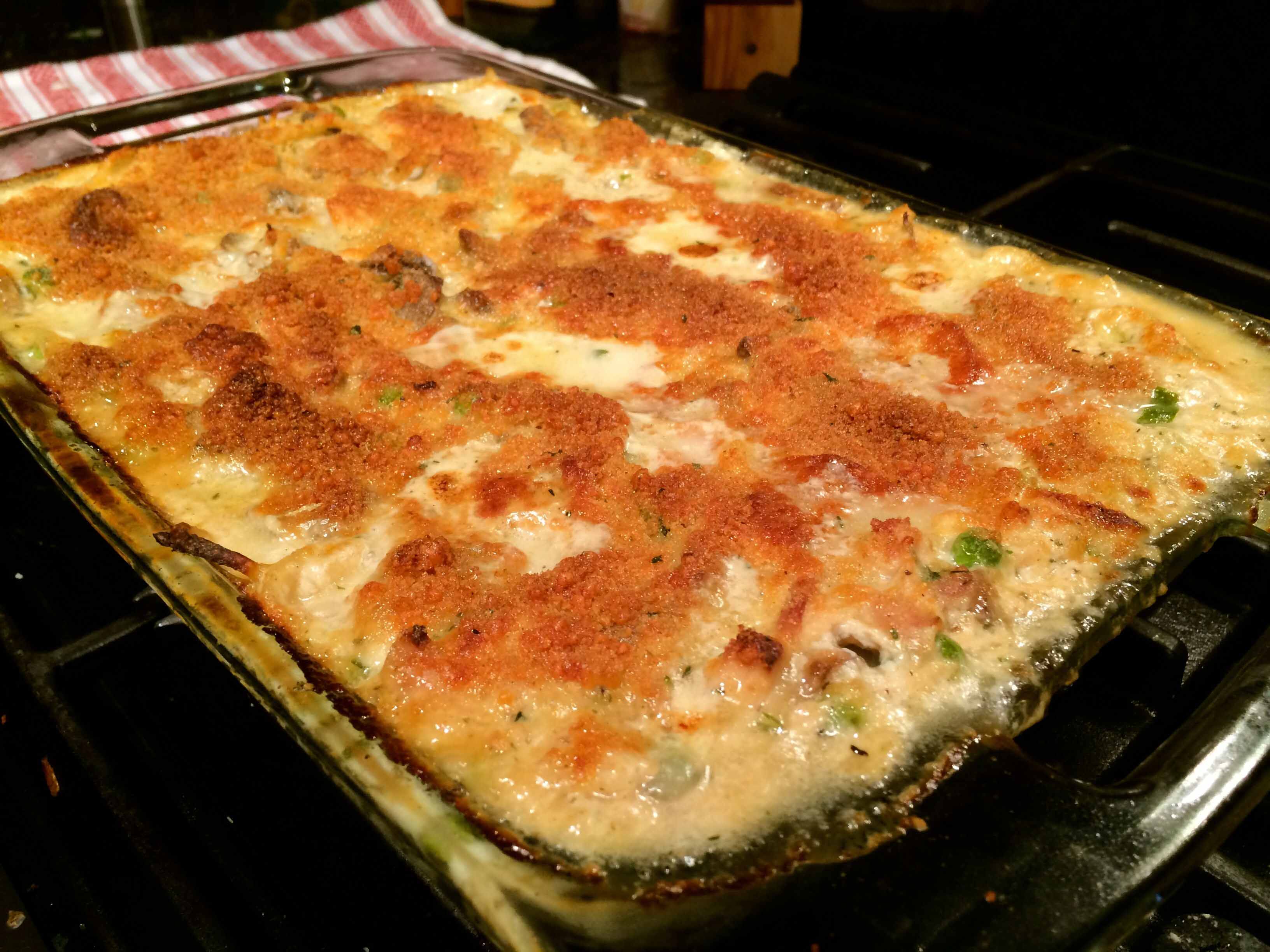
Transfer the pasta mixture to the prepared baking dish. Stir the cheese and breadcrumbs in a small bowl to blend. Sprinkle the cheese mixture over the pasta. Dot with the remaining 3 tablespoons of butter. Bake, uncovered, until golden brown on top and the sauce bubbles, about 25 minutes.

From the oven
From the oven

Read more and view a video of the preparation at:

http://www.foodnetwork.com/recipes/giada-de-laurentiis/chicken-tetrazzini-recipe.html

Wine Pairing: Chardonnay

Farmhouse Chicken Noodle Soup

noodlesoup2

Soup was on the menu last night. Nothing fancy, nothing exotic, nothing international, just plain, old-fashioned chicken noodle soup. Time constraints, however, led me to my pressure cooker, which considerably reduces the cooking time and, in my opinion, turns out a tastier, clearer soup than conventional methods.

My recipe came from one of my go-to books for this type of cooking: Pressure Cooker Perfectionfrom America’s Test Kitchen. Although the recipe at first glance would lead one to believe that the soup would be ready in 20 minutes (the time under pressure), in real time, including prep and cooking the noodles, it took about an hour. One ingredient, specifically soy sauce, gave me some pause, but it actually gave the soup a deeper meat flavor. And extra-wide egg noodles cooked in the finished broth added extra body.
Farmhouse Chicken Noodle Soup Adapted from Pressure Cooker Perfection by America’s Test Kitchen

1 tablespoon vegetable oil (I used extra-virgin olive oil.)
1 onion, chopped fine (I used a large yellow onion.)
3 garlic cloves, minced
1 teaspoon minced fresh thyme
8 cups water (I had to reduce the amount of water for my pressure cooker to avoid over filling by about a cup and a half. I compensated for the difference when I cooked the noodles in the broth.)
4 carrots, peeled and sliced 1/2 inch thick
2 celery ribs, sliced 1/2 inch thick
2 tablespoons soy sauce
1 (4 -pound) whole chicken, giblets discarded (I opted for an organic bird. I think they have more flavor.)
Salt and pepper
4 ounces (2 2/3 cups) wide egg noodles (I used extra wide.)
1/4 cup minced parsley

Heat oil in pressure cooker pot over medium heat until shimmering. Add onion (and a pinch of salt) and cook until softened, about 5 minutes.

Stir in garlic and thyme and cook until fragrant, about 30 seconds. (Be careful not to brown the garlic.)

Stir in water, carrots, celery, and soy sauce, scraping up any browned bits.

Season chicken with salt and pepper and place, breast-side up, in the pot. (Putting the chicken breast side up ensures more even cooking of the chicken. After adding the chicken, be sure that the contents of the pot do not exceed the max fill level of your pressure cooker.)

Lock pressure cooker lid in place and bring to high pressure over medium-high heat. As soon as the pot reaches high pressure, reduce heat to medium-low and cook for 20 minutes, adjusting heat as needed to maintain high pressure.

Remove pot from heat. Quick release pressure, then carefully remove the lid, allowing steam to escape away from you. (Follow your pressure cooker’s manual for quick-release instructions.)

Transfer chicken to cutting board, let cool slightly, then shred meat into bite-size pieces, discarding skin and bones. (I went for big chunks of chicken.)

Using a large spoon, skim excess fat from the surface of the soup. Bring soup to boil, stir in noodles, and cook until tender, about 5 minutes.

Stir in shredded chicken and parsley, season with salt and pepper to taste, and serve.

Wine Pairing: Chardonnay


Coq Au Riesling

coqaurieslingsmall

What attracted me to this dish when I saw Nigella Lawson preparing it on the Food Network was that the chicken did not require any browning, which definitely shortens the clean-up time. I admit, however, that I was skeptical, since I knew that without any color, the chicken might not be too visually appealing. Nevertheless, the ease of prep and minimal cooking time convinced me to go ahead.

I was more than pleased with how the dish turned out the first time and have made it several times since, making small adjustments to the original recipe. As for the esthetics, the fresh dill add a lot of color. The savory-bacon and woodsy-mushroom flavors of the broth when combined with the buttered noodles have prompted many a guest to ask for seconds.

Coq au Riesling Adapted from Nigella Lawson
Ingredients
2 tablespoons extra virgin olive oil
1 large clove garlic peeled and lightly smashed
1 cup bacon sliced into 1/4 inch strips
1 1/2 leeks (finely sliced) Slice from the white just to where the leek starts to turn green.
12 boneless, skinless chicken thighs (about 2.75 pounds)
3 bay leaves
12 oz portabello mushrooms (torn into strips)
1 bottle dry riesling, ideally Alsatian.
salt (to taste)
fresh ground black pepper (to taste)
2 tablespoons chopped fresh dill (to serve)
Buttered egg noodles to accompany.

Method
Heat the oil and garlic clove in a heavy bottomed Dutch oven and fry the bacon stripe until crisp Remove the garlic clove when it starts to take on color;

Add the sliced leeks and a pinch of salt and soften with the bacon for a minute or so.

Add the chicken thigh with the bay leaves, torn mushrooms and wine.

Season with salt and pepper to taste and bring to the boil. Cover the pot and simmer gently for 1 hour. Like all stews, this will taste even better the next day.

Serve sprinkled with dill and together with some buttered egg noodles.

Note: Do not skimp on the quality of the Riesling. It accounts for a lot of the flavor in this dish.

Here’s a link to the original recipe.

Wine Pairing: Dry Alsatian Riesling, Sauvignon Blanc

Roast Chicken

chickplatedsmall

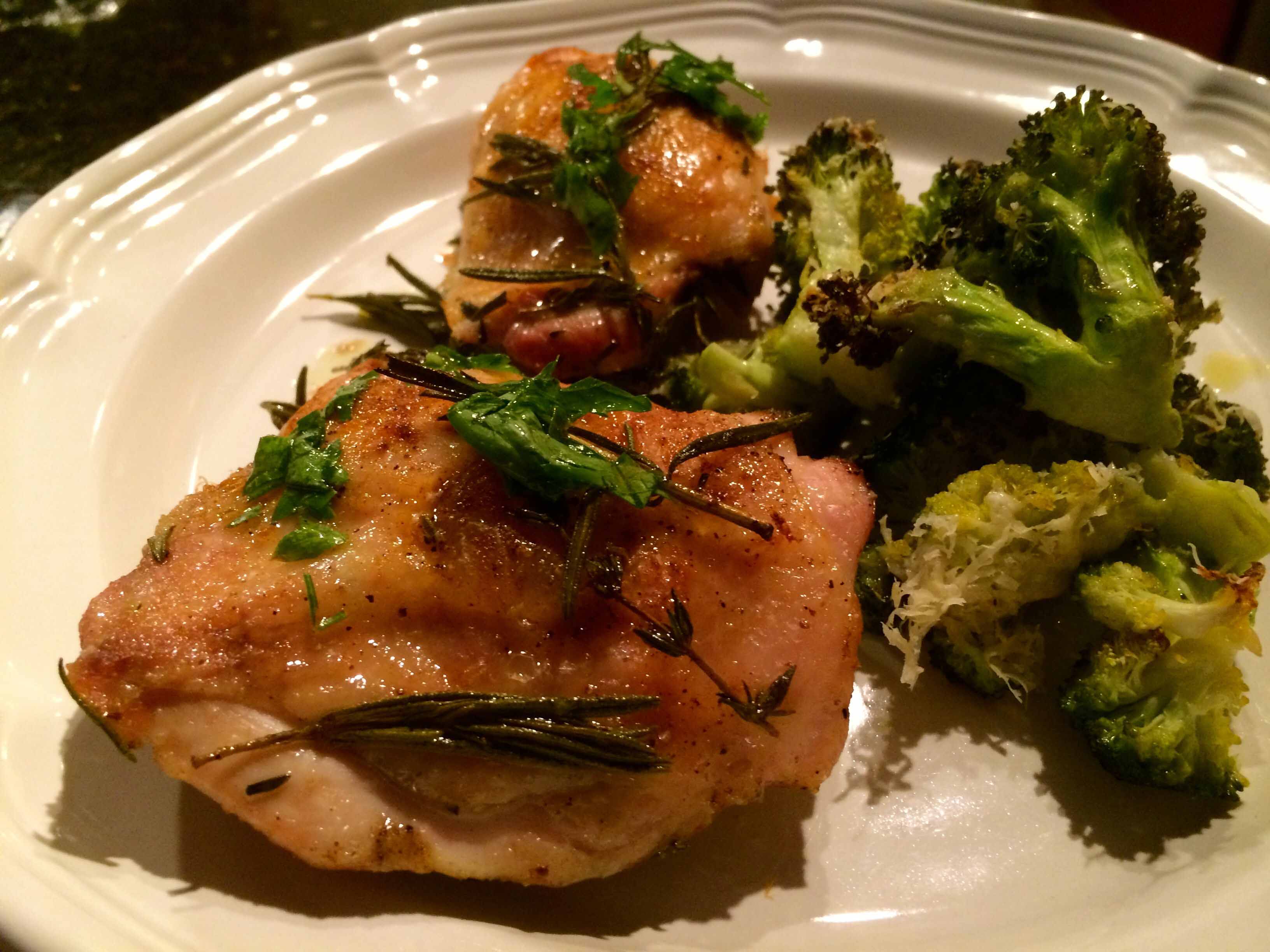
Roast chicken has to be one of my favorite poultry dishes. However, for a weeknight dinner roasting a whole bird may be a little too time consuming. That’s one of the reasons why I use Dave Lieberman’s recipe “Dad’s Roast Chicken My Way.” Lieberman somehow disappeared from the Food Network, but his easygoing approach to cooking was a welcome alternative to some of the network’s more flamboyant stars.

Over the years, I’ve tweaked this recipe adding a little ground cumin to the seasoning, upping the amount of herbs, and sprinkling the skin with some paprika for added color. But my major change is substituting skin-on, bone-in thighs for the chicken pieces. In my opinion, thighs are the tastiest parts of the chicken.

I like to serve this dish with roasted broccoli.

Also, take the time to make the olive oil drizzle. Just a little adds a lot of flavor to the chicken, especially if you don’t enjoy eating the skin.

Dad’s Roast Chicken My Way Adapted from The Food Network

Ingredients
For the chicken:
1 (3 1/2-pound) chicken cut in 8 serving pieces (I use thighs.)
Kosher salt and freshly ground black pepper
Ground cumin
5 sprigs fresh rosemary
5 sprigs fresh thyme
Olive oil, for drizzling
Zest of 1 lemon
Paprika

For the parsley drizzle:
1/2 bunch parsley
1/2 cup extra-virgin olive oil
1/2 lemon, juiced
Kosher salt and freshly ground black pepper

Directions
Preheat the oven to 400 degree F.

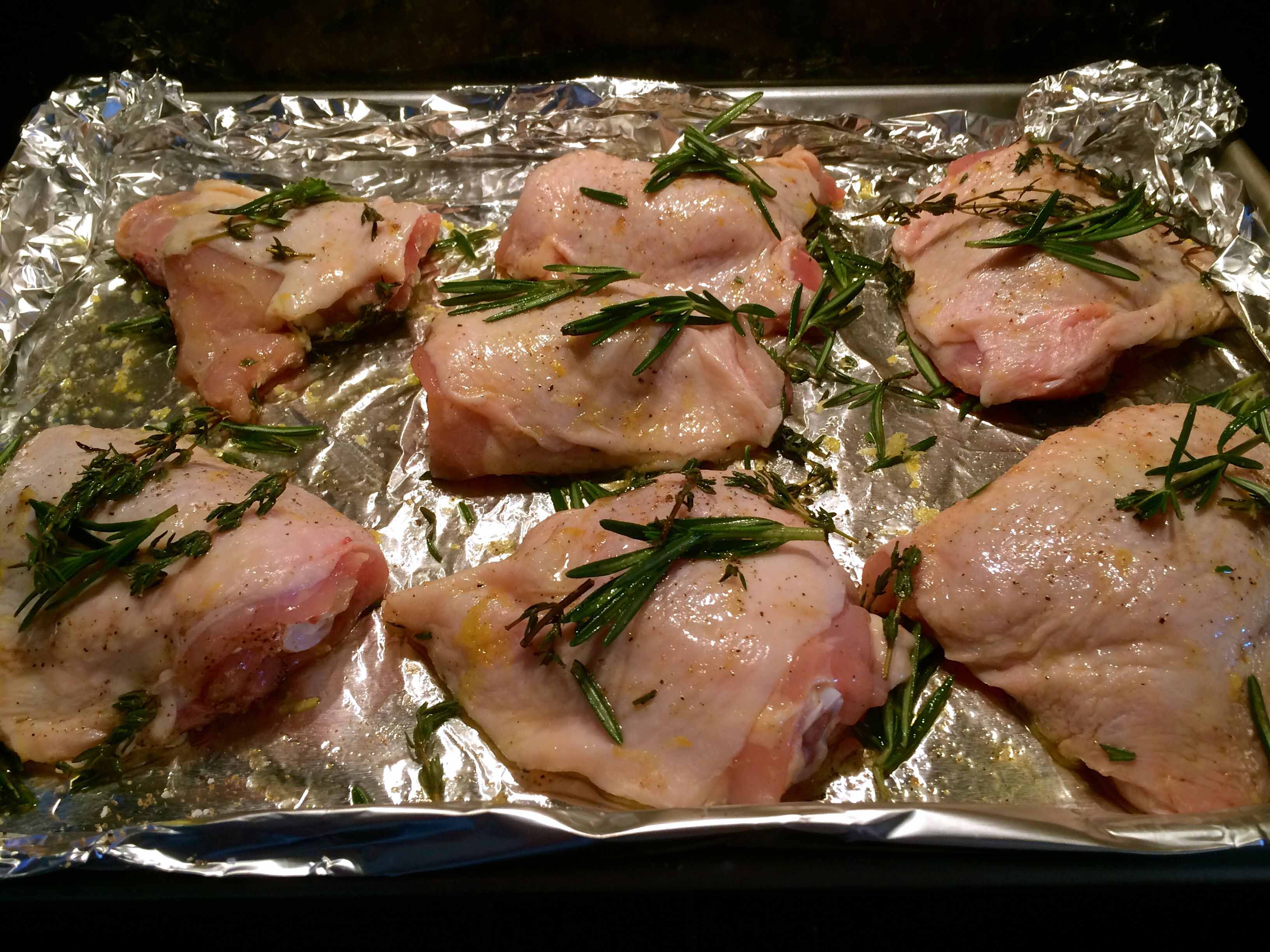
Trim off any excess skin or fat from the chicken. Cut off and discard the wing tips. Place the chicken pieces in an 11 by 13-inch baking pan lined with foil, or any pan that that they fit in without crowding.

Season the chicken pieces generously with salt, pepper, cumin olive oil, the herbs, and the lemon zest. Toss through all the seasonings and then arrange the chicken piece skin side up in the pan. Allow to marinate for 30 minutes at room temperature. (You can season the chicken pieces and set them up in the roaster up to a day before you cook them. Cover the pan with plastic wrap and refrigerate.)

Chicken marinating
Chicken marinating

Roast until the skin is nicely browned and there is no pink near the thigh bone and the juices run clear, about 35 to 40 minutes. Check both white meat and dark meat. If the white meat is done before the dark meat, take it out and set it on the serving plate until the dark meat is done.

For the parsley drizzle, wash and dry the parsley. Remove the leaves from the stems and chop the leaves finely. Combine the remaining ingredients in a bowl and use immediately to garnish the roast chicken.

Wine Pairing: Chablis, un-oaked Chardonnay, Pinot Noir


Chicken Braised with Porcini Mushrooms

newpoloporcinismall

Being somewhat of an impulse shopper, I managed to amass quite a stash of dried porcini, woodsy dried mushrooms that, when rehydrated, impart loads of flavor to a dish. Although these mushrooms have a good shelf life, they won’t last forever. To their rescue, another recipe from Giuliano Hazan’s Every Night Italian: Chicken Braised with Porcini Mushrooms.

Rather than cutting up a whole chicken as called for by the recipe, I used only thighs. The chicken is browned on all sides and then braised with sautéed thinly sliced onions, chopped pancetta, re-hydrated dried porcini, tomatoes, parsley, and the mushroom soaking liquid for 40-45 minutes with the pan cover slightly askew. This makes for a thick rich sauce with deep mushroom flavor.

Here’s a link to the recipe online. Chicken Braised with Porcini Mushrooms.

Wine Pairing: Rosso di Montalcino

Monday Night Leftovers

leftoverchickensmall

Didn’t have a chance to grocery shop on Monday, so I looked through the fridge for ideas.

I chose our spicy grilled chicken from Sunday night. I thought it would be perfect served at room temperature accompanied by some traditional Mostarda di Cremona, a fruit preserve made with mustard essential oils, for some sweet piquant flavors.

When serving leftovers, I like to cook something fresh as a side. I had a bunch of pencil-thin asparagus that needed to be used up. So I roasted these in the oven at 400°F for about 15 minutes, seasoned with salt and nutmeg, drizzled with extra virgin olive oil, and sprinkled with plenty of Parmigiano Reggiano. I served them topped with eggs fried in olive oil and a tad of butter. When you cut into the runny yolk, it mixes with the melted cheese, making a perfect sauce for the asparagus.

ocrerougepinotsmall

For wine, I chose a bottle that we found recently at our local merchant. It was a light 2012 Pinot Noir from Domaine de l’Ocre Rouge in the Languedoc-Roussillon region. A Vin de France (the new appellation for Vin de Table), with only 12% alcohol, it’s fresh, balanced, and packed with lively fruit and spice flavors. Ever so slightly chilled, it was the perfect accompaniment to our chicken.

Wine Pairing: Pinot Noir, Sauvignon Blanc


Spicy Grilled Chicken Roman Style

pollogrilledsmall

Last night, we grilled on the terrace for the first time this year. Not allowed by our building to use charcoal or propane, we have a small outdoor electric grill which does have its limitations (size, heat, etc.). Nevertheless, the grill is large enough to accommodate a splayed chicken held in place with a clamp grill, like the one used to grill hot dogs.

This recipe comes from one of my favorite Italian cookbooks, Cooking the Roman Way. (The book is out or print, but is available in an affordable Kindle edition.) It calls for a four-pound chicken with its backbone removed and then flattened with a mallet. You can either do this at home or, if you’re like me, ask you butcher to do the dirty deed.

The result is a juicy lemony chicken, fragrant with rosemary and garlic, with crispy skin and moist meat.

Galleto alla Diavola (Adapted from Cooking the Roman Way by David Downie)
4 pound chicken, back bone removed , spread, and flattened with a mallet or rolling pin.
2 cloves garlic, peeled and minced
6 sprigs of rinsed and dried rosemary (remove the leaves from two and chop fine; leave the other 4 whole)
2 lemons juiced and halves flattened
1 Tbs extra virgin olive oil
1/2 tsp crushed red pepper flakes (The recipe says you can also use 2 peperoncini, Italian hot chili; but these can be rather hard to find.)
2 strips bacon
Kosher salt, coarse ground black pepper (The recipe specifies fine salt, but I chose coarse Kosher.)

1. Rinse and pat dry the chicken and place it in a baking dish large enough to accommodate it spread open.

2. In a small bowl, place the minced garlic, 2 sprigs of minced fresh rosemary, 1/2 teaspoon (or a tad more if you really like things hot) of crushed red pepper flakes, the juice of two lemons, and 1 tablespoon extra virgin olive oil. Flatten the juiced lemon halves and reserve. Mix thoroughly.

3. Using a basting brush, spread this mixture on both sides (skin and meat) of the chicken.

4. Secure 1 slice of bacon with a toothpick to each inner side of the chicken. And then place two sprigs of rosemary over each slice of bacon. Top these with the flattened lemon halves. Season the chicken generously (or to taste) with Kosher salt and fresh coarsely ground black pepper. Cover with plastic wrap and/or foil and let the chicken marinate in the fridge for at least one hour or even better over night. (I went for about 8 hours.)

5. Preheat your grill or build a medium-hot charcoal fire. (You can also do this dish in the broiler, but unless you’re good at broiling, I would not attempt it.)

pollomarinatedsmall

6. Place the chicken in the clamp grill with the rosemary. (I removed the lemons.) Clamp it shut and place the chicken on the grill. (I started skin side down.) Cook turning frequently until cooked through, about 30 to 35 minutes. (Given my grill, I cooked the chicken for almost 50 minutes and turned it almost every 10 minutes.) You can tell when the chicken is done by pricking it with a fork and the juices run clear. You can also use an instant-read thermometer.

The book gives directions for cooking the chicken either under a broiler or on a grill without the clamp grill using a steel spatula. Given the frequent turning and the size of the bird, I think it’s better shelling out a few bucks for the clamp grill.

Serve hot.

We served with fingerling potatoes roasted with garlic and herbs followed by an arugula salad.

Wine Pairing: Pinot Noir, Sauvignon Blanc

Pollo alla Cacciatora Tuscan Style

cacciatori2small

I was recently gifted with a copy of Giuliano Bugialli’s The Fine Art of Italian Cooking. I haven’t read it yet, but thought I would try out one of his recipes. As I skimmed through the book, I found an interesting one for pollo alla cacciatora, chicken hunter’s style.

Most recipes for this popular dish use a heavier tomato sauce, as well as a couple of vegetables like peppers, onions, mushrooms, and the like. Bugialli, however, presents a more austere Tuscan version that gets most of its flavor from woodsy herbs like rosemary and sage. And rather than tomatoes, the recipe calls for tomato paste, which when toasted a little gives the sauce a deeper, darker flavor.

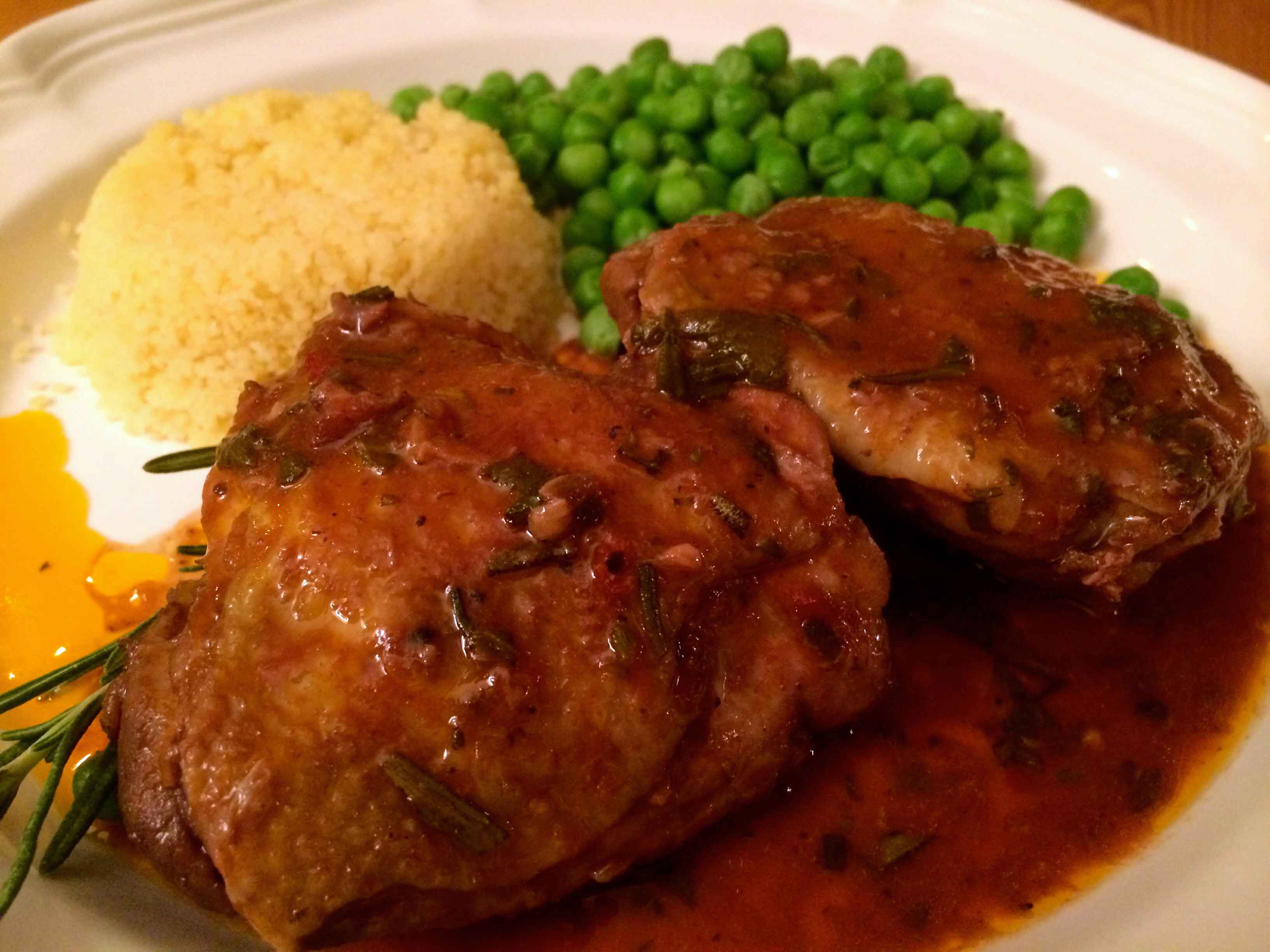
I think this was one of the best versions of the dish I have ever had. We served it with some couscous and peas. Below is my edited version of the recipe.

Chicken alla cacciatora 
1 chicken (3 to 3 1/2 pounds)
1 Tbs fresh rosemary leaves
10 fresh leaves sage
2 large cloves garlic
1/2 cup olive oil
Salt and freshly ground black pepper to taste
Pinch of hot red pepper flakes
1/2 cup dry red wine
1 bay leaf
2 Tbs imported tomato paste
1 1/2 cups hot water

  1. Cut the chicken into 16 pieces; coarsely chop the rosemary, sage, and garlic. (I used 8 skin-on, bone-in chicken thighs. Also be sure to coarsely chop the herbs and garlic so that they do not burn when sautéed in the oil.)
  2. Heat the oil in a large casserole or Dutch oven that is big enough to hold the chicken in a single layer. Add the chopped herbs and garlic and sauté gently until lightly golden (10 to 12 minutes). (Be sure to keep your eye on the pot during this stage. I kept the garlic on top of the herbs to prevent burning and kept adjusting the heat to allow for a slow cooking of the ingredients.)
  3. Add the chicken and sauté over moderately high heat until golden all over (about 15 minutes). Add salt, pepper, and hot pepper flakes.
  4. Lower the heat and pour in the wine. Let it evaporate very slowly (about 10 minutes), then add the bay leaf, tomato paste, and 1/2 cup of the water. (I stirred in the tomato paste making sure it was evenly distributed in the pot. I also turned the chicken pieces at this point to coat them with the sauce.)
  5. Cover the pan and let simmer very slowly for 20 minutes, adding more of the hot water if needed. (I turned the chicken pieces one or two times to ensure even cooking. I also found that I did not need any additional water.)
  6. At this point, the chicken should be cooked and there should be a small quantity of thick sauce. Remove the bay leaf and transfer the chicken and sauce to a serving dish. Serve hot. (I found a lot of fat on top of the sauce and skimmed off a good deal of it before plating the chicken.)

Bugiialli says this dish is even better when reheated.

Wine Pairing: Barbera d’Alba, Sangiovese, Merlot


Chicken Paillard

paillardsmall

Yesterday, we had a late lunch at an Italian restaurant that features la vera pizza Napolitana, real Neapolitan pizza. Needless to say, I ate more than my share of these thin-crusted beauties with San Marzano tomatoes, mozzarella di bufala, and basil, cooked in a wood-fired over for just a few minutes.

On the way home, we had to stop by our local supermarket for a few things, and I thought maybe I’d pick up something for a later that night just in case we were hungry. Pre-washed Mesclun salad was first and then I saw some thinly cut boneless, skinless chicken breasts.

I must admit that I’m not a fan of this cut. I almost always prefer chicken with its skin on and bones in. But when time, and calories, are the deciding factors, these breasts can be turned into a nice dish.

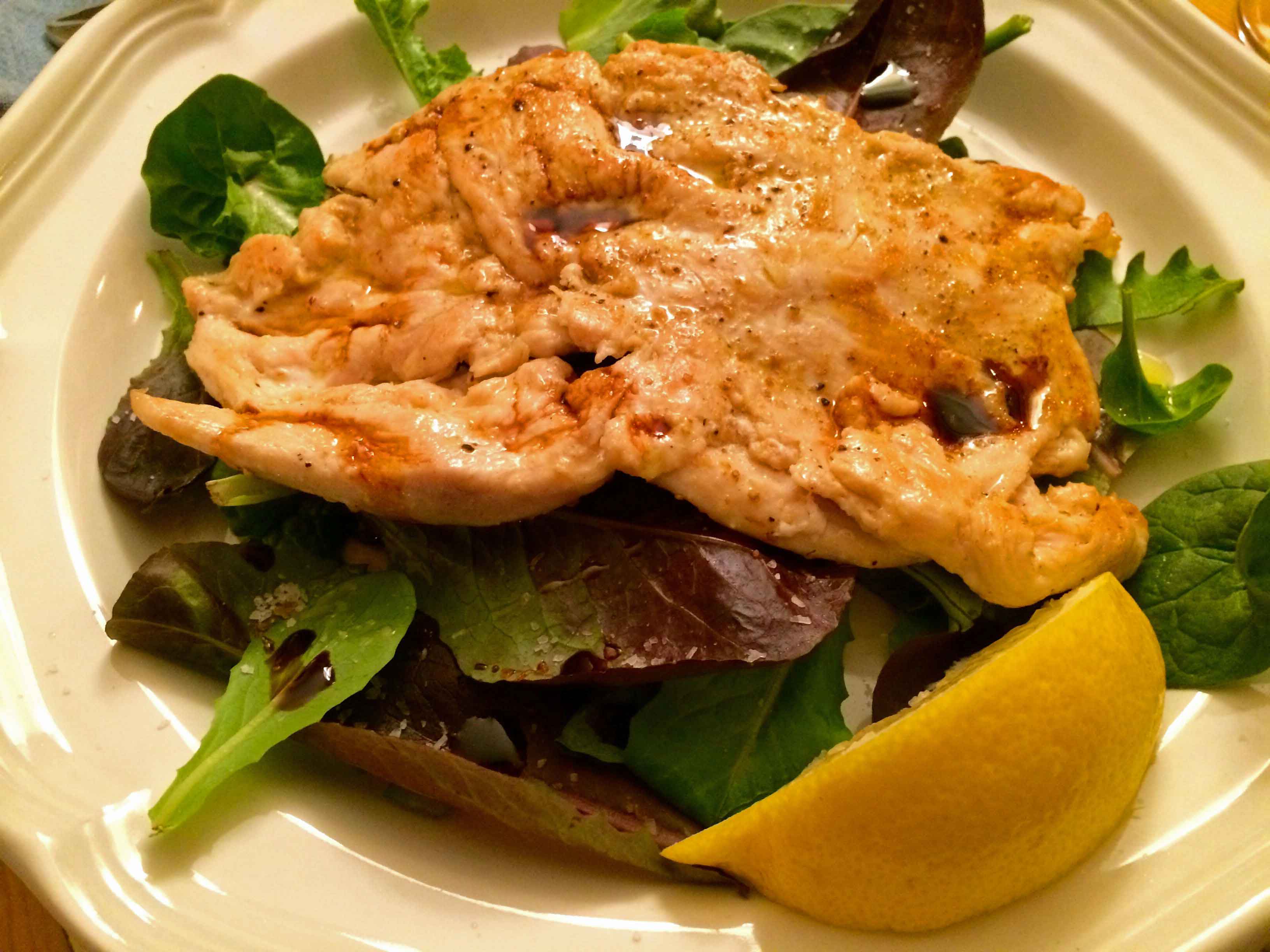
It was now rather late, and we were both somewhat hungry. Given the time, I wanted über simple and thought I would use the breasts for paillards or cutlets.

Recipes abound for these both in cookbooks and on the internet. Some call for breading, others for rolling and stuffing; some prescribe marinating or applying rubs to the meat. But I wanted simple, straightforward chicken and it was late. So here’s what I did.

2  Thin cut boneless, skinless chicken breasts.
Salt
Pepper
Cumin
1 Tbs Unsalted butter
1 Tbs Olive Oil
Extra Virgin Olive Oil, Lemon juice, Balsamic vinegar for finishing the chicken and dressing the greens.
Washed mesclun salad greens or arugula

1. Place a thin cut, boneless, skinless chicken breast between two pieces of plastic wrap. With a meat pounder or the side of a cleaver or even a heavy skillet pound the breast until it is about 1/4 inch thick. Season one side with salt, pepper, and a cumin. Repeat this step for each breast.

Note: You must keep hygiene in mind when handling raw chicken. Be sure to keep your hands and work surfaces clean when handling and pounding the chicken.

2. Over medium to medium-high flame, heat a skillet large enough to hold one or two pounded breasts in a single layer and add about a tablespoon of olive oil and a tablespoon of butter to the pan. When the butter stops sizzling, place the chicken in the pan, seasoned side down. Season the top side of the breast with salt and pepper.

3. Cook for two minutes and then flip with a pair of tongs and cook for an additional two minutes. Juices should be running clear. Cooking times will vary depending both on the heat and the thickness of the chicken. Avoid moving the chicken when it is in the pan; it will release when it’s ready.

4. When done, remove the breasts from the pan and place over a bed of mesclun or other greens that have been lightly dressed with olive oil and some lemon juice. Do not over dress the salad.

5. Drizzle the breasts with some extra virgin olive oil and just a few drops of a thick balsamic vinegar and serve with a lemon wedge to be squeezed on the chicken and the salad.

Wine Pairing: Cotes du Rhone for red; Macon Villages for white.