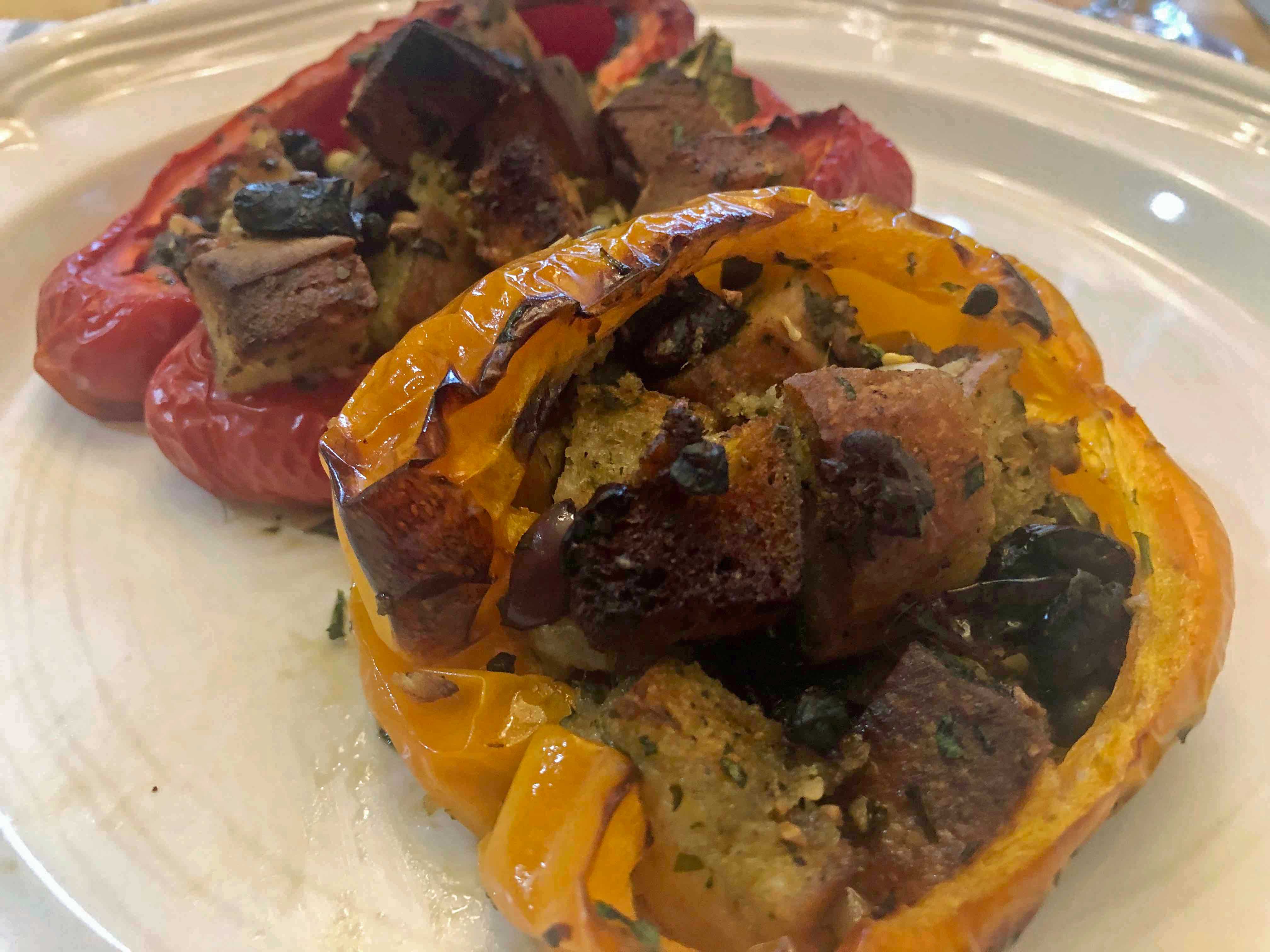
My Neapolitan aunt’s stuffed peppers were one of my favorite side dishes. Even at an early age, I relished their savory bread-crumb stuffing laced with anchovies, capers, garlic, and parsley. To date, however, I haven’t found a recipe to duplicate them. But when I came across one for Campania-style stuffed peppers in Arthur Schwartz’s Naples at Table, I thought I’d give them a shot.
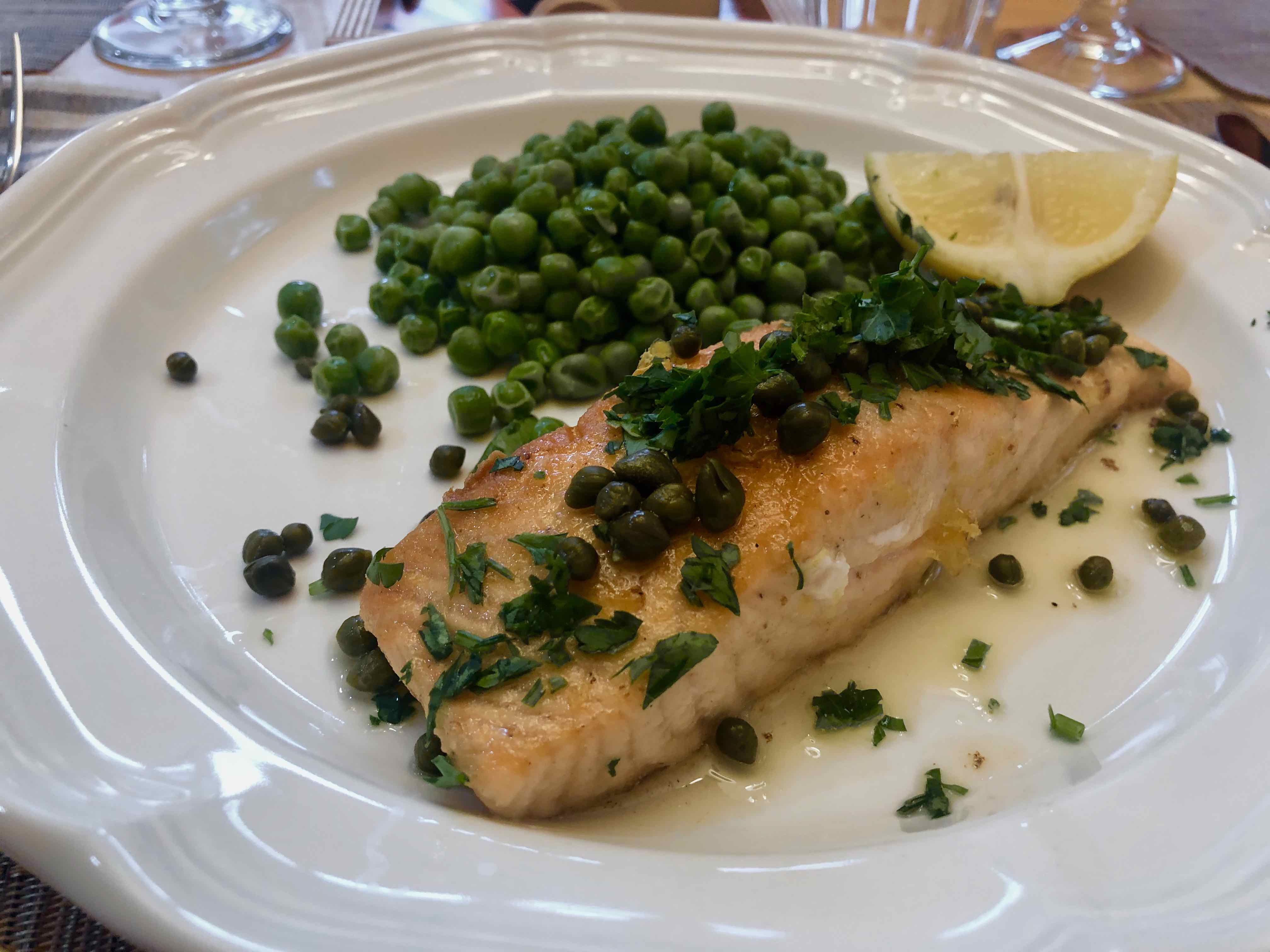
During COVID, we relied heavily on home delivery of our groceries from the supermarket as well as from shopping channels like QVC and HSN. And even now that the pandemic has been declared officially over, we still do a lot of shopping online since we’ve opted not to have a car and also because I’m still wary of crowded stores with narrow aisles. Throughout this period, one of our staples has been frozen salmon fillets which have been remarkably good albeit challenging to cook owing to their irregular size. So, when we get two almost identical fillets, I turn to one of my favorite recipes for them: salmon meuniere.
I’ve never been into grilling; yet despite my stance on it, we’ve owned three. Our first one was a small electric that we had purchased for our small terrace in our New York studio apartment. We used it three times. When we moved to a downtown-San Diego one-bedroom condo, with a considerably larger terrace, we bought a medium-size gas grill and used that no more than four times before we gave it away when we moved to New Jersey. So last year, now situated in a rural suburban townhouse, with quite a large deck that’s fitted with a natural-gas hookup, we bought an even larger grill and, as you might have already guessed, we used it maybe five times. This year, however, we decided it was time to join the grilling craze and began our outdoor grilling season with a huge ginger-soy London broil.
I’ve always been a fan of Jamie Oliver. Perhaps it’s his relaxed, almost reckless, approach to cooking or the relative simplicity of his recipes that I find appealing. So, when I came across his recipe for “Chicken in Milk” adapted by Sam Sifton, on the New York Times “Cooking” website a few weeks ago, I thought I’d make it the subject of a post on my blog.
Nine years ago, I posted a blog entry about turkey-spinach meatballs in a marinara sauce adapted from a recipe in Bon Appétit. Although my husband and I were both surprised by how good they were, I hadn’t made them again until last week. And, once again, we weren’t disappointed. So yesterday, when I was thinking about my next installment for my series on meatballs, I decided to do a variation on them using beef instead of turkey.
Well, I’m happy to report that this departure from the original recipe yielded an even more delicious dish. Whereas most of the turkey meatballs’ flavor came from the spinach, cheese, and fennel seeds, as well as from the spicy sauce, the beef version’s savor was more balanced with the meat contributing as much smack as the other ingredients. The robust, slightly acidic flavor of the spinach complemented the rich and savory essence of the beef, while the notes from the other seasonings and even the sauce were more muted.
Although I’m fearless when it comes to preparing seafood, I wince when it comes to cooking fresh fish. But every so often, I come across a recipe that prompts me to face my fears and take on one of those scaly creatures. I must admit, however, that having skinned and sliced salmon fillets makes the feat far less daunting.
A sale and the weather were the main influencers of this week’s post. Because our local supermarket had a great special on London broil, we had decided to break out the grill for the first barbecue of the season. But when the weather forecast put the kibosh on outdoor cooking, I started to consider a few alternatives like pan grilled or broiled, neither of which struck my husband’s fancy. So, I asked him to go through a few of our cookbooks and find a recipe for London broil that would.
An hour or so later he returned to my office, cookbook in hand and grinning. The book was Lidia Bastianich’s Commonsense Cooking and the recipe he chose was “London Broil Steak with Sun-Dried Tomatoes Marinade.” Luckily, I had all the ingredients on hand—even the fresh basil, which I had purchased for another dish.
Sometimes I just want or even have to cook something simple yet tasty. Such was the case yesterday, when I realized all the work my initial recipe for this post required and that I didn’t have the time to make it. Consequently, I opted for a far less complicated dish that despite its simplicity yielded loads of flavor: Crispy Baked Chicken.
“Meatballs.” Just the word conjures up feelings of culinary comfort for me; and when these tasty morsels are paired with pasta, I’m transported back to my childhood where they often showed up as part of a Sunday dinner. I do know that some Italian-food traditionalists may scoff at these meaty orbs coated with tomato sauce, dismissing them as Italian-American fare. Indeed, I recall having dinner with a friend from Italy who looked at me in disbelief when I ordered one as an appetizer in a well know Chicago restaurant. “Stai scherzando,” (You must be joking) he said. I trust the satisfied expression on my face after I consumed the last tasty morsel proved him wrong.
This post will be the first in a series devoted to meatballs that I plan to publish periodically over the next few months. The recipe, “Pasta with Meatballs” comes from Nigella Lawson’s cookbook Nigella Bites and can also be found online. (I used the latter.) I chose it for a number of reasons: I found some ground pork in the back of the freezer; there was no frying or roasting involved; and it yielded 30 meatballs slightly larger than a cherry tomato. Another motivation came from finding her online version of the recipe, which substituted semolina for breadcrumbs as well as jarred passata for canned tomatoes.
Last week, I decided to proffer a farewell to winter and welcome in spring with a classic beef stew. Although my original choice for a recipe, one from Sally Schmitt’s Six California Kitchens, appealed to me for its simplicity, on second look, its lack of a thickener for a gravy and its relatively quick time for cooking the vegetables (15 minutes on high) after simmering the meat on the stove for two hours gave me some pause. Eventually, a search through my bookshelves led me to a similar recipe from the Cook’s Illustrated Cookbook that addressed my concerns with the first and required only a little more effort. That it called for oven rather than stove-top cooking made it even more attractive.


 Cooking from Books