As I’ve probably mentioned before, I typically let what’s available in my supermarket influence what will be on my table for dinner. Such was the case this weekend when a 50%-off sale on pork shoulder led to the purchase of a five-pound roast and a subsequent search for a recipe with which to prepare it.
Slow and steady, so they say, wins the race. A perfect example is Marcella Hazan’s Ragu Bolognese, which requires six hours of simmering to yield “when clinging to the folds of homemade noodles,” to quote Marcella, “one of the most satisfying experiences accessible to the sense of taste.” But when you’re really hungry, especially after a nerve-racking day, sometimes quick and easy is the way to go.
My friend, Italian-wine aficionado Ciro Pirone, recently posted a photo of pasta with zucchini on his informative Twitter feed @Vinofilosofia. It looked so appetizing that I asked him for the recipe. His response: “Senza ricetta…tutto ad occhio (No recipe, all by eye.) I sauté a little onion and then add thinly sliced zucchini, salt and pepper, and cook low, covered; halfway I add half a glass of water and let cook till they fall apart. Toss in the pasta and some parmigiano!”
Researching the recipe for this post made me think of the popular children’s game of telephone, where participants stand in line and the first person whispers a message to the second, who whispers what he heard to the next person in the line, and so on. The object of the game is to keep the message as close as possible to the original. At the end of the line, the final message is compared to the original and, as you’re probably aware, the differences between the two can be quite dramatic. Indeed, it’s the variation that provides the chief source of enjoyment.
Never before have I’ve been flooded with so many requests from friends and family to make a recipe that they saw in The New York Times. Heck, even The Times itself e-mailed me several times about the same dish. Although, I had already come across this cannellini bean and pasta recipe on my own when it first appeared, I didn’t find it all that exciting. I must admit, however, that upon reading the recipe’s backstory and why its developer chose to use a classic French beurre blanc, I became more interested.
When the publication of an intriguing New York Times Cookingrecipe for crisp gnocchi coincided serendipitously with my finding a forgotten shelf-stable package of those dumplings in the back of my cupboard, I had to make the dish.
Planning, preparing, and sharing dinner with my husband may be the quotidian pleasure I enjoy the most. It’s our time to look back on our day, discuss what’s on our mind, and give thanks for what we have. Unfortunately, fate occasionally steps in, snatches this delight away, and leaves me alone for dinner. In my youth, I may have handled this disappointment with a pre- and post-prandial libation, skipping the dinner between them. These days, however, being much older and a tad wiser, I may limit myself to one cocktail but shall never forego cooking and having at least a simple meal after it. I guess it’s my way of countering fortune and carrying on.
Recently, I’ve been reading two mid-century cookbooks: one by Jeanne Carola Francesconi, La Cucina Napoletana (1965), considered by many to be the bible on Neapolitan cooking; the other by Elizabeth David, Italian Food (1954), one of the first English-language books to emphasize authenticity and seasonality in its exploration of the subject.
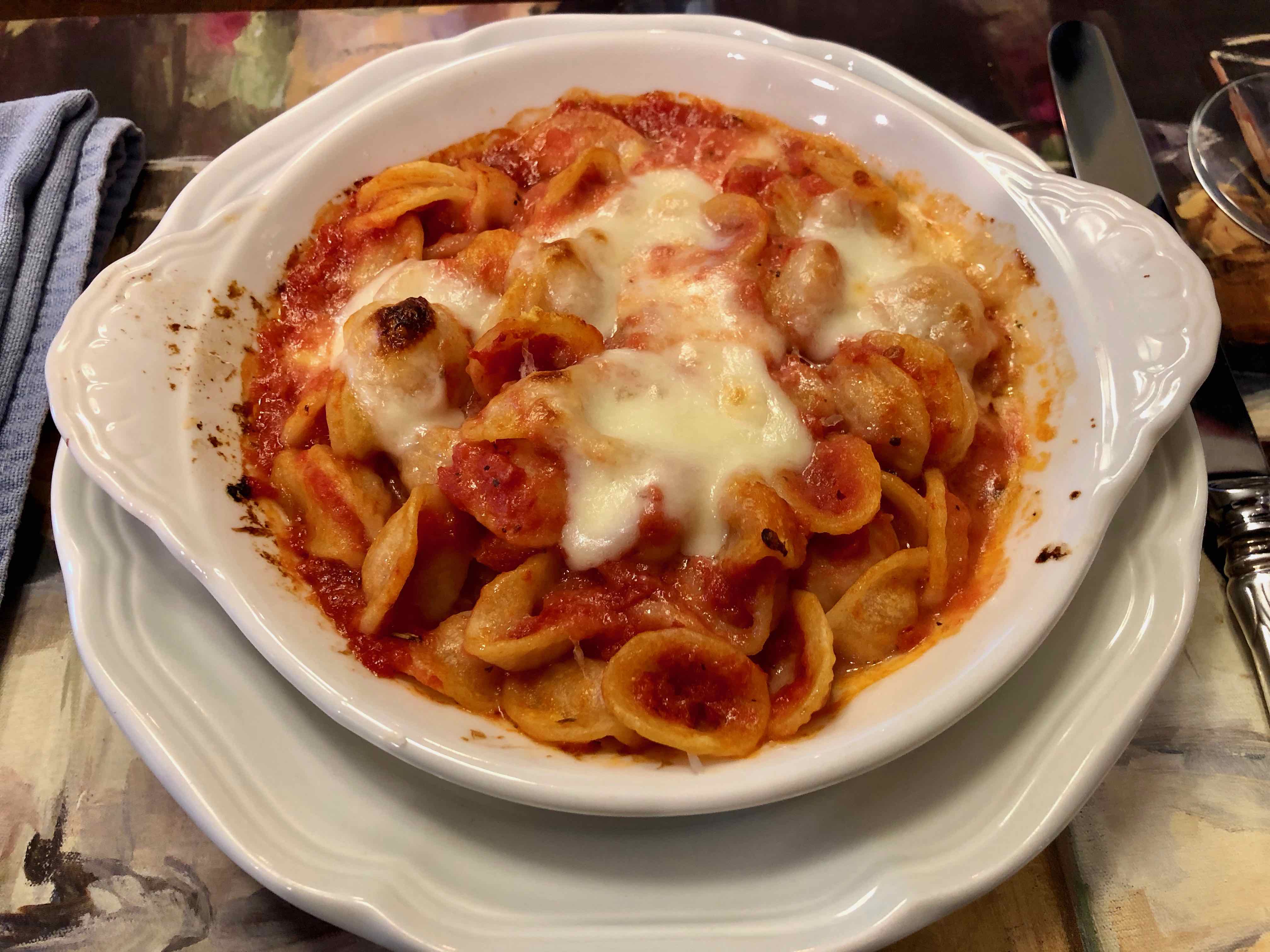
Frequent cooking at home typically yields a variety of odds and ends in the fridge: a handful of mushrooms, a small piece of cheese, a few herbs, a cup of sauce. For us, ingredients like these usually wind up in a frittata or a pasta. Such was the case the other night when, while cleaning out the fridge, I found some uncooked tomato sauce and a three-ounce piece of mozzarella left over from making a pizza a few days before.
In a house with a kitchen dominated by two women, one Sicilian (my mother), the other Neapolitan (my aunt), it was rare that my father took to the stove. Born around Naples and coming to the States when he was around 10 years old, he only cooked twice that I remember. And only once did he share a recipe with me. (I can’t remember why but no one else was at home.) It was a recipe so simple that he must have leaned it as a child back in his home town, Cappacio, in the province of Salerno.



 Cooking from Books