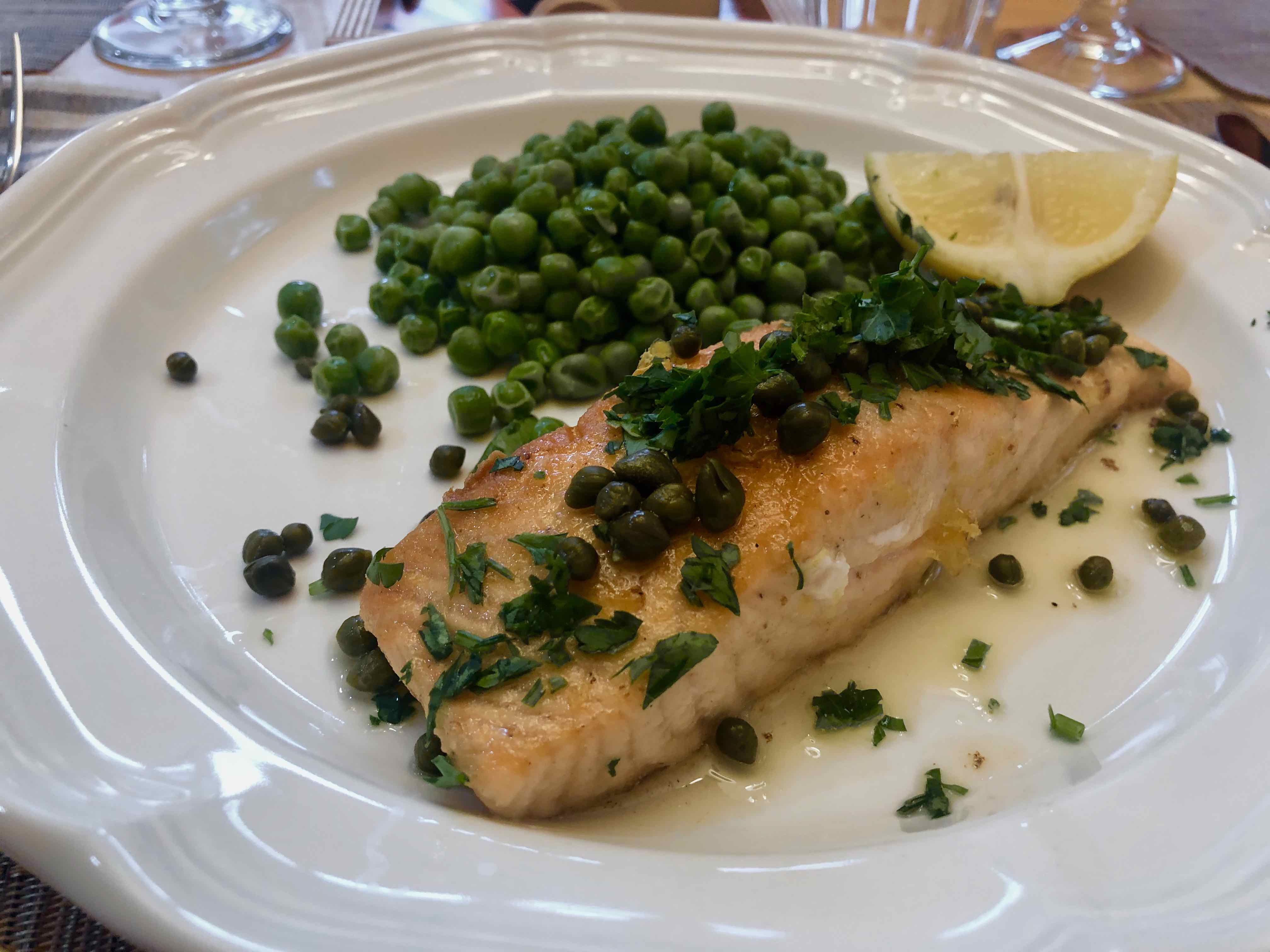
During COVID, we relied heavily on home delivery of our groceries from the supermarket as well as from shopping channels like QVC and HSN. And even now that the pandemic has been declared officially over, we still do a lot of shopping online since we’ve opted not to have a car and also because I’m still wary of crowded stores with narrow aisles. Throughout this period, one of our staples has been frozen salmon fillets which have been remarkably good albeit challenging to cook owing to their irregular size. So, when we get two almost identical fillets, I turn to one of my favorite recipes for them: salmon meuniere.
For a recent dinner party, I thought a slow-cooker dish would allow me to have everything prepared well before our guests arrived. Michele Scicolone’s The French Slow Cooker provided the perfect recipe for a blustery mid-winter evening: “Short Ribs with Red Wine and Prunes.”
With a cooking time between 8 to 10 hours on low and our guests arriving at 6PM, I figured I’d have to get everything into the slow cooker by 8 or 9AM. So, with prepping the aromatics and browning two batches of ribs, I planned a starting time around 6AM.
Well, as the saying goes about “the best laid plans,” things went astray when I over slept and arose after 9 that morning. My only solution was to pass on the slow cooker and go with the tried-and-true enameled cast-iron Dutch oven for the braise. Fortunately, the internet provided some helpful guidelines for converting the recipe for the stove that suggested reducing the cooking time to approximately 3 hours at 325°F and increasing the amount of braising liquid by about a cup since there is more evaporation with an oven than with a slow cooker.
Having endless hours at home these days, I decided to do some housecleaning on my computer, deleting old emails, files, and photos that were just taking up a lot of space. This chore eventually led me to the largest folder on my Mac, labeled “Recipes.”
I use this folder to collect ideas for posts from online sources like Epicurious, Food & Wine, the New York Times “Cooking” site, and the like. Not surprisingly it’s huge, bulging with recipes, some dating back six or seven years. Almost all of them include source information, which facilitates giving credit to their originators.
Even though our San Diego winters are nothing like those we experienced while living in New York City, they are nonetheless chillier and darker than our only other season “spring-summer-fall” and we find ourselves gravitating to hibernal fare like braises and stews. So with the arrival of daylight-saving time this weekend, I thought we’d have our last hurrah for winter cooking: a long braise of beef with loads of onions, anchovies, and green olives along with tomatoes and a full bottle of red wine.
Growing up, the only mussels I ate were served southern-Italian style, sauced with a hot marinara and accompanied by a thick bread biscotto to sop up the condiment. Today, it’s a dish I make quite often at home.
In the summer of my junior year in high school, however, I spent 14 weeks in France with a group of classmates, studying the language and serendipitously broadening my culinary horizons.
During that time, we were forbidden to speak English or to consume anything that wasn’t French. In fact, near the beginning of our stay, on a day trip through the Loire valley, our teacher and guide, a true Francophile Jesuit, went apoplectic at lunch when the restaurant, seeing us as tourists, brought out bottles of ketchup with our steak frites. “Enlever le ketchup!” (Remove the ketchup!) he demanded. The ketchup disappeared—alas.
We were studying at the University of Grenoble and took most of our meals in the school’s cafeteria. But when we were on our own, a few friends and I would venture into local bistros. It was on one of these days that I discovered a dish that would become one of my French favorites: moules au Pernod, mussels napped in a light sauce of cream, onions, and Pernod. The smooth anise-scented sauce provided the perfect counterpart to briny mussels.
It’s the perfect summer’s night entree, especially paired with a crisp Sauvignon Blanc, preferably a Sancerre, and a crusty baguette to get the last bit of sauce.
MUSSELS WITH PERNOD AND CREAMAdapted from Epicurious.com
Ingredients
1 1/4 cups leeks sliced 1/4-inch thick using only the white and pale green portion
1 1/2 cups Sauvignon Blanc or other dry white wine
1/4 cup finely diced red bell pepper
2 pounds mussels, scrubbed, debearded
1/2 cup heavy cream
Kosher salt
Fresh ground black pepper
4 tablespoons Pernod or other anise liqueur
3 tablespoons finely chopped fresh parsley
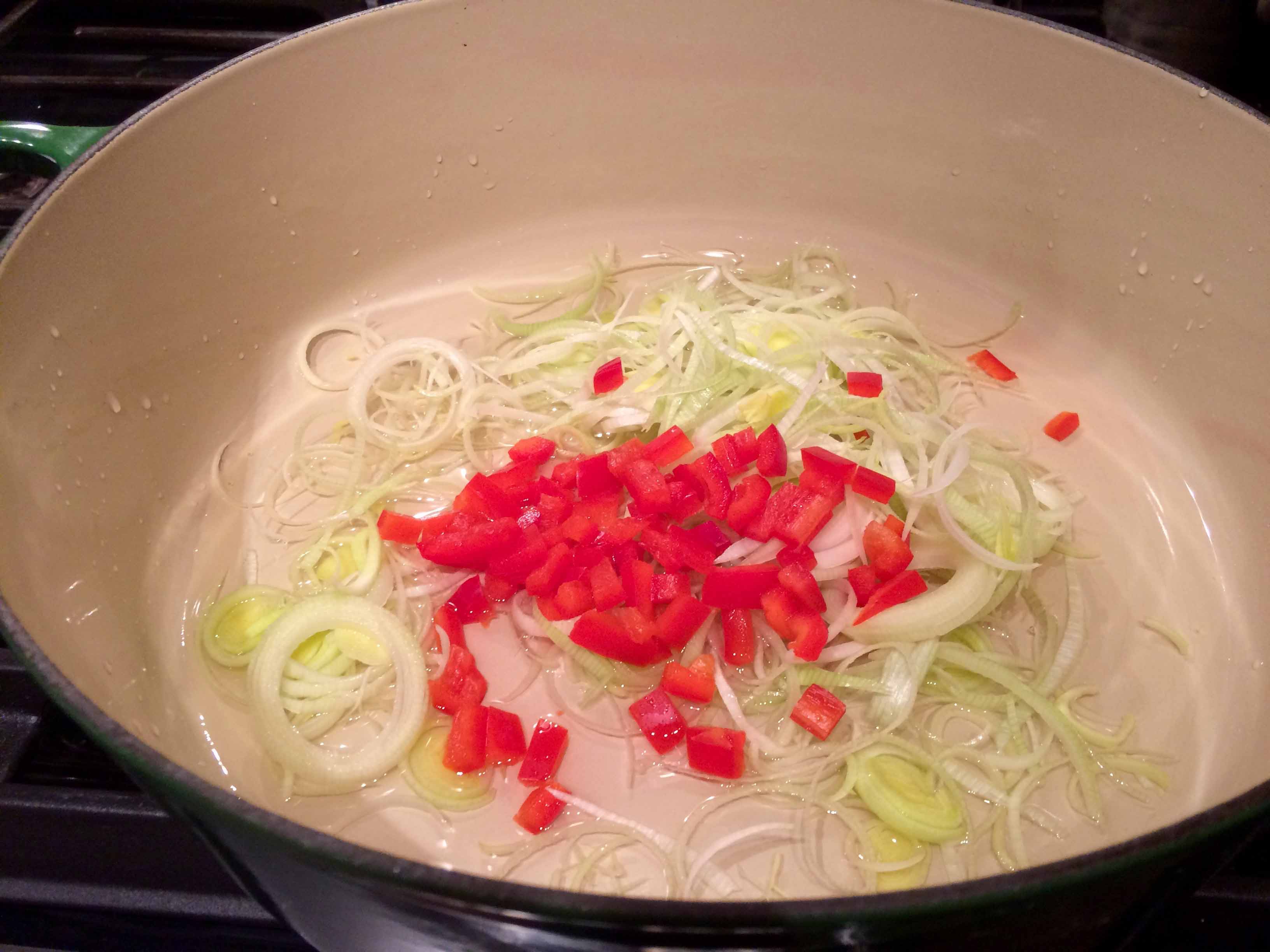
Combine the sliced leeks, wine, and bell pepper in large heavy-bottomed non-reactive pot. Bring to boil over high heat.
Leeks, peppers, wine
Add the mussels. Cover the pot and cook until mussels open, about 5 minutes, shaking the past once or twice.
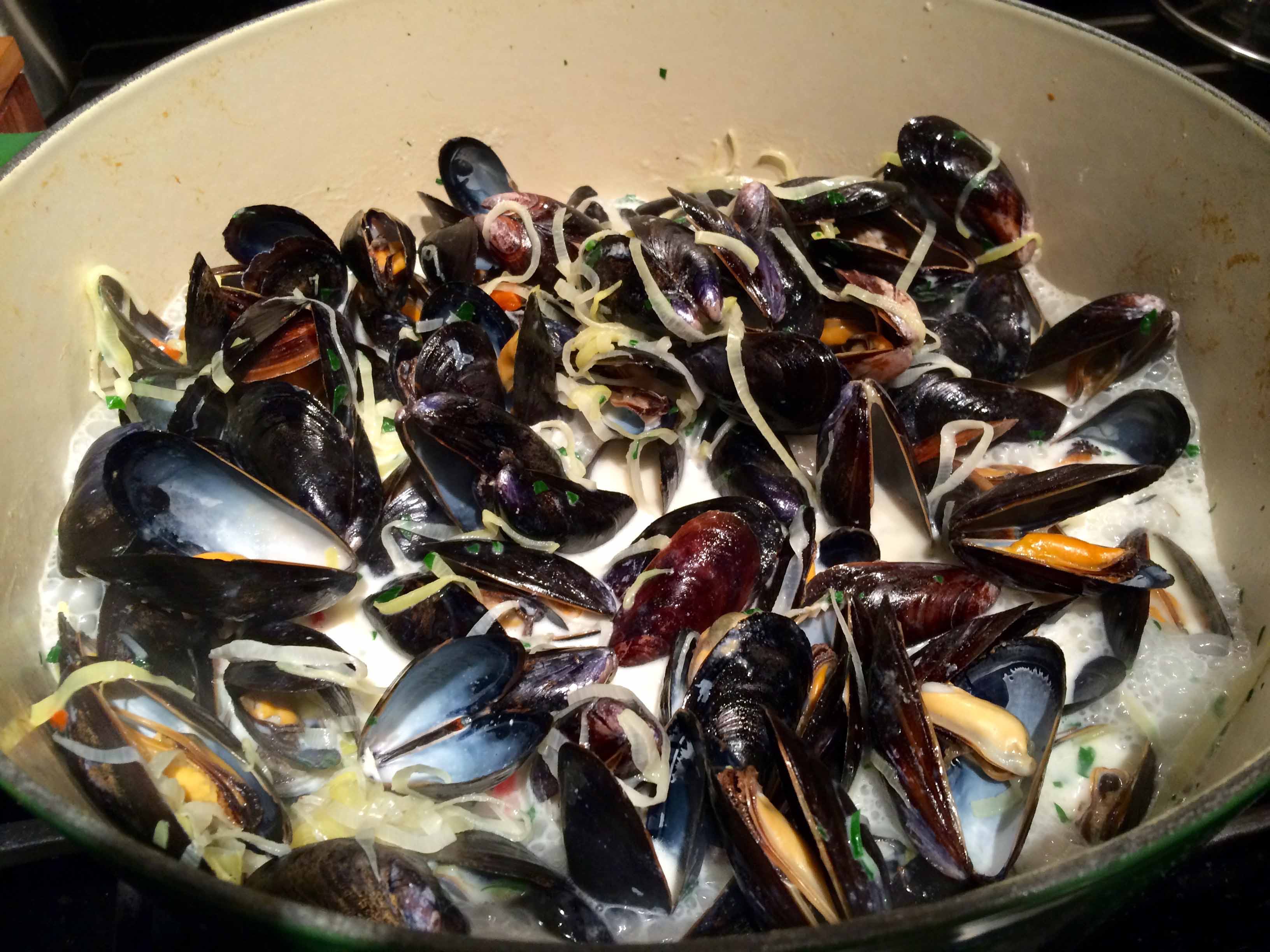
With a slotted spoon, transfer the mussels to a bowl (discard any mussels that do not open).
The opened mussels
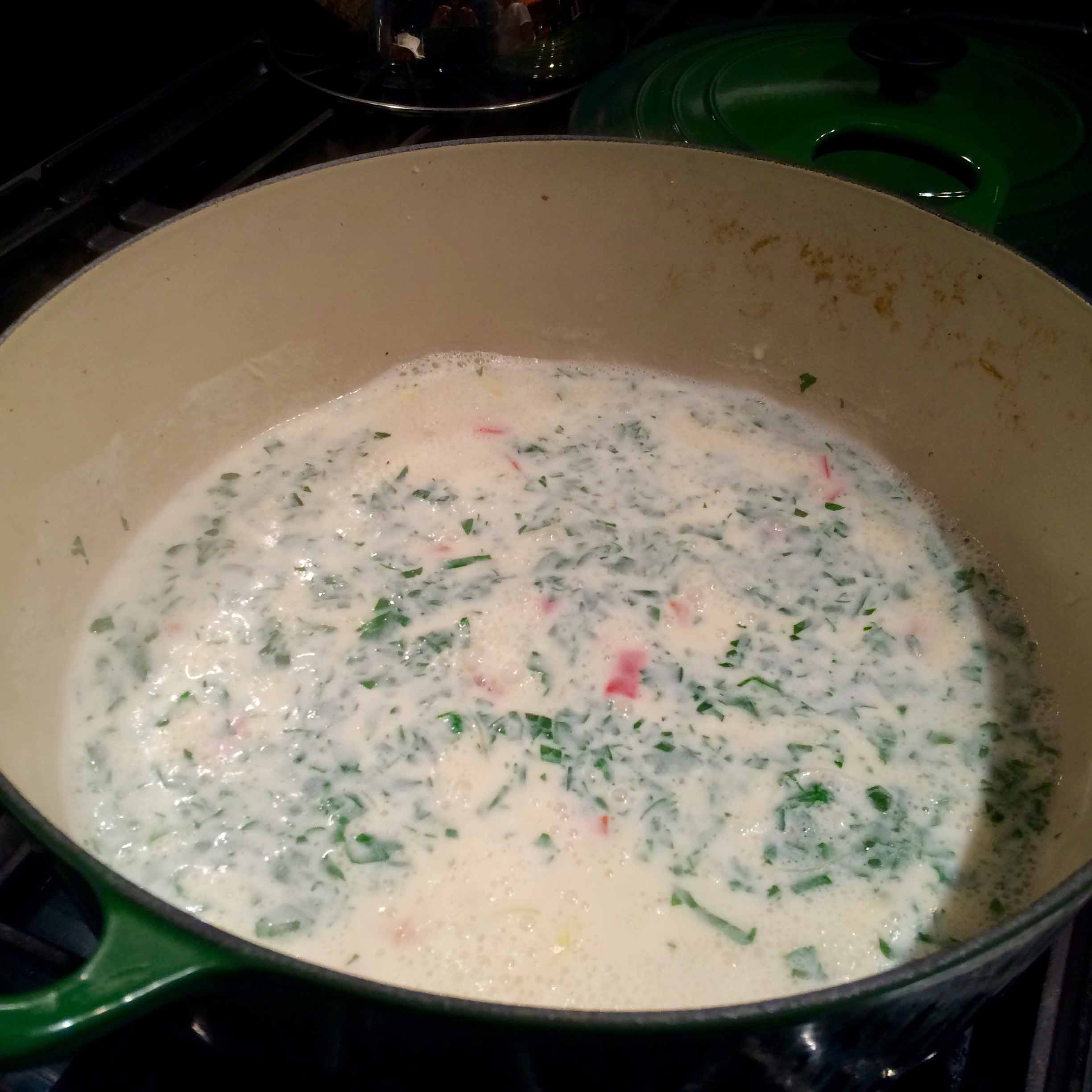
To the pot, add the cream, salt and pepper to taste, and Pernod. Boil until liquid is slightly reduced, about 4 minutes. Mix in chopped parsley.
Making the sauce
Return the mussels and any accumulated juices to pot. Simmer until mussels are warmed through, about 1 minute; adjust the seasoning. Serve mussels with the sauce.
While pork chops may not live up to everyone’s idea of a Valentine’s Day dinner, for us they made the perfect late-night supper, especially when prepared as they were last night. We had seen them prepared a few weeks ago on the Cooking Chanel’s “French Food at Home” by Canadian chef Laura Calder and were eager to prepare them at home.
When we found the recipe on line, however, we were surprised by how many discrepancies there were between the television and website versions. For example, the online recipe calls for 4 fatty pork chops rather tan the 4 fat, thick chops used on the show. Similarly, the online version listed 1.5 pounds potatoes thinly sliced, while on television Calder specifically specified waxy potatoes sliced thick.
Consequently, I modified the recipe to follow the dish prepared on the show and was extremely pleased with the result. Although I had some reservations about cooking the chops for close to two hours, they came out perfectly succulent and tasty.
The next time I prepare this dish, I’ll probably use chops a little thicker than an inch and extend the cooking time a tad. But even if you only have inch-thick chops, you’ll enjoy this French country dish.
Pork Chops with Potatoes adapted from Cooking Channel Chef Laura Calder INGREDIENTS
4 thick bone-in rib pork chops (a least 1-inch thick)
2 cloves garlic, sliced (try to have 3 slices per chop)
Kosher salt and freshly ground black pepper
1 tablespoon extra virgin olive oil
1 tablespoon butter
1 1/2 pounds waxy potatoes, peeled and sliced thick, about 1/2 inch
1 large sweet onion, sliced 1/4 inch
2 to 3 thick slices bacon, cut into 1/4 inch lardons
1/2 teaspoon juniper berries
1/2 cup dry white wine
1/2 cup chicken stock
Chopped fresh parsley, for garnish
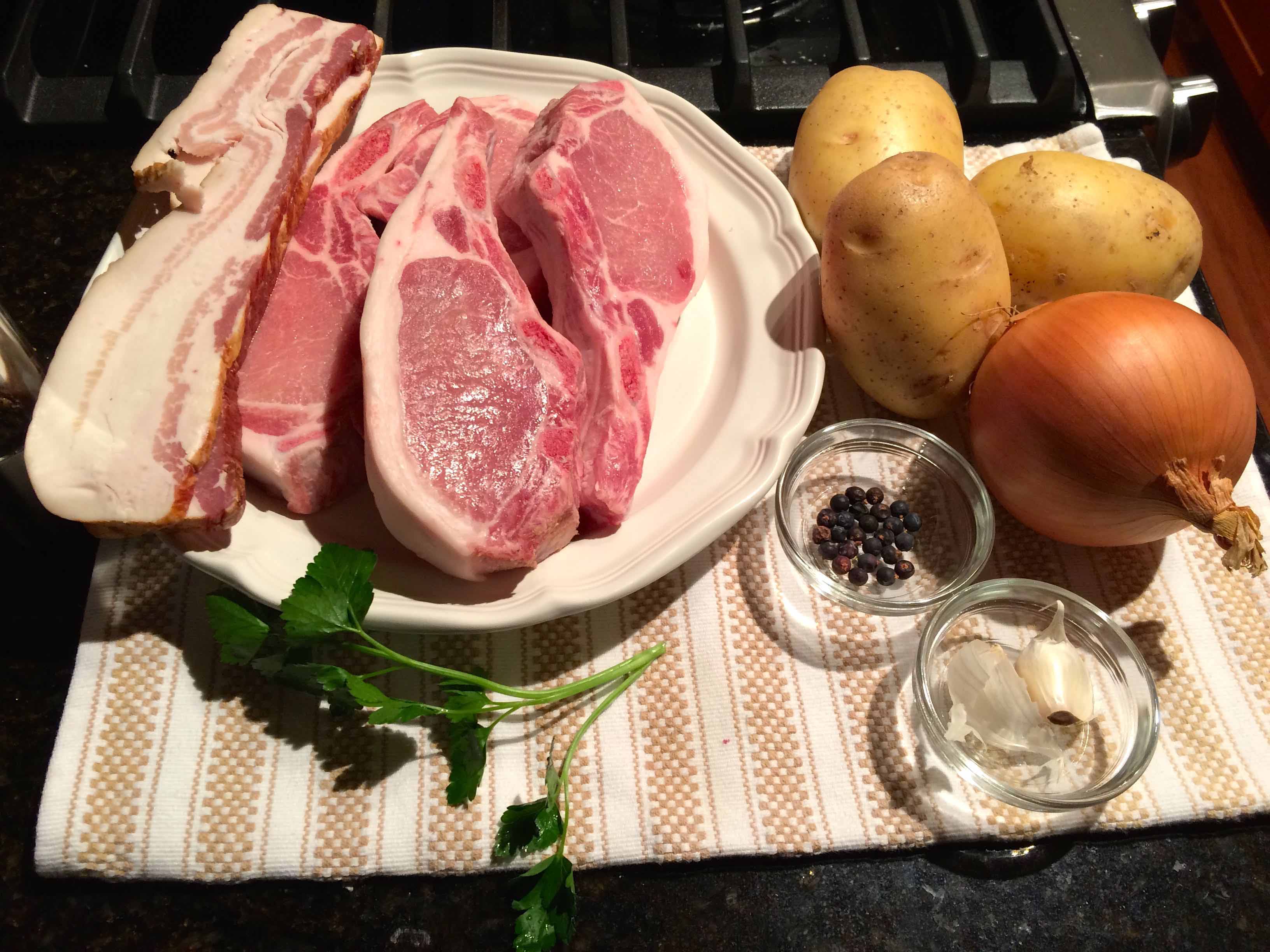
The chops and other ingredients
DIRECTIONS
Pre-heat the oven to 325 degrees.
Cut 2 to 3 slivers along the fatty edge of each pork chop and slide in the slices of garlic.
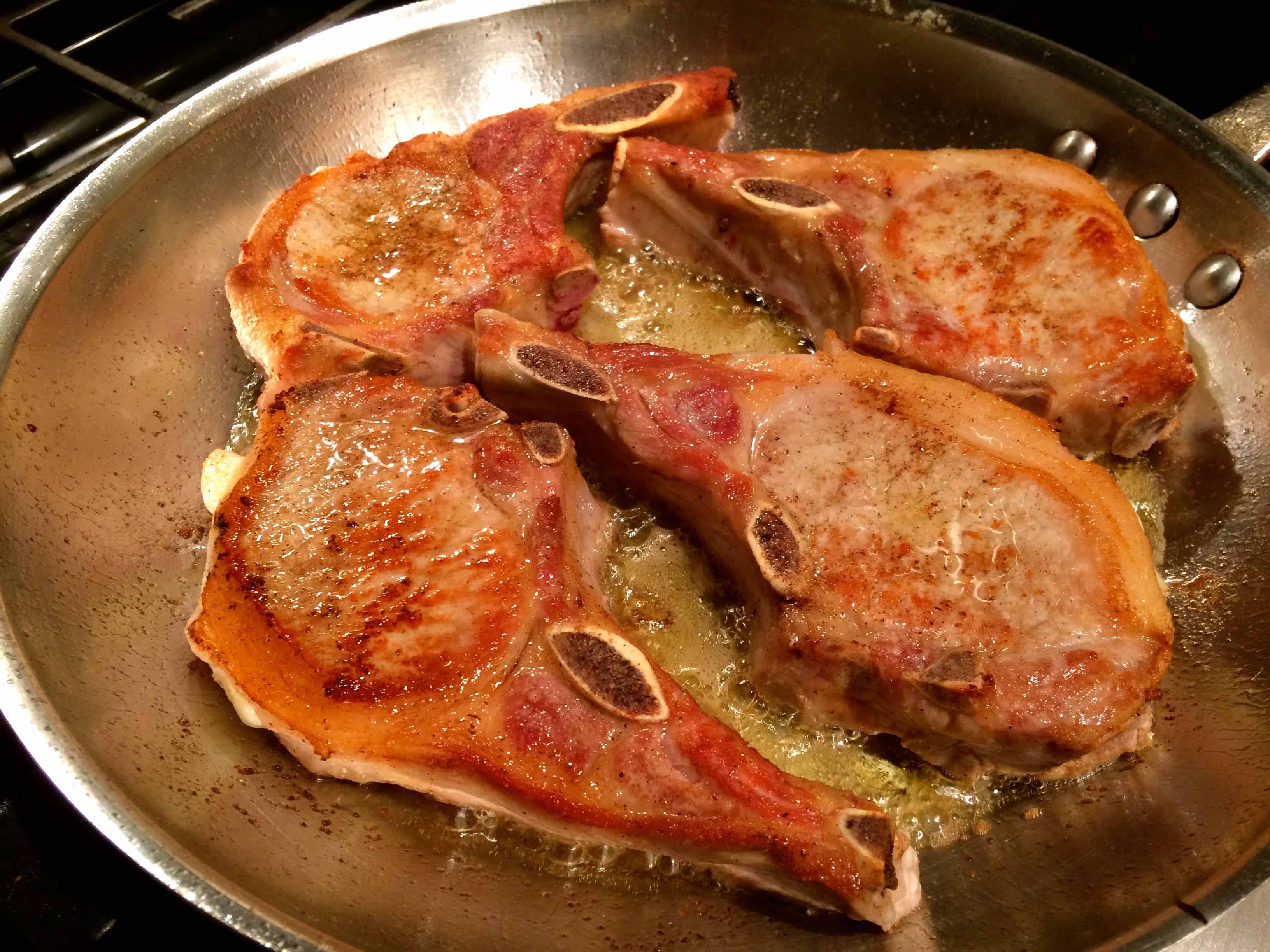
Heat the oil and the butter in skillet large enough to accommodate the 4 chops on high heat. Season the chops with salt and pepper and brown them well, about 3 minutes per side.
Browning the chops
Transfer the chops to a plate and deglaze the pan with a splash of white wine. Transfer the pan juices to a large enamel-cast iron Dutch oven.
Arrange half the potatoes and onions over the pan juices in the Dutch oven. Season with salt and pepper lay two chops on top of the potatoes and onions.
First layer of potatoes and onions
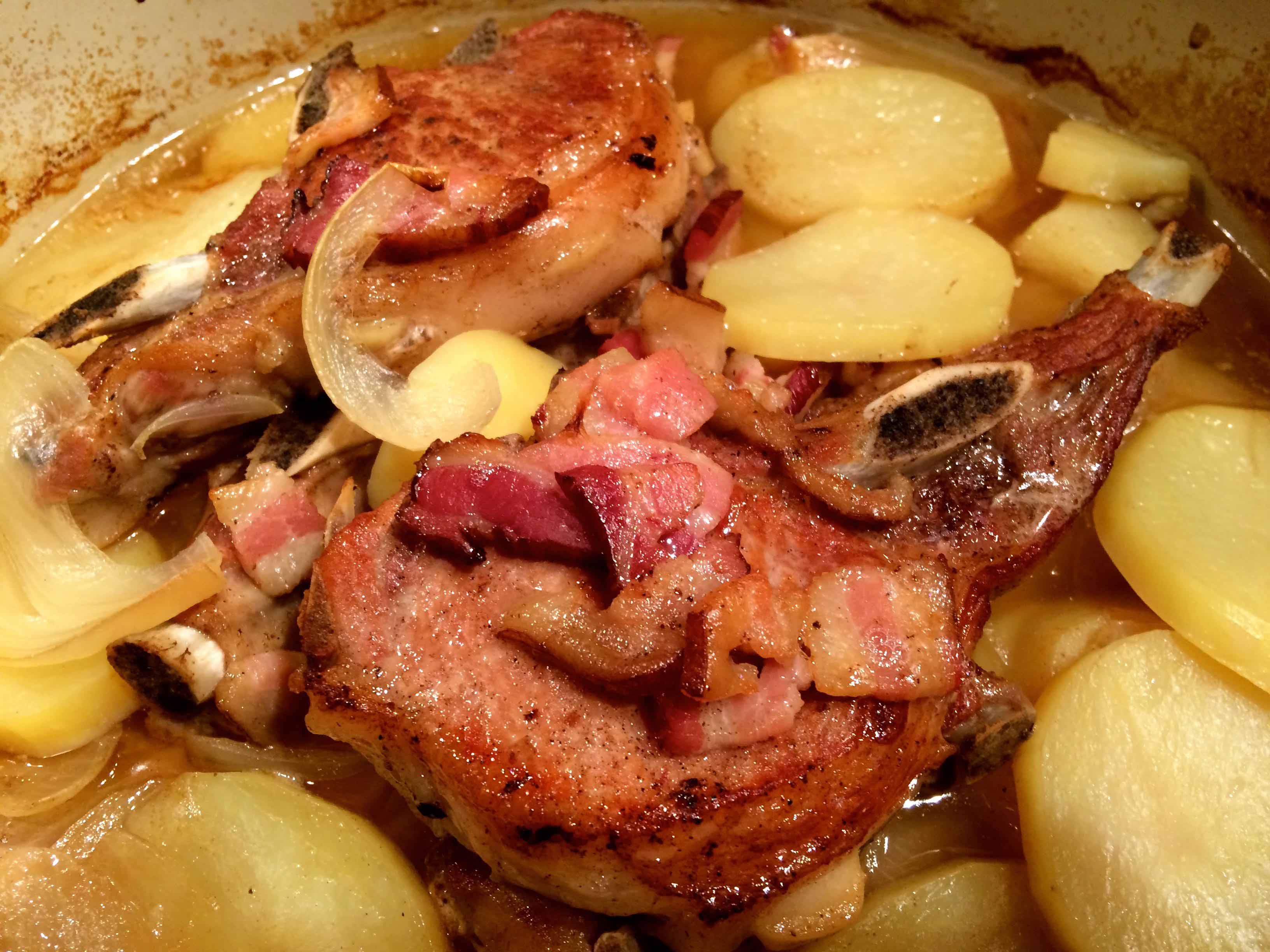
Then stack the remaining two chops on top of the chops in the pot. Scatter the bacon and juniper berries over the stacked chops.
Stacked chops
Cover with the remaining potatoes and onions. Season this layer with additional salt and pepper. Pour over the wine.
Cut a piece of parchment to fit over the potatoes and pork chops and lay it in on top.
Bake the dish for about 1 hour and 45 minutes (longer if using thicker chops), pouring in the chicken stock halfway through baking. Sprinkle with parsley to serve.






 Cooking from Books