Whenever I think about fall cuisine, braised meat immediately comes to mind. The chill in the air, the turning leaves, the shorter days conjure up images of hunks of meat slow roasting in the oven for hours and filling the house with tantalizing aromas accompanied by wafts of spices and herbs.
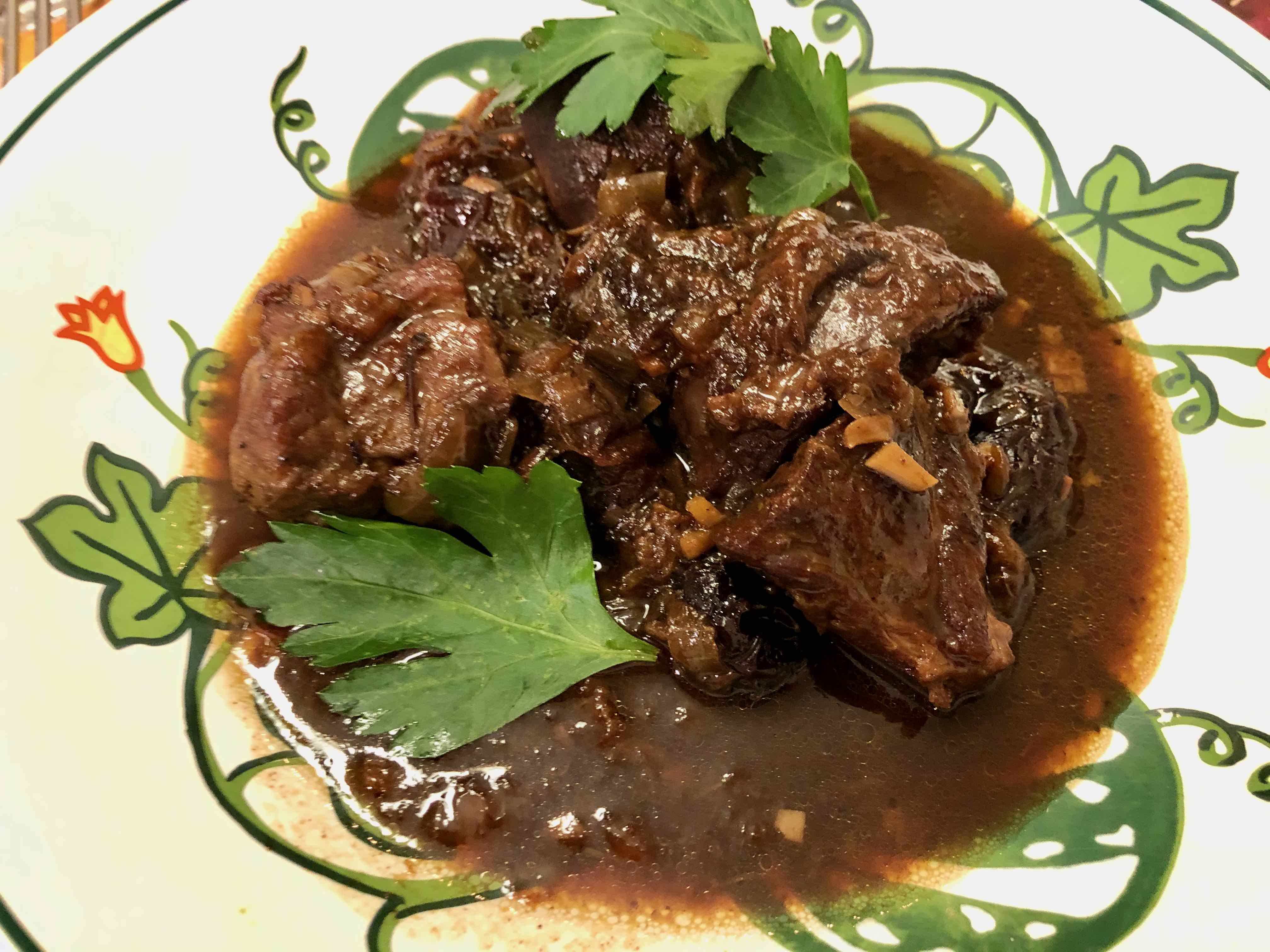
For a recent dinner party, I thought a slow-cooker dish would allow me to have everything prepared well before our guests arrived. Michele Scicolone’s The French Slow Cooker provided the perfect recipe for a blustery mid-winter evening: “Short Ribs with Red Wine and Prunes.”
With a cooking time between 8 to 10 hours on low and our guests arriving at 6PM, I figured I’d have to get everything into the slow cooker by 8 or 9AM. So, with prepping the aromatics and browning two batches of ribs, I planned a starting time around 6AM.
Well, as the saying goes about “the best laid plans,” things went astray when I over slept and arose after 9 that morning. My only solution was to pass on the slow cooker and go with the tried-and-true enameled cast-iron Dutch oven for the braise. Fortunately, the internet provided some helpful guidelines for converting the recipe for the stove that suggested reducing the cooking time to approximately 3 hours at 325°F and increasing the amount of braising liquid by about a cup since there is more evaporation with an oven than with a slow cooker.
Upon his physician’s advice, my husband recently decided to go on the Keto diet for the next two months. Given the intrinsic role food plays in our lifestyle, I couldn’t let him do it alone. So I’ve joined him on this a high-fat, moderate-protein, no carb or sugar venture.
I’ve always been a fan of Mark Bittman and his minimalist approach to cooking. Not only are his dishes easy to prepare, but the typically limited number of ingredients in his recipes makes for clean, rich flavors Read more
“Not with a Bang but a Whimper” might well be an apt title for this post on Jamie Oliver’s “Bangin’ Beef Stew,” from his 5 Ingredients cookbook, which promised much bang but delivered little. Don’t get me wrong, the stew was not a disaster, but rather a rough disappointment.
Once again, I have to attribute the origin of yet another blog post to my better half. A couple of weekends ago, we were watching an episode of “Lidia’s Kitchen” on our local PBS channel. As she was cooking, I remarked that my only disappointment with Lidia Bastianich’s show is her neglecting to provide exact measurements for key ingredients to a dish.
While I continue to maintain she does it to promote sales of the cookbooks on which her shows are based, Andrew more forgivingly attributes it to Lidia’s being a “q.b.,” or “quanto basta,” chef, an expression found in Italian cookbooks that means “just enough” or “as much as you think you need.” However, when he recently surprised me with a copy of Lidia’s Commonsense Italian Cooking, which he “happened” to order after watching the aforementioned episode, I’m sticking to my “profit-motivated” position.
A great sale on beef short ribs at my local Whole Foods triggered our Sunday supper. After returning home from the market, I started to look for recipes and found one I thought would be perfect for a late-summer night, Jacques Pepin’s “Beef Short Rib, Mushroom, and Potato Stew.” The fact that it utilized a pressure cooker made it especially appealing, as we were having a bit of a heat wave. I made another trip to the market to pick up the potatoes and dried shiitake mushrooms called for by the recipe. Back home, as my husband was unpacking the shopping bag, he asked what the mushrooms were for. When I told him, he looked a bit perplexed and said: “Didn’t you write that one up already?” I searched my blog and, sure enough, I had done a post on the dish last year.
Another cook-book search for a recipe that wouldn’t require another walk to the market (We don’t have a car.) yielded one that could use the just-purchased potatoes and didn’t call for anything I didn’t already have on hand. The source was Mark Bittman’s tome How To Cook Everything; the recipe, “Short Ribs Braised with Potatoes and Mustard.”
An old favorite found its way to our table this weekend, Chicken Thighs, with Saffron, Green Olives and Mint. I had forgotten how good this dish is with its sweet and savory onions, tangy olives, and whiffs of saffron and fresh mint. The long cooking time, actually a braise, renders chicken thighs with meat that falls of the bone and a rich sauce just waiting to be sopped up by couscous. The saffron and mint lead me to believe the origins of the dish are Sicilian, or perhaps even Moroccan.
I know that braised meat dishes serve typically as cold-weather fare, but I had some lamb shanks in the freezer that were reaching their use-by date. Moreover, since I usually prepare lamb for Easter dinner, I thought that Mario Batali’s recipe for “Braised Lamb Shanks with Leeks and Grapes” from his book Molto Batali was a good choice.
What I found interesting about the recipe was the absence of any herbs. So many lamb recipes use at least one, most often rosemary, but this had none. Even the seasoning was minimal: just salt and pepper. In addition, I was intrigued by the addition of red grapes at the end of cooking, which I thought would serve the same role as a mint sauce or red-currant jelly does with a lamb roast. I should perhaps note that until my husband mistook a garlic clove for a grape, I hadn’t realized that I had failed to stir in the grapes at the end of cooking. Consequently, I stirred them into the sauce after serving and then placed a few on each plate.
While today’s recipe may not readily be associated with late spring, it turned out to be the perfect dish for a mildly chilly San Diego evening. The real impetus behind it though was an incredible sale on lamb shanks at the supermarket that I couldn’t pass up.
When I started to look for recipes I immediately turned to books for slow cookers, but then I came across one for a slow oven braise by Ina Garten that adds orzo to the dish in the final step. As with the aforementioned sale, I couldn’t pass it up.
One thing I realized after making this dish is just how different lamb tastes when braised in the oven for two and a half hours as opposed to being cooked in a slow cooker for eight. Although I can’t deny the convenience of the latter method, the former yields in my opinion a better textured lamb with deeper flavor.
The recipe is from Garten’s cookbook Barefoot Contessa Foolproof but can also be found on the Food Network’s website. My only variations were substituting olive oil for the recipe’s grapeseed oil and, as I was cooking for two, halving the number of lamb shanks. Note that I did not reduce any of the other ingredients as I figured any left-over orzo would make a good weeknight supper.
The Ingredients Prepped
Ingredients
1 cup all-purpose flour
Kosher salt and freshly ground black pepper
4 lamb shanks (1 to 1 1/2 pounds each)
3 or more tablespoons grapeseed oil (I substituted olive oil.)
2 tablespoons good olive oil
3 cups chopped yellow onions (2 to 3 onions)
2 cups medium-diced carrots (4 to 5 carrots)
2 cups medium-diced celery (3 stalks)
1 tablespoon minced fresh rosemary leaves
3 large garlic cloves, minced
2 (14.5-ounce) cans diced tomatoes, including the liquid
2 cups canned beef broth
1 1/2 cups dry white wine, plus extra for serving
2 bay leaves
2 cups orzo (Use a good quality orzo that will stand up to long cooking.)
Directions
1-Preheat the oven to 325 degrees.
2-Combine the flour, 2 teaspoons salt, and 1 teaspoon pepper in a bowl and dredge the lamb shanks in the mixture, shaking off the excess.
The Shanks Dredged
3-In a large (13-inch) Dutch oven such as Le Creuset, heat 3 tablespoons of the grapeseed oil over medium-high heat. Add 2 lamb shanks and cook for 10 minutes, turning every few minutes, until browned on all sides. Transfer the shanks to a plate, add more grapeseed oil, and brown the remaining 2 shanks. (Don’t rush this step; make sure to get a good brown on the lamb.)
The Shanks Browned
4-Wipe out the Dutch oven with a paper towel, add the olive oil, and heat over medium to medium-high heat. (Do not be tempted to skip this step as it really does reduce the amount of fat in the final dish.)
5-Add the onions, carrots, celery, and rosemary and cook for 8 to 10 minutes, until the vegetables are tender. Add the garlic and cook 1 more minute.
Adding the Vegetables and Herbs
6-Add the tomatoes, beef broth, wine, 4 teaspoons salt, and 2 teaspoons pepper. Add the lamb shanks, arranging them so they’re almost completely submerged in the liquid. Tuck in the bay leaves and bring to a simmer on top of the stove.
Lamb Shanks Submerged
7-Cover the pot and place it in the oven for 2 hours, turning the shanks once while they cook.
8-Stir in the orzo and return the lamb shanks to the oven for 20 to 30 minutes, until the orzo is cooked and the lamb shanks are very tender. Discard the bay leaves, stir in 2 to 3 tablespoons of white wine, and taste the orzo for seasonings. Serve hot.





 Cooking from Books