Farfalle with Sun-Dried Tomatoes and Arugula

farfalletom1small

I needed a pasta course last night that would be perfect for dining al fresco. Wanted something light yet flavorful. My search led me to Molto Bataliby Mario Batali, where I found the recipe below for Farfalle with Sun-Dried Tomatoes and Arugula.

Farfalle with Sun-Dried Tomatoes and Arugula Adapted from Molto Mario.

1/4 cup extra virgin olive oil
6 garlic cloves, thinly sliced
10 oil-packed sun-dried tomato halves, thinly sliced
1/4 cup dry white wine
2 tablespoons salt
1 1/2 pounds farfalle pasta
4 cups (about 5 ounces) baby arugula, trimmed

Bring 8 quarts of water to boil in a large pasta pot.

While the water is heating, heat the olive oil in a 14-inch sauté pan over medium heat. Add the garlic and cook until light golden brown. (I added my thinly sliced garlic to the cold oil. I watched it carefully, stirring occasionally so that the garlic would cook slowly and not get overly browned. If your garlic should burn, start over.)

Add the sliced sun-dried tomatoes and the wine to the oil and garlic, and bring to a boil to create your sauce. Remove from the heat.

Add the salt to the boiling water. Drop the farfalle into the boiling water and cook for 1 minute less that the package instructions indicate. Just before the pasta is done, carefully ladle 1/4 cup of the pasta water into the sauté pan containing the sauce.

Drain the pasta in a colander and add it to the pan containing the sauce. Add the arugula and toss well. Over medium heat, toss again for about 30 seconds, until the pasta is nicely coated, and then pour into a warmed serving bowl.

Serve immediately.

This recipe serves up to 10 as a first course or 6 as a main. If you are only making only a pound of pasta, I would not reduce the ingredients for the sauce.

farfallecheesesmall

We ended our meal with the some fresh cherries and Pecorino Romano Genuino. The term “genuino” can only be used for Romano produced in Lazio, the province of Rome. I find it a bit milder and more flavorful than other types of pecorino Romano.

Our dinner wine was a delicious chilled Chiaretto Valtenesi from producer Pasini San Giovanni, a blend of Groppello, Marzemino, Barbera and Sangiovese.

Wine Pairing:  Dry Rosé.

A Date for Baked Ziti

bakedzitismall

Every so often, my menu is determined not by choice but by one or more expiration dates. (Alas, I remember when the dates that influenced my cooking were of a more romantic variety.) But getting back to the present: Looking in the fridge, I found some mozzarella leftover from pizza making last weekend and some ricotta that I had purchased for eggplant involuting about a week ago. Both were soon approaching their best used by date and there was about 8 ounces of each—too much to throw out without feeling guilty.

Growing up Italian, the two typical ways of putting leftovers to work were frittatas or pasta. Last night, I opted for the latter and decided to make some baked ziti.

I preheated the oven to 350°F .

Next, I made a 20-minute marinara sauce with a small clove of garlic, olive oil, crushed tomatoes, basil, salt and pepper. I minced the garlic and added it to the pan with 2 tablespoons of olive oil and some salt and pepper. I sautéed the garlic for a few minutes, until it was aromatic but had not taken on any color. Next, I added about a teaspoon of chopped basil and sautéed that with the garlic for about 30 seconds and then added a 16 ounce can of chopped tomatoes. I brought this to a simmer over medium heat and let the sauce simmer uncovered over low for about 15 minutes.

As the sauce was cooking, I added an egg yolk to the ricotta, together with some Pecorino-Romano (1/4 cup), chopped fresh basil (1 tablespoon) and a little salt and pepper. I beat this mixture with a spoon until it was creamy.

Meanwhile, I cooked some left over whole-wheat penne, about 8 ounces, that had also been around a tad too long, to about a minute before the al-dente stage.

When the pasta was done, I transferred it to the ricotta mixture and stirred it until well coated.

I then placed a few spoonfuls of the tomato sauce on the bottom of a small baking dish. I followed this with a layer of half of the pasta and ricotta mixture. Over this layer, I spread about half of the sauce and about 3 ounces of mozzarella which I pulled into chunks from the ball. Over the top of this layer, I grated some pecorino. I repeated this process to form a second layer ending with the mozzarella, grated cheese, and a light drizzle of olive oil.

I placed this in a 350°F oven and baked for 30 minutes. After removing it from the over, I let it rest tented with foil for 10 minutes before serving.

bakedziti2small

Keeping with the left-over theme, our wine was a half bottle of Chianti.

Would enjoy hearing how my readers use up their about-to-expire ingredients.

Veal Stew Revisited

vealstewrevisitedsmall

Recently, my friend Arthur Schwartz, an expert on southern Italian cooking, told me about an extremely simple tomato sauce made from just four ingredients: olive oil, garlic, concentrated tomato paste, and milk.

In a sauté pan, sauté a peeled and smashed garlic clove in a couple of tablespoons of olive oil. Remove the garlic just before it takes on any color. (Your nose should let you when.) Next, add two full tablespoons of imported Italian tomato paste. (The one that comes in a tube.) Stir for about two minutes or until the paste has dissolved into the oil. Finally, add a scant cup of milk, season with salt and pepper, and cook uncovered until the sauce has slightly thickened. That’s it. I knew I would eventually make this sauce.

Well last night, I remembered some veal stew with mushrooms that had been sitting in the fridge for a few days. (See my June 6th posting.) There wasn’t enough meat for two servings, so I thought I could stretch and even refashion the stew as a sauce for some fresh pappardelle.

The stew, however, even when we had it the first night, didn’t have a lot of sauce. And after several days in the fridge, there was even less. That’s when I thought of my friend’s tomato and milk sauce.

After preparing the sauce as described above, except for enriching it with just a touch of cream, I added the stew to the sauté pan and let it reheat partially covered for about 15 minutes. I then added about a half cup of frozen peas and cooked the sauce until the peas were warmed through.

While the stew, now a sauce, was still on the heat, with a spider strainer I transferred the cooked-a-minute-before-al-dente pappardelle to the pan, tossing the pasta to coat with the sauce. After less than a minute, I removed the pan from the heat. Over the pasta, I grated some Parmigiano-Reggiano, sprinkled some torn basil leaves, and gave it all a final toss.

Served accompanied by a Rosso Piceno from Italy’s Marche region, our revisited stew made a perfect Sunday night pasta.

In a comment to this post, please feel free to share any of your recipes for refashioning leftovers.

Fregola with Manila Clams

clamsfregolasmall

Last night we had a tasty dish of fregola (Sardinian couscous) with Manila clams. The attached recipe is from BBC television cook Nigella Lawson. The link below to the BBC site also has a helpful video of the recipe.

Lawson calls for tomato puree, which is actually a concentrated tomato paste. I used an imported one from Italy that comes in a tube. After adding it to the pan, I let it toast slightly while stirring it before I added the broth and the vermouth. I think toasting the paste makes for a deeper tomato flavor.

For the small clams called for in the recipe, I used the Manila variety, which I find have a delicious briny sweetness to them. Note that the clams may take a minute or two more to open than the 3 minutes called for in the recipe. Shaking the covered pan may help the clams to open.

clamsfregola2small

This is a quick and easy to prepare dish for a weeknight meal.  And if you don’t have fregola in the cupboard, it’s worth a trip to your Italian specialty store or an online search to find some. Here’s a link to the BBC Recipe.

vingrissmall

I paired the dish with a 2013 Bonny Doon Vin Gris de Cigare, a Rhone-style blend rosé. A crisp dry rosé, with hints of strawberry on the nose and an earthy minerality, it was the perfect complement to the briny fregola.

Wine Pairing: Dry Rosé, Dry Riesling, Pinot Grigio


Pork Rib Ragu

pork ragusmall

One of the dividends from slow cooking is definitely the leftovers. Even if you’re simply reheating them, they can often be even better than the first time you served them.

Yesterday, I pulled from the fridge some slow-cooked pork ribs in smoked Spanish paprika sauce that we had on Sunday. On their own, there wasn’t enough left for two portions, so I decided to turn them into a ragu for pasta. (See my May 26th post for more about the ribs.)

For almost any rich, meaty sauce, my favorite variety of pasta is pappardelle. The name for these broad, flat noodles comes from the Italian verb “pappare,” which means “to gobble up.” Their heft and shape make them the perfect carrier for a thick ragu.

pork ragu3small

After skimming the congealed fat from the ribs, I removed the meat from the bones and shredded it, discarding any thick pieces of fat. I placed the meat and the sauce into a heavy-bottomed sauce pan with a little water and heated it over a low flame, with occasional stirring, for about 30 minutes. After 10 minutes, I also added some milk to the sauce for a creamier texture.

I then transferred the sauce to a skillet wide enough to accommodate the pasta and placed it over a low flame

I cooked the fresh pappardelle for 2 minutes in heavily salted water. Just before they reached the al dente stage, I transferred the pasta from the pot to the skillet with a spider-style strainer and tossed the noodles with the sauce for about 30 seconds to coat and finish cooking.

pork ragu2small

Off the heat, I added a handful of grated Romano and some parsley.

Wine Pairing: Sangiovese, Merlot, Cabernet Franc

Spaghetti with Anchovies

pastaachiugesmall

It was a hectic day and I couldn’t go shopping for dinner. Luckily, I had some oil-packed anchovies and fresh, well almost fresh, parsley in the fridge. The pantry yielded a half box of spaghetti, garlic, and olive oil.

What to make was obvious: another dish from my childhood that I actually hated then but love now: pasta acciughe, or spaghetti with anchovies.

Spaghetti with Anchovies (Serves 2)
4 Tbs olive oil
1 clove garlic, minced fine
1/4 tsp crushed red pepper flakes
5 or 6 oil-packed anchovies
2 Tbs fresh Italian parsley
8 oz spaghetti
Fresh black pepper

  1. While the water starts to boil for the pasta, put the olive oil, garlic, and pepper flakes in a pan and poach over low heat for about 5 minutes, stirring and making sure the garlic takes on no color.
  2. Start cooking the pasta, according to package directions for al dente.
  3. Add the anchovies to the pan, smashing them with the back of a wooden spoon until they dissolve into the oil. Add 1 Tbs of the the parsley and cook for just a couple of minutes. Remove from the heat.
  4. When the pasta is done, transfer it with tongs to the pan with the sauce. Add another tablespoon of parsley, a few grinds of fresh black pepper, and toss to coat the pasta. If too dry, add a tablespoon or so of the pasta water.

Serve on warmed plates.

This dish is sometimes served with toasted breadcrumbs, which is fine if you want a heavier dish.

Another version of this dish can be found in Chez Panisse Pasta, Pizza, Calzone. Here a link to the recipe online.

Wine Paring: Lacryma Christi Rosso, Nero d’Avola, Syrah

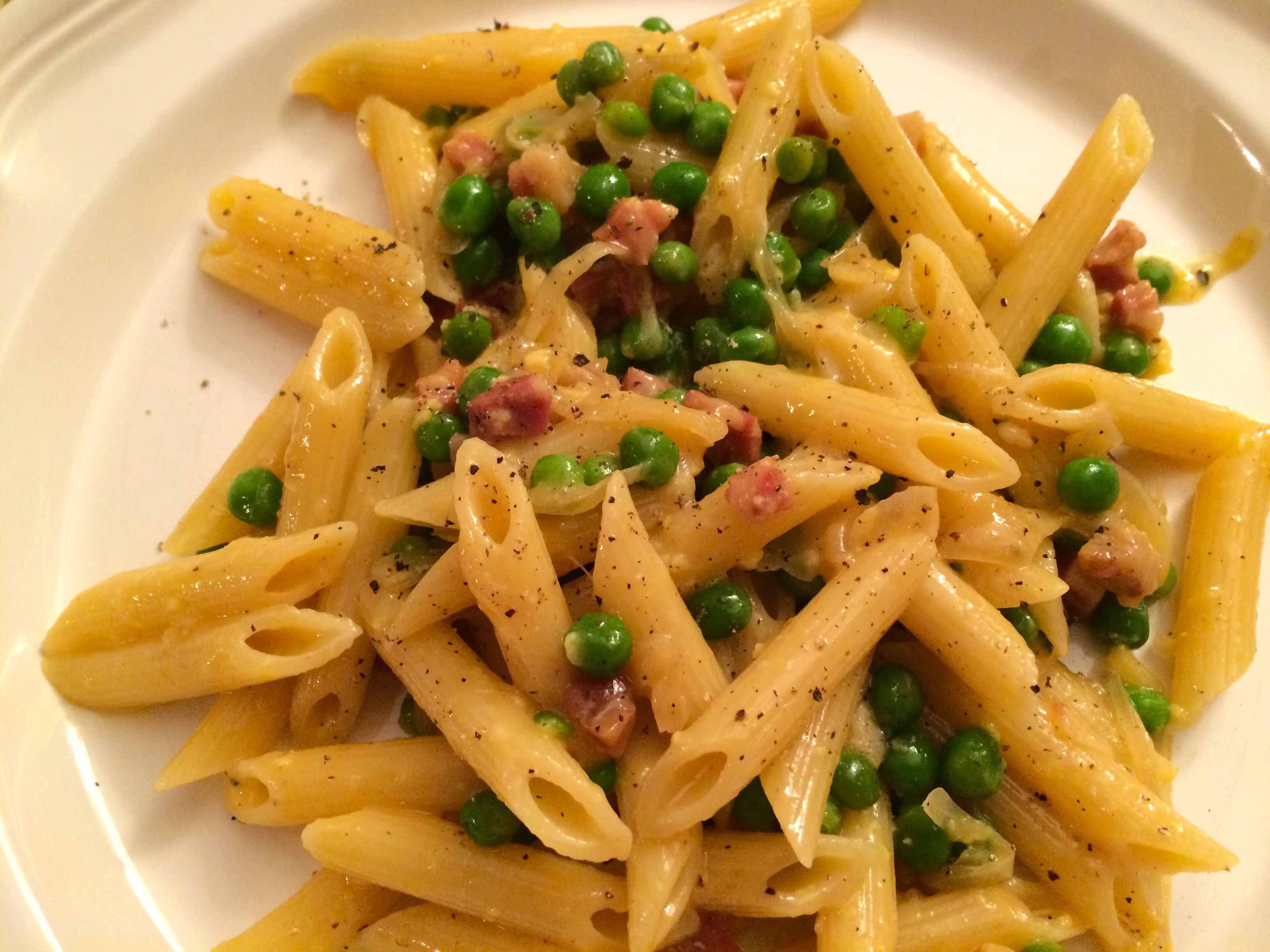
Penne Fusion

pennewpeassmall

On Saturday afternoon, as I was passing a nearby outdoor cafe, I saw a inviting plate of fresh tagliatelle with peas. It looked so good that I thought I would make something like that for dinner.

As I began to think of peas, however, my mind turned to a childhood dish of those little green gems simmered with sautéed onions and pancetta. But then, the thought of savory pancetta brought to mind pasta alla carbonara. By the time I got home, I decided to attempt a fusion of the two dishes for supper.

The following recipe is based on one of my favorites for the classic Roman spaghetti alla carbonara from David Downie’s Cooking the Roman Way. Here’s a link to a good online adaptation that you may also want to try: Spaghetti alla Carbonara

Here’s my recipe:

Penne Fusion
1Tbsp extra-virgin olive oil
4 ounces pancetta, diced
1 small onion, sliced thin
1 cup frozen petit peas, defrosted
2 large eggs, at room temperature
Salt
Crushed black pepper
1/4 cup Pecorino Romano or more to taste
8 oz penne or spaghetti

  1. Bring a a large pot of water to a boil for the pasta; for 8 oz of penne, I use a 4qt pot.
  2. Chop the pancetta into small dice.
  3. In a 3qt sauté pan or Dutch over medium heat, heat the oil. Add the pancetta and let it render its fat; then add the thinly sliced onion and cook until the onion is soft and the pancetta is lightly crisp. Add the defrosted peas and cook for an additional couple of minutes until the peas are heated through.
  4. Remove from the heat and let the pan cool for a few minutes.
  5. Meanwhile, when the water has reached a full boil, add a small handful of salt. Add the salt slowly so that pot does not boil over. When the water has returned to a boil, add the pasta and stir. Cook uncovered until just before al dente.
  6. While the peas are heating, beat the eggs well with the cheese, a pinch of salt, and a generous grinding of black pepper.
  7. Reserve a cup of the pasta water.
  8. Right before the pasta is cooked to a nice al dente stage, pour the beaten eggs into the sauté pan and stir with the pancetta, onions, and peas. The pan must still be warm enough to heat the egg mixture but not so hot that the eggs will scramble.
  9. Immediately drain the pasta and add it to the sauté pan tossing it with the sauce to coat. If the sauce is too thick, add a tablespoon or so of water to loosen. Cover the pan and let it stand for about a minute.

Serve with additional cheese and black pepper.

The difficult part of this recipe is the timing. As I said before, the sauté pan with the pancetta, onions, and peas cannot be too hot or else the egg mixture will scramble when it is added. On the other hand, it should be just warm enough to heat the egg mixture so that it will coat the pasta.

It’s also important to add the pasta while it is still hot so that its heat will help heat the egg mixture as well.


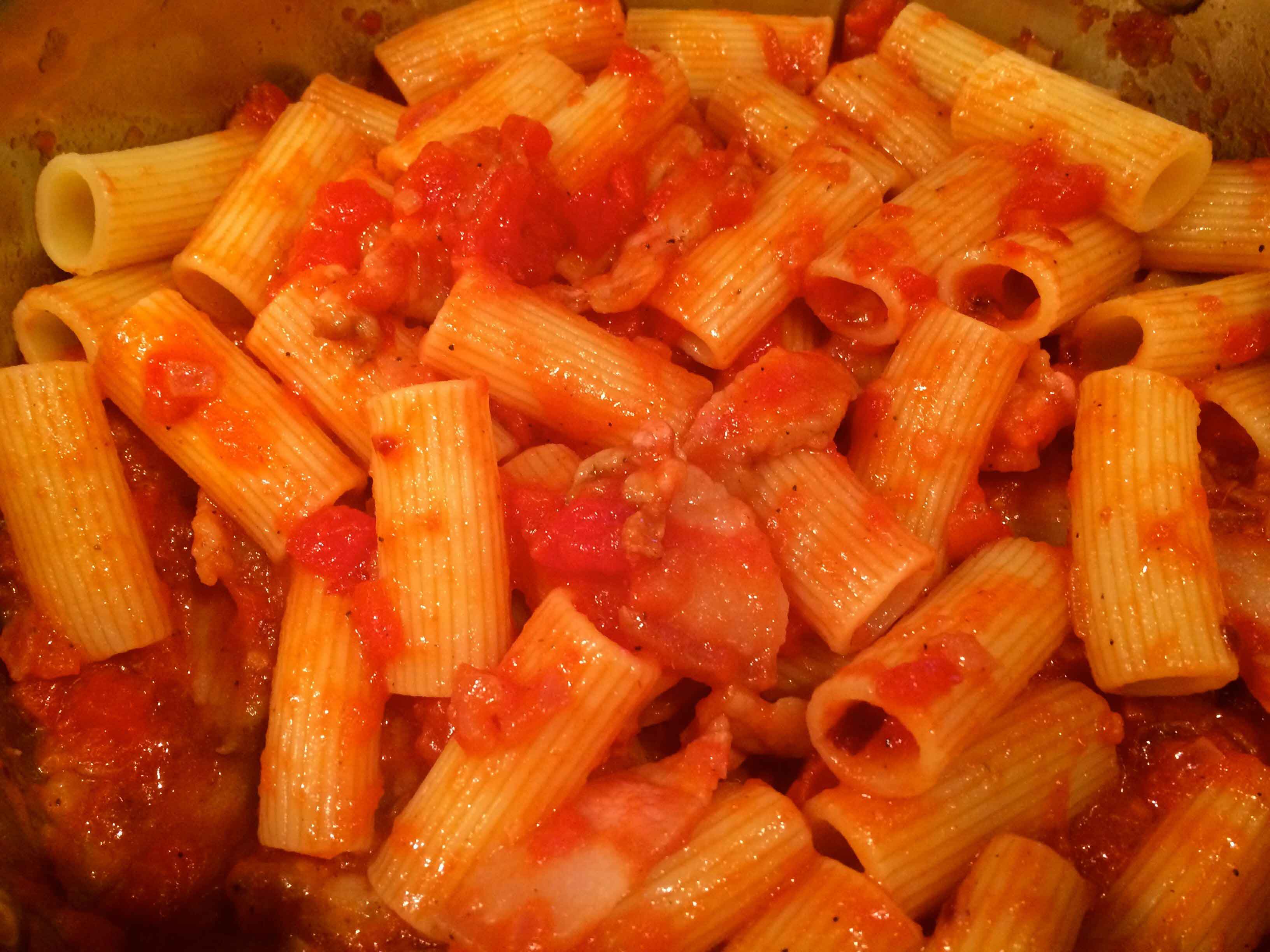
Pasta all’Amatriciana

Image

I couldn’t get to the grocery store yesterday, and we both wanted pasta. Therefore, I had to rely on what was on hand: half a red onion, canned plum tomatoes, olive oil, crushed red-pepper flakes, a half pound of rigatoni.

That lineup could have worked well for a simple marinara. A second look in the fridge, however, yielded a left-over piece of guanciale. When I saw this cured pork made from a pig’s cheek, the die was cast: pasta all’ Amatriciana.

Recipes for this classic Roman pasta dish abound, as do debates over its preparation. The major disagreement seems to be over the use of onion. Many feel that it adulterates the flavor of the original. But I like the sweetness the onion adds to the sauce and, if I have some in the kitchen, will use it.

Another dispute centers on the meat: pancetta or guanciale. Most traditionalists I know call for the latter. However, two of my favorite cookbooks, Marcella Hazan ’s Essentials of Classic Italian Cooking and David Downie’s Cooking the Roman Way call for pancetta. I find pancetta too salty and therefore opt for guanciale, which maintains its silky texture during cooking and makes for a more succulent sauce. But either will do.

Finally, there are differing opinions on the pasta shape. Some purists call for spaghetti; others, for bucatini. I prefer the thicker bucatini, but when I don’t have any available, I’ll use rigatoni or even penne.

So here’s my recipe for a serving for two, based on Marcella Hazan’s.

1 Tbs Olive Oil
1 Tbs Sweet Butter
1/2 Red Onion, diced fine
4 oz of Guanciale, cut into strips about 1/4 inch thick and 1/2 inch long
1 14 oz can Italian crushed tomatoes (I prefer San Marzano if available)
1 tsp crushed red-pepper flakes or to taste (I prefer the hot Calabrian)
Salt
1/2 lb pasta (bucatini, rigatoni, penne)
1 Tbs of Pecorino Romano, grated, plus more for the table

  1. Add the oil, butter, and onion to a sauté pan and cook over medium flame until the onion is soft. Be sure to stir occasionally to avoid burning the onion. About 5 minutes.
  2. When the onions are soft, add the guanciale and cook until the guanciale starts to render its fat. About 3 minutes.
  3. Add the tomatoes, red-pepper flakes, salt to taste, and stir.
  4. Bring to a slow simmer and cook at a simmer uncovered for about 30 minutes. Taste, at the end, for salt and hot pepper.
  5. Meanwhile, bring a large pot of water to a boil. When boiling, add a generous amount of salt to the water. Add the salt slowly to avoid the water boiling over. Add the pasta and bring back to a boil and cook for about a minute or two less than indicated on the package for al dente.
  6. When the pasta is done to a good al dente stage, drain well, saving about a cup of the pasta water.
  7. Add the drained pasta to the sauce in the sauté pan and cook over a low flame, tossing for about a minute. If too dry, add a tablespoon or so of the pasta water.
  8. Turn off the flame, add the cheese, and toss again.
  9. Serve on heated plates accompanied by some additional grated cheese.

Wine Pairing: My go-to wine for this pasta is a chilled Frascati, the wine of Rome. However, for red-wine drinkers a Montepulciano d’Abruzzo would work well.