Last week when I wrote about chicken cacciatore, I invited my readers to submit their favorite recipe for the dish. Well, fellow blogger and cookbook author, Diane Darrow, who publishes “Another Year in Recipes,” an extremely informative and culinarily literate food blog, submitted her recipe.
It was for a Campanian version of the dish, which intrigued me for two reasons. First, it did not require browning the chicken, thus eliminating the dreaded cleanup associated with this process. Second, before any tomato is added, the chicken is infused with the flavors of a battuto, a mince of carrots, onion, and celery.
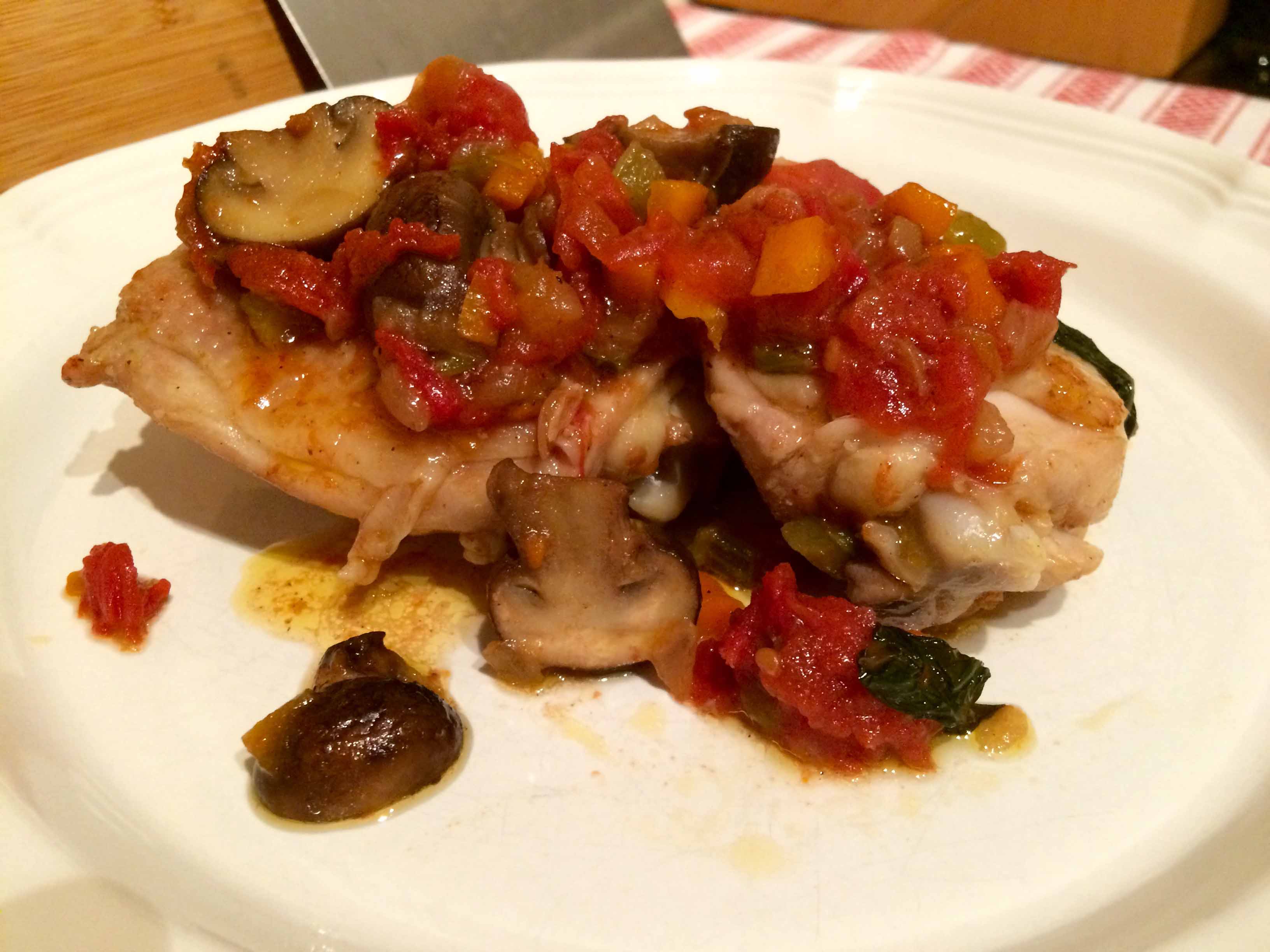
So last night I decided to make the recipe exactly as it was presented on Diane’s blog. I’m happy to report that it turned out perfectly, with succulent chicken napped in aromatic and savory sauce.
Since her recipe is richly illustrated, I chose to provide a link to it below and use only one photo of my finished dish. I strongly recommend trying this recipe as well as checking out Diane’s blog. Here is the link: Campanian Chicken alla Cacciatore.
Because I cook at home almost every night, our refrigerator is often at its max capacity. As I triage the remainders of meals gone by, tossing out wilted parsley, a shriveled zucchini, and sundry unidentifiable objects, I often find some salvageable items. Such was the case yesterday, when I discovered a couple of chicken thighs from Thursday’s cacciatore, a half a bottle of tomato passata from a pasta dish, a half of a smoked mozzarella along with some basil from Friday’s pizza night, and a small chunk of ricotta salata.
After I put these discoveries aside, I rummaged through my pantry to see if there was anything there I could use with them. When I saw a box of orzo and a canister of bread crumbs , I thought why not make a small timballo, in other words, bake the orzo along with the other ingredients.
I removed the skin and bones from the two leftover chicken thighs, pulled the meat apart, and placed it together with the sauce from the cacciatore into a 2.5 quart saucepan. To supplement the scant sauce, I added the half bottle of passata and some chopped basil to the pan, which I covered and placed on a low flame for about 20 minutes.
While the chicken and sauce were reheating, I cooked 8 ounces of the orzo until just a few minutes before it would reach al dente and then drained it well. Meanwhile, I cut the smoked mozzarella into chunks, grated the ricotta and some Parmigiano-Reggiano, and finally buttered an 8” x 8” baking dish, which I dusted with a couple of tablespoons of dried breadcrumbs.
After the chicken and sauce were fully reheated, I stirred in the orzo and let it cook for a few minutes so that it would be infused with the sauce. I then tasted it and adjusted for seasoning, with some salt and freshly ground black pepper.
I transferred half the chicken and orzo mixture to the baking dish and spread it into an even layer, which I then covered with half of the mozzarella, ricotta salata, and Parmigiano. I subsequently made a second layer with the remaining chicken and orzo, which I then topped with the remainder of the three cheeses.
I placed the baking dish into a preheated 375° F oven and baked it for about twenty minutes. When it was finished cooking, I removed the dish, tented it with some foil, and let it rest for about 10 minutes so that it would firm up a bit.
Finished timballo
I must admit this dish was delicious and turned out far better than I had thought it would. (In fact, that’s one of the reasons I have no photos, as I usually do, of its preparation.) The pasta was richly flavored, the chicken succulent, and the melted cheese, creamy and piquant, tied everything together. Yet what was even more satisfying was being able to create this dish from what could have easily found its way into the trash. My frugal mother would have been proud.
Except for the Italian-American chicken parm, cacciatore (Italian for hunter’s style) may be the most ubiquitous poultry offering on Italian restaurant menus. As might be expected, given its popularity, there are many variations on the dish both here in the U.S. as well as in Italy. Even at home, my mother and my aunt, Sicilian and Neapolitan respectively, prepared their distinctive versions: my mother’s more savory with capers, olives, and vinegar; my aunt’s more sweet and spicy with onions, tomatoes, and crushed red pepper.
Last night, I chose to prepare a version closer to my aunt’s based on a recipe from Arthur Schwartz’s Naples at Table. This Neapolitan cacciatore epitomizes the simplicity of Italian cooking, calling for just a few ingredients and a minimum of technique. However this austerity requires that the basic ingredients, the prima materia, be of the highest quality—especially the tomatoes. My aunt would use the Roma tomatoes she jarred every August. Working in the confines of a New York City apartment, I rely on the imported canned whole San Marzano variety. As for technique, it’s essential that you take the time to brown the chicken thoroughly and avoid overcrowding the pan to get the most flavor from the bird.
I’m sure many of my readers have their own version of cacciatore and I would enjoy hearing about them. As I said earlier the recipe below is based on one from Arthur Schwartz. The original recipe uses a whole chicken and also includes a variation with red peppers. Here’s a link to the original on the author’s website.
Chicken Cacciatore Adapted from Naples at Table by Arthur Schwartz
3 tablespoons extra-virgin olive oil
8 skin-on bone-in chicken thighs, well trimmed
Kosher salt
Freshly ground black pepper
1 medium onion sliced thin (3/16”)
2 5-inch sprigs fresh rosemary
1/2 cup dry white Vermouth
Big pinch hot red pepper flakes
1 28 ounce can imported whole and peeled San Marzano tomatoes, well-drained and coarsely chopped
The basic ingredients
1. Season the chicken on both sides with salt and pepper.
2. In a 12-inch saute pan with cover, heat the oil over medium-high heat and when it is hot, brown the chicken on the skin side first, then the underside. Do not crowd the pan. Brown the chicken in batches if necessary, setting aside the browned chicken on a plate until the rest is done.
Browned chicken
3. When the last few pieces of chicken are almost browned and still in the pan, add the onion and rosemary sprigs and sauté until the onion is tender.
Adding the onions and rosemary
4. Arrange all the browned chicken in the pan, skin side up, and add the vermouth. Add the hot red pepper flakes, and then let the wine cook until it has almost entirely evaporated, just a couple of minutes. While it is reducing, turn the chicken in the liquid once or twice, but leave it skin side up at the end.
Reducing the wine
5. Add the tomatoes. Cover the pan, lower the heat, and let cook at a gentle simmer, without turning, for about 30 minutes, or until the chicken is done. Check the pan every so often to make sure the sauce does not stick to the pan.
With the tomatoes
6. Remove the chicken to a serving platter, increase the heat to high and let the sauce reduce for about 2 minutes. Adjust for seasoning.
Reducing the sauce
7. Pour the sauce over the chicken and serve immediately.
One of my go-to books for Neapolitan cooking is Naples at Tableby New York based food maven, Arthur Schwartz. The book is a veritable tome of authentic recipes gathered by the author during his travels in Campania, a region in southern Italy, the capital of which is Naples.
The “Introduction” provides a wealth of background information on the history and culture of the region and the prefaces to each of the book’s sections, as well as the many sidebars, are chockablock with culinary advice and guidance. Arthur’s encounters with home cooks personalize many of the recipes, like the one I chose for dinner last night: Pollo al Limone di Agata Lima (Agata Lima’s Lemon Chicken).
This dish does require some babysitting to ensure that the chicken pieces do not stick to the pan, but with good company in the kitchen and a glass of wine, the time passes quickly. I should also point out that since the recipe does not call for any browning of the chicken and all the cooking is done over a low flame, the chicken takes on only a pale-gold color. Nevertheless, the dish’s intense lemon and herb flavors compensate for any chromatic deficiency. In fact, the finished dish reminded me of many chicken or rabbit offerings on Italian trattoria menus labeled “in bianco.”
As you will see from my italicized parenthetical comments, I made very few departures from the original recipe. I substituted well-trimmed, skin-on, bone-in thighs for the cut up chicken because we prefer dark meat. I also added the zest of one of the lemons to intensify the citrus flavor.
I served the dish with some string beans which I had on hand, but I think a side of rosemary and garlic oven roasted potatoes would have been a welcome addition.
Pollo al Limone di Agata Lima From Naples at Table by Arthur Schwartz
Serves 4 (at least)
1 3½- to 4-pound chicken, cut into 10 pieces (I opted for 10 well trimmed bone-in skin-on thighs.)
Salt
Freshly ground black pepper
4 or 5 large cloves garlic, lightly smashed
12 or more large sage leaves
2 or 3 6-inch sprigs rosemary, leaves stripped off the stem
½ cup dry white wine
2/3 cup freshly-squeezed lemon juice (I added the zest of one lemon.)
1 rounded tablespoon finely cut flat-leaf parsley
1. Season the chicken all over with salt and pepper.
2. Arrange the chicken (skin-side down) in a skillet or sauté pan that can hold it all in 1 layer – a 10- to 12-inch pan. The chicken may crowd the pan. Tuck in the garlic, the sage, and the rosemary. Do not add any oil or fat. (I cheated here and lightly misted my pan with some olive oil.)
Chicken with herbs and garlic
3. Set over low heat and continually shake the pan or jiggle the pieces of chicken so they don’t stick to the pan. After a few minutes, the chicken’s fat and juices will start running, and this will become less of a problem.
(Note: This first stage of cooking took approximately 10 minutes, which is the amount of time I waited between each of the subsequent turns of the meat.)
4. Turn the chicken pieces. Continue to cook over low heat, turning the chicken frequently. It will not brown, but will take on color. If the chicken juices accumulate in the pan, more than just skimming the bottom of the pan (because the chicken is particularly moist), increase the heat slightly.
Chicken after first turn
5. After about 15 minutes, when the chicken has taken on some color, add ½ the white wine. When the first addition of wine has nearly evaporated, in about 10 minutes, add the remaining wine. There should never be more than a skimming of liquid at the bottom of the pan. Keep turning the chicken frequently.
Chicken after second turn
6. When the second additional of wine has evaporated, add ½ the lemon juice (and, if using, the lemon zest). When the first addition of lemon juice has reduced, add the remaining juice. Altogether, the chicken will cook about 50 minutes. In the end there should be very little sauce – just a few spoons of reduced juices and fat.
Chicken with reduced wine and lemon juice
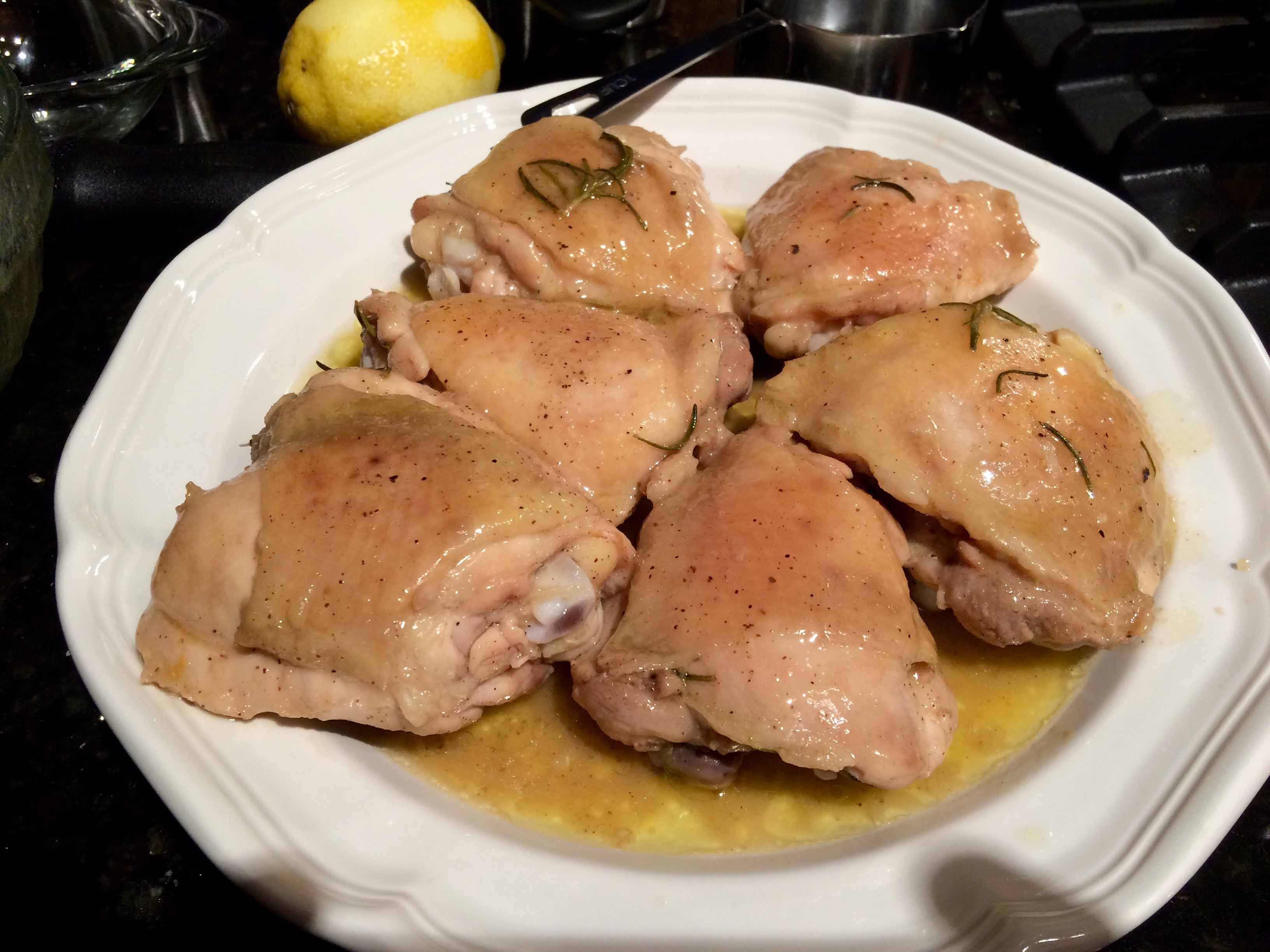
7. Arrange the chicken on a platter. Scrape whatever is left in the pan – herbs, garlic juices – into a strainer. With a spoon or spatula, Press the juices out of the solids and let them drip over the chicken.
Chicken on the platter
8. Serve hot, sprinkled with parsley. (As you can see from my photos, I forgot the parsley.)
Growing up Italian in the 1950s wasn’t too difficult in Brooklyn. After all about 50% of my neighborhood shared my ethnic heritage. But when my parents purchased a summer home in a private lake community in northern New Jersey, I began to understand the struggles that my family had when they first arrived in the United States.
The community where we spent most of our summers was predominantly WASP. My uncle Al had bought home there and was approved to join the community club largely because he was a physician. A few years later my father’s application was accepted for a similar reason, he was an attorney. Over time, more Italian families gained entrance, but somehow we were always regarded with some skepticism.
I recall sitting on our patio one afternoon as our neighbor, a long time member with staunch German heritage once commented to my mother and aunt how we were different from other Italians she knew. “You’re not what we expected,” she said. “No babushkas, not loud, not…”
When she left, I asked my mother how she could tolerate such talk. “That’s what prejudice is all about,” she said. “You’ll never change her. But don’t give her a chance to find fault with you.”
A few days later, my feisty aunt, however, decided to address our neighbor’s comments not so much with words, but with food. On our outdoor grill, she cooked a chicken that was marinated in olive oil, lemon, and plenty of garlic. As the chicken cooked, she basted it with the marinade using a parsley brush. Twenty minutes into the cooking, our neighbor came by asking what that lovely aroma was. My aunt escorted her to the grill and said “grilled chicken; it’s the aroma of garlic that you’re probably picking up. A recipe we brought over with us from the old country.”
After our neighbor left, my aunt said, with a subtle smile, “I think she got the message.”
The other evening I decided to recreate this recipe on our small outdoor electric grill.
Italian Grilled Chicken
2 lemons, zested and juiced
1 bunch parsley, coarsely chopped
2 garlic cloves, finely chopped or rasped
1/2 teaspoon crushed red pepper flakes
1 teaspoon Kosher salt
1 teaspoon freshly ground black pepper
1/2 cup extra virgin olive oil
3 to 4 pound chicken, spatchcocked and pressed flat, wing tips removed (Here’s a link to instructions for spatchcocking a chicken.)
In a large bowl combine all the ingredients except the chicken and whisk until well combined. Set aside 1/4 of the marinade to used as a dipping sauce.
Place the spatchcocked chicken in a gallon-size zip-lock bag and add the remaining marinade. Seal the bag and make sure the marinade is well distributed over the chicken. Allow to marinate in the refrigerator for 3 hours or so.
Place the chicken in a two-sided hinged grilling basket to keep the chicken flat. Place on the grill skin side down, baste well with the marinade, and allow to cook for about 25 minutes. Turn the chicken, baste with remaining marinade, and cook for another 20 to 25 minutes.*
Remove from the grill and let the chicken rest covered for 5 to 10 minutes. Cut into quarters and serve with the reserved marinade.
*My cooking times are based on my small electric grill with the lid closed as much as possible. I’m not a grill master and you may need to adjust the cooking times based on your own experience with your grill.
Back from a week of enjoying authentic Venetian dishes and returning to my tutoring position in Harlem made me long for some homemade American comfort food. Among the first emails I read when we got home was one from the New York Times Cooking Newsletter that had a link to a recipe for Craig Claiborne’s Smothered Chicken. The original recipe appeared in a feature he wrote for the Times in 1983: “Make Dinner: A Home Cooking Manifesto.”
The recipe appealed to me not only for its comforting qualities but also for its ease. It requires minimal shopping: a small chicken; the rest of the ingredients are kitchen staples: chicken stock, flour, butter, salt and pepper. It’s also a one-pot dish: a cast-iron skillet and takes about an hour and a half to complete.
Even with getting back from work around 6:30 and having to go food shopping, I was able to get this dish on our table by 8:30.
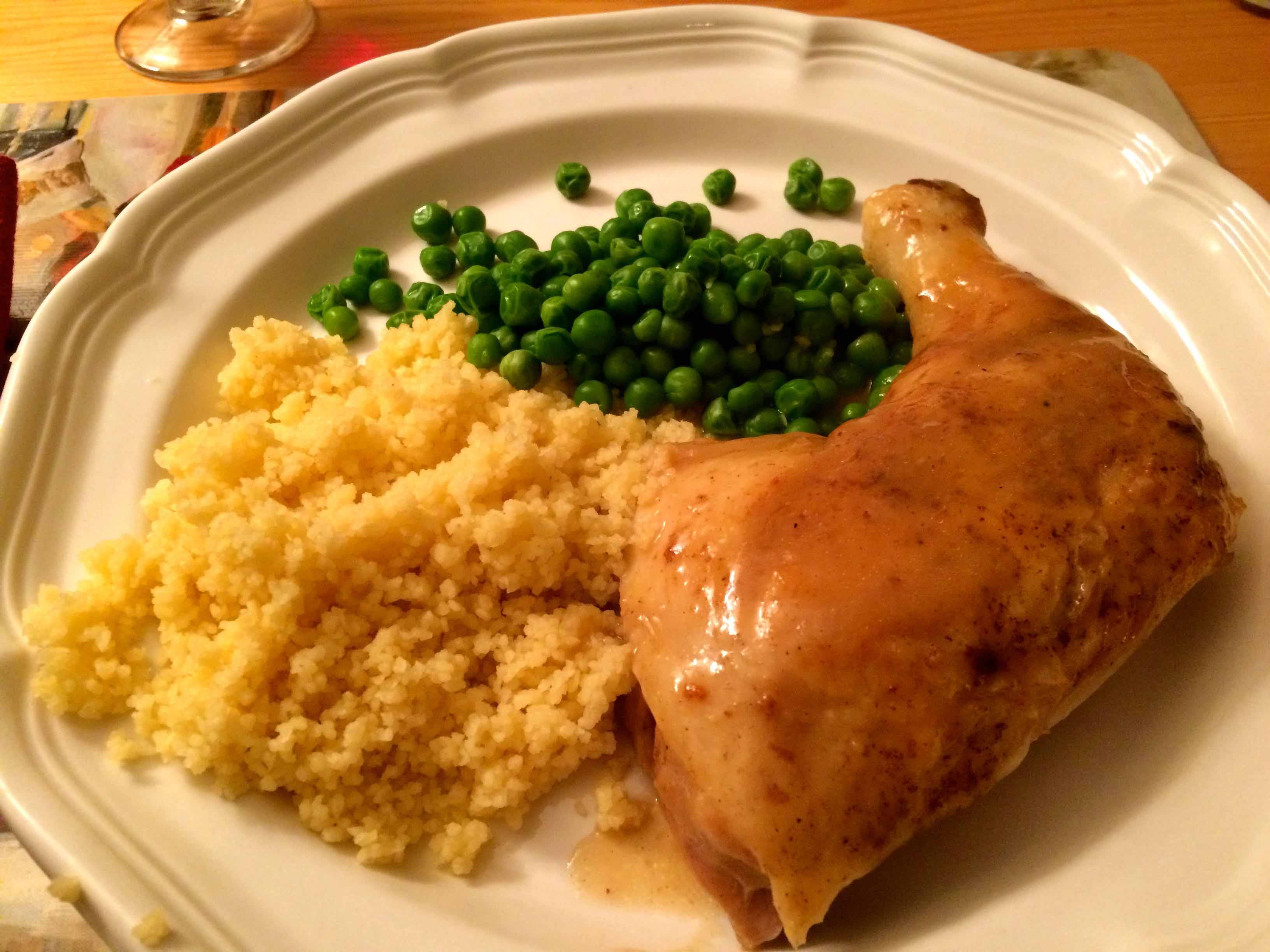
Accompanied by some quick-cooking couscous, buttered peas, and an American Chardonnay, the dish delivered all the comfort we were looking for. After we finished, we looked at each other with contented smiles and I thought: “Gee, it’s great to be back home.”
Spatchcock a small chicken, by removing the backbone with a pair of kitchen shears, and season to taste with Kosher salt and freshly ground pepper.
Melt butter in a heavy skillet, preferably cast-iron, and add the chicken skin-side down.
Spatchcocked chicken in the pot
Cover with a dinner plate and weigh it down with a heavy weight. As you can see, I used an enameled cast iron casserole.
The weighed down chicken
Cook over low heat until it is browned well (about 25 minutes) and then turn skin side up.Replace the place and the weight and continue to cook for about 15 minutes more.
Browned side up
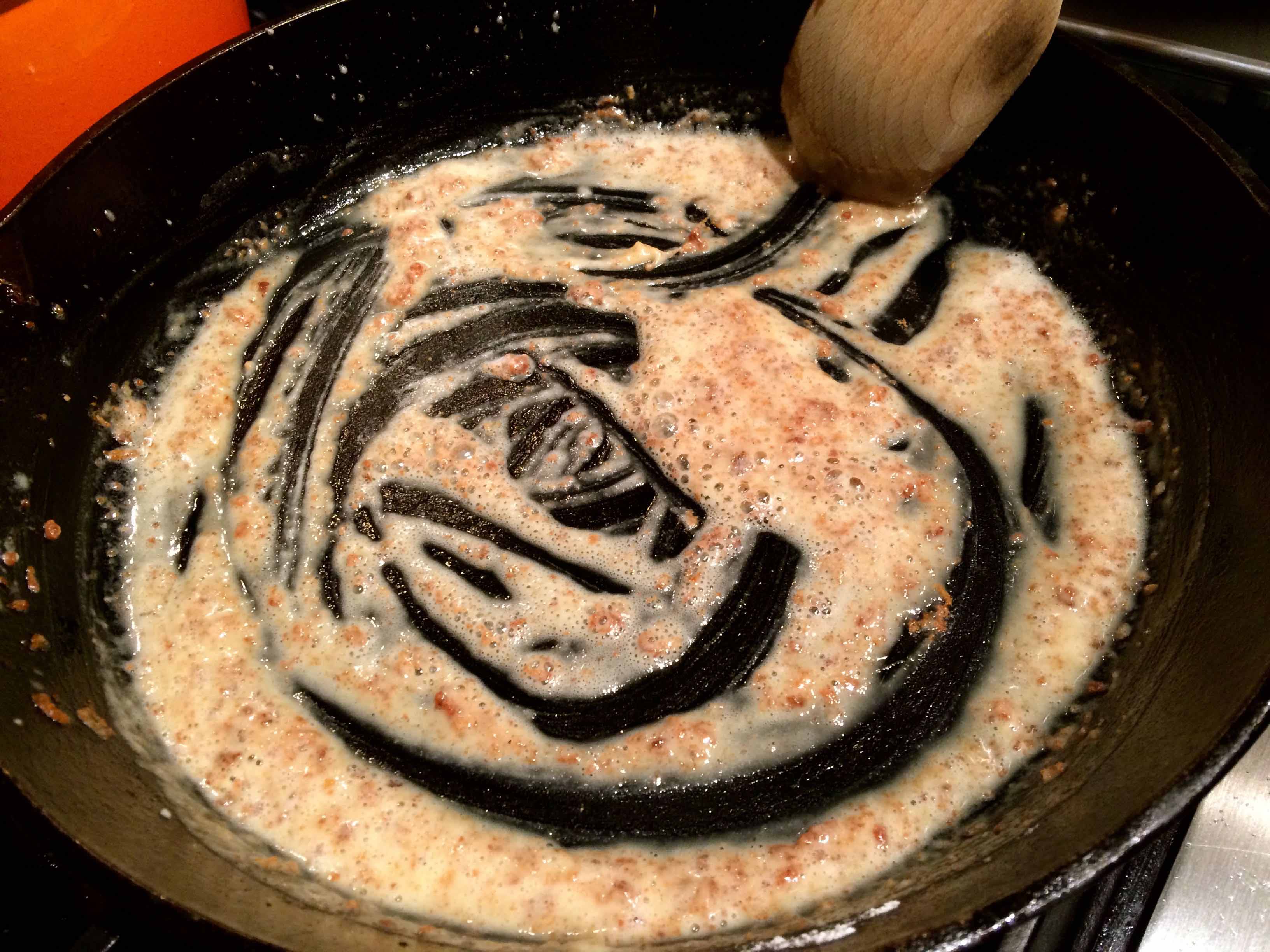
Remove the chicken from the pan. Pour off most of the fat, add some flour and cook for a few minutes stirring with a wooden spoon.
Cooking the flour and the fat
Slowly add some stock and whisk until thickened. Adjust the seasoning.
Whisking the gravy
Return the chicken to the skillet skin side up, Cover again with the plate and weight and continue to cook over low heat for about 25 minutes. Spoon with the sauce before serving.
Back in the ’70s, when I was in graduate school, for about a year, on Friday nights, I sometimes served as a shabbos goy at the home of a Jewish friend’s grandmother. Before sunset, we would walk to her apartment on Riverside Drive to join her for dinner, where my duties were simple: turn on the oven and extinguish the candles. Although our conversations would cover a wide array of subjects, ranging from the art criticism of Meyer Schapiro to the politics of Golda Meir, the menu always remained the same: a gefilte-fish appetizer, a Meal Mart roast chicken, and a parve dessert. There was also always a bottle of Kedem, a popular Kosher wine, on the table, which we served in cordial glasses, and I made sure to keep grandma’s glass full, which made our conversations even more lively.
What brought back these fond memories was a roast chicken I prepared the other night based on a recipe from Ina Garten. Somehow, whenever I want simple comfort food that’s not Italian, I turn to one of her books for a recipe, confident that I will get the sought after contentment.
A 5 to 6 pound chicken is seasoned inside and out with salt and pepper and stuffed with a large bunch of thyme, lemon halves, and a sliced head of garlic. Although the recipe calls for brushing the chicken with butter, I prefer to use extra-virgin olive oil.
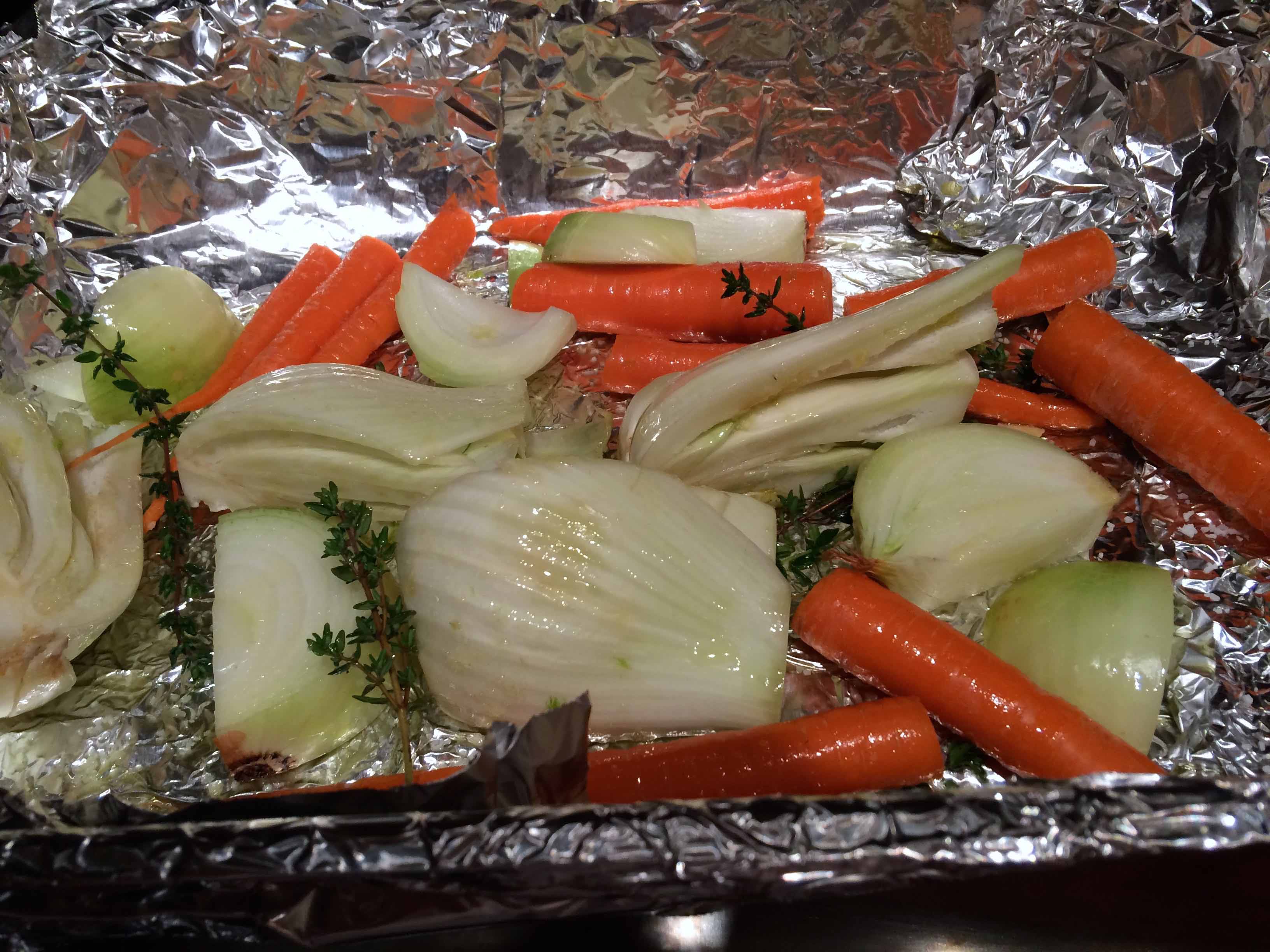
The oiled and seasoned vegetables
The legs of the chicken are then tied together with kitchen string, another step which I skip, as I think the bird cooks, although less aesthetically, more evenly. The chicken is them placed atop a bed of thickly sliced fennel, carrots, and onion, when are tossed with olive oil, salt, pepper, and thyme.
The stuffed bird
All are roasted for about an hour and a half in a 425°F oven.
If you choose to make this recipe, you may want to continue the roast the vegetables, after the chicken is done and while it is resting covered, for another 10 minutes or until roasted to your liking.
There’s something about Nigella Lawson. I can’t put my finger on it, but I can watch her cook for hours, even replaying her shows, and never get bored. Yes, she’s probably the most attractive TV chef around, but she brings more than good looks to the table. As she sashays through her kitchen with a just a hint of insouciance, she describes her dishes so sensuously that your mouth waters. And when she cooks, Italian, well…be still my palate.
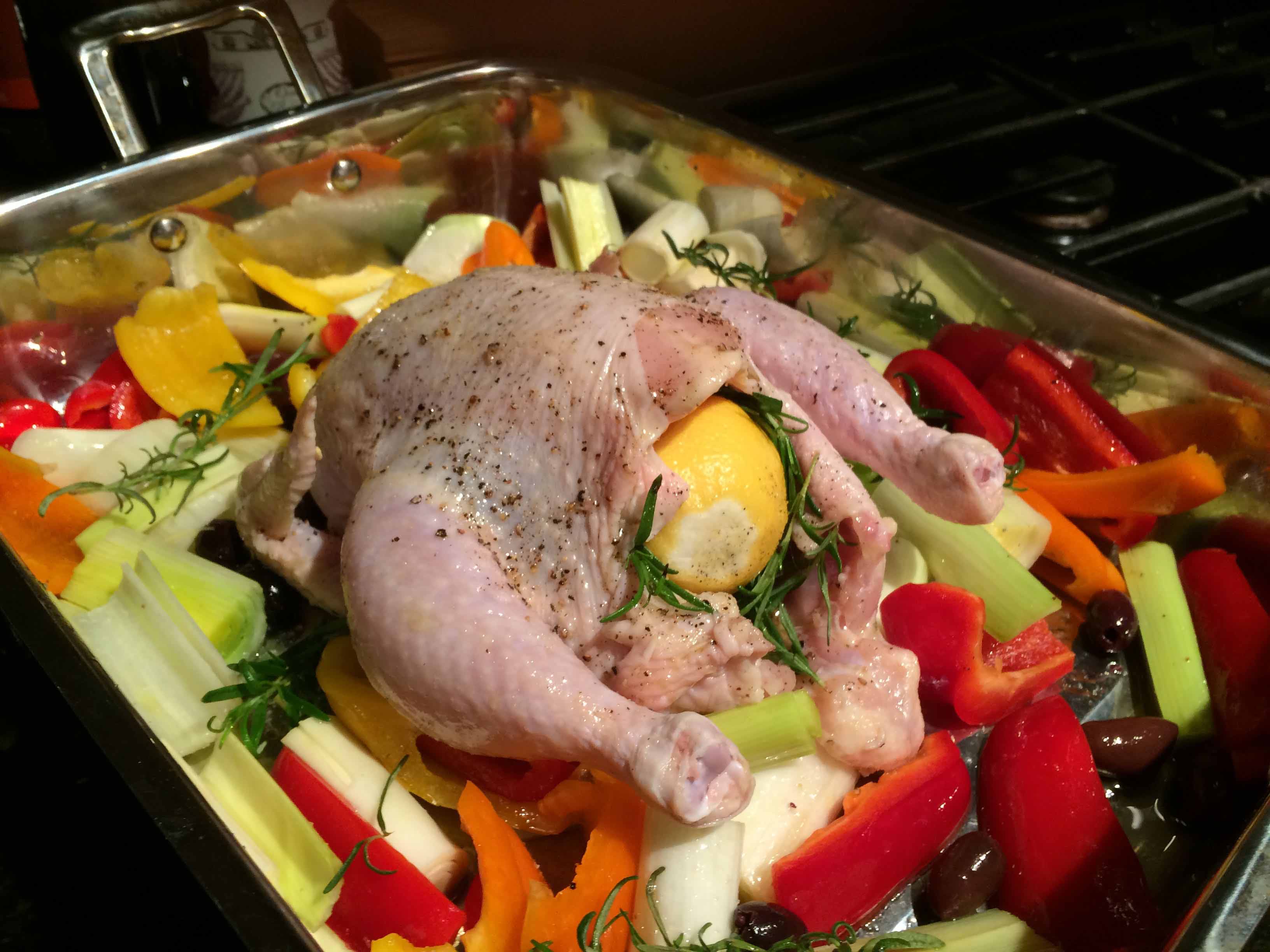
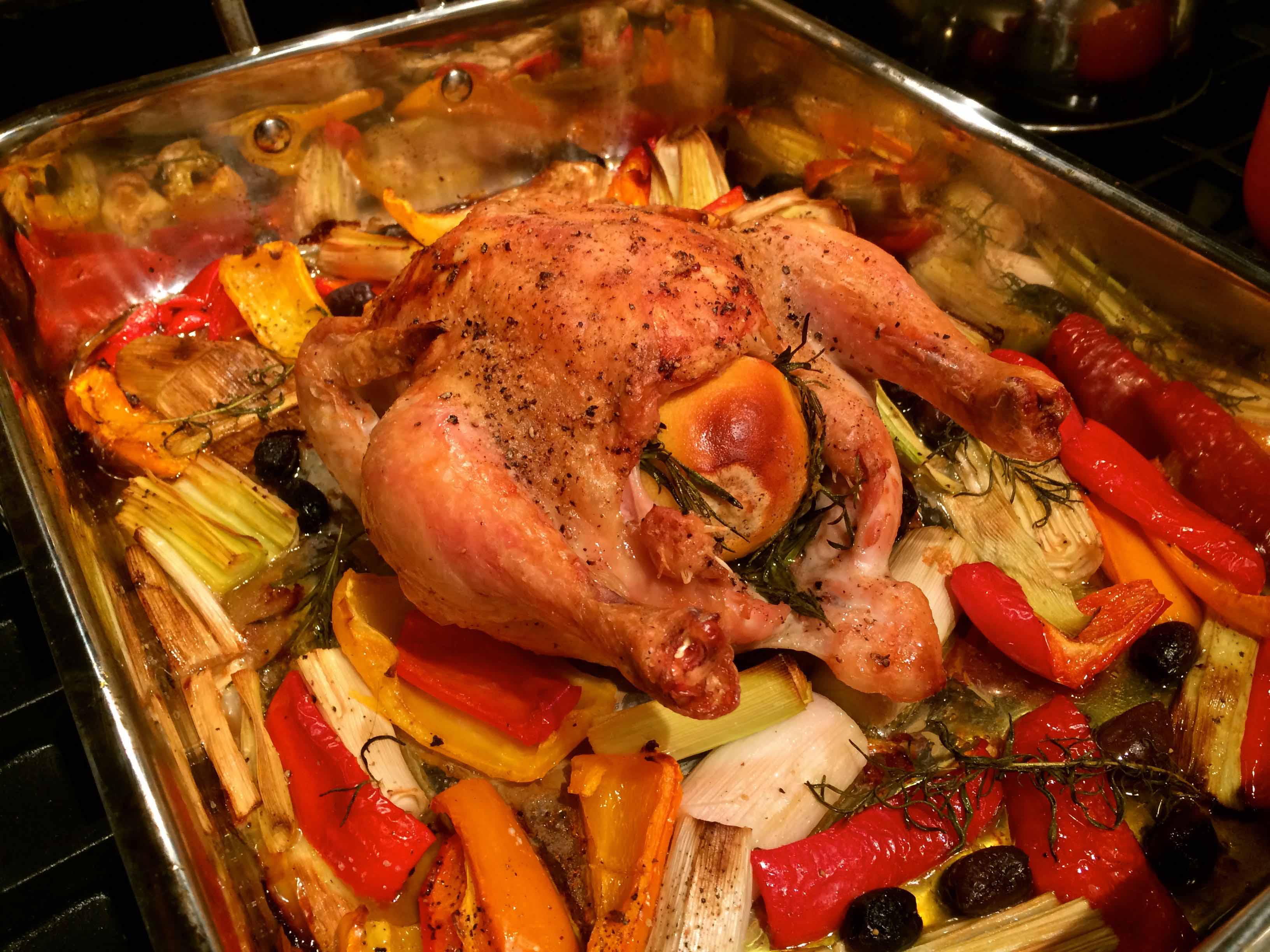
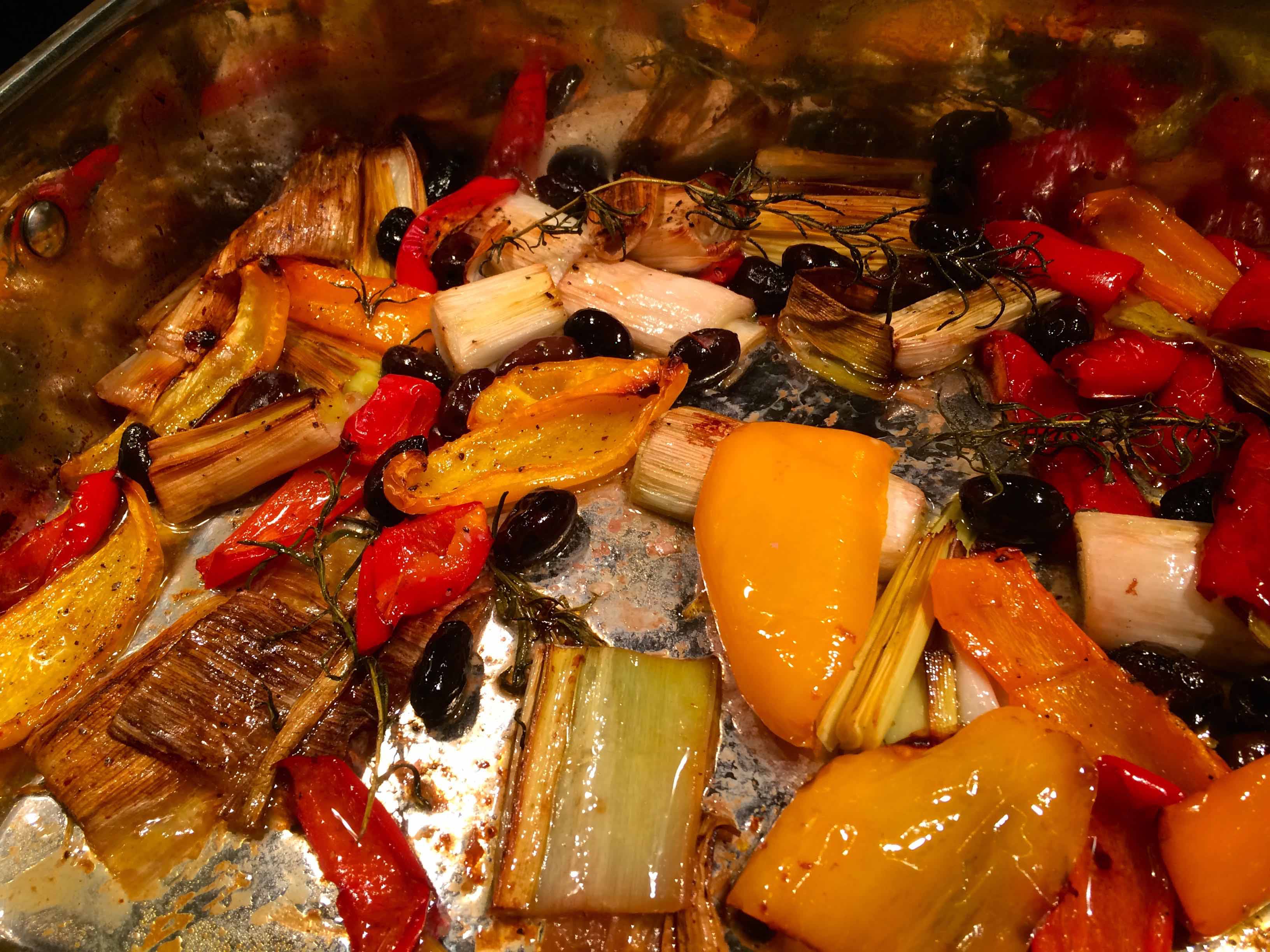
Most recently, I watched her making an Italian roast chicken with peppers and olives accompanied by a saffron orzotto. The chicken is cooked untrussed in a roasting pan, stuffed with a half of lemon and rosemary, atop sliced red, yellow, and orange peppers, leeks, and pitted black olives. Everything is drizzled with olive oil and seasoned simply with sea salt and freshly ground black pepper. A few more sprigs of rosemary are tossed in with the sliced vegetables.
Oven-ready chicken and vegetables
Because the chicken is untrussed, it cooks rather quickly in a 400°F oven for about an hour or an hour and a quarter. As the chicken, or as Lawson calls it “my burnished bird,” rests, the vegetables continue to roast for another 10 minutes.
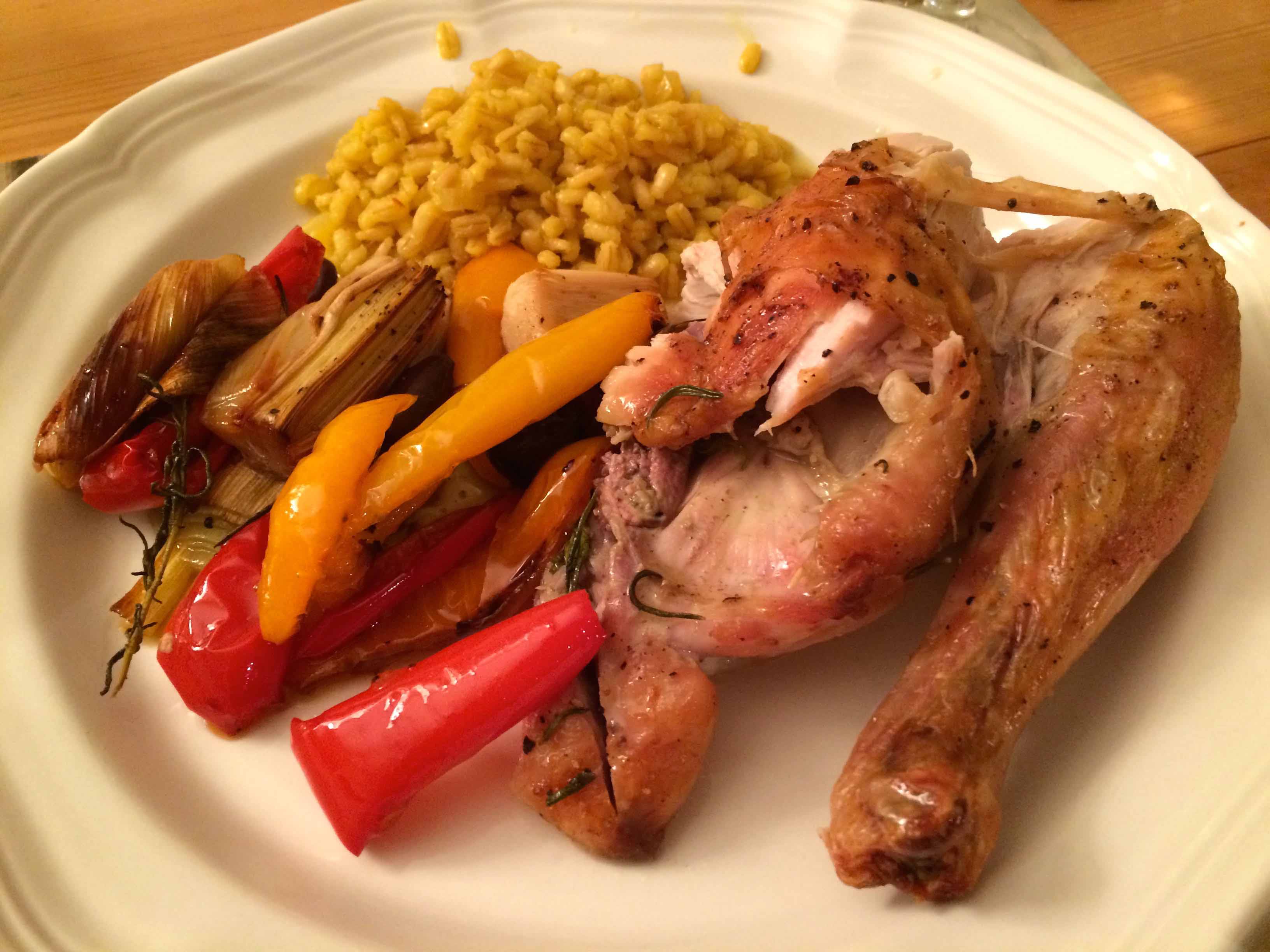
The “burnished bird”
Lawson accompanies this succulent chicken with a saffron orzotto, an easy alternative to a risotto Milanese. I prepared it for two and used a half cup of pearled barley (orzo in Italian).
Heat 1 cup of chicken stock and add about a 1/4 teaspoon of saffron threads. Keep it warm.
Finely chop a banana shallot and cook it over medium heat in a couple of tablespoons of olive oil. When the shallot has softened, in about 5 minutes, add the barley, stirring to thoroughly coat the grains with the oil for about 1 minute.
Add the stock, cover, reduce the heat to low and simmer for about 30 minutes or until the barley is cooked. At the end, stir in some freshly grated Parmigiano-Reggiano and serve.
The finished vegetables
There is nothing difficult about this menu. The multicolored vegetables and the golden orzotto alongside the burnished chicken make for a colorful presentation.
Back in the day when the Food Network seemed to care more about food than personalities and featured cooks who could teach rather than stars who entertain, Sara Moulton was one of my favorites. Her style was similar to Julia Child’s: instructive and encouraging.
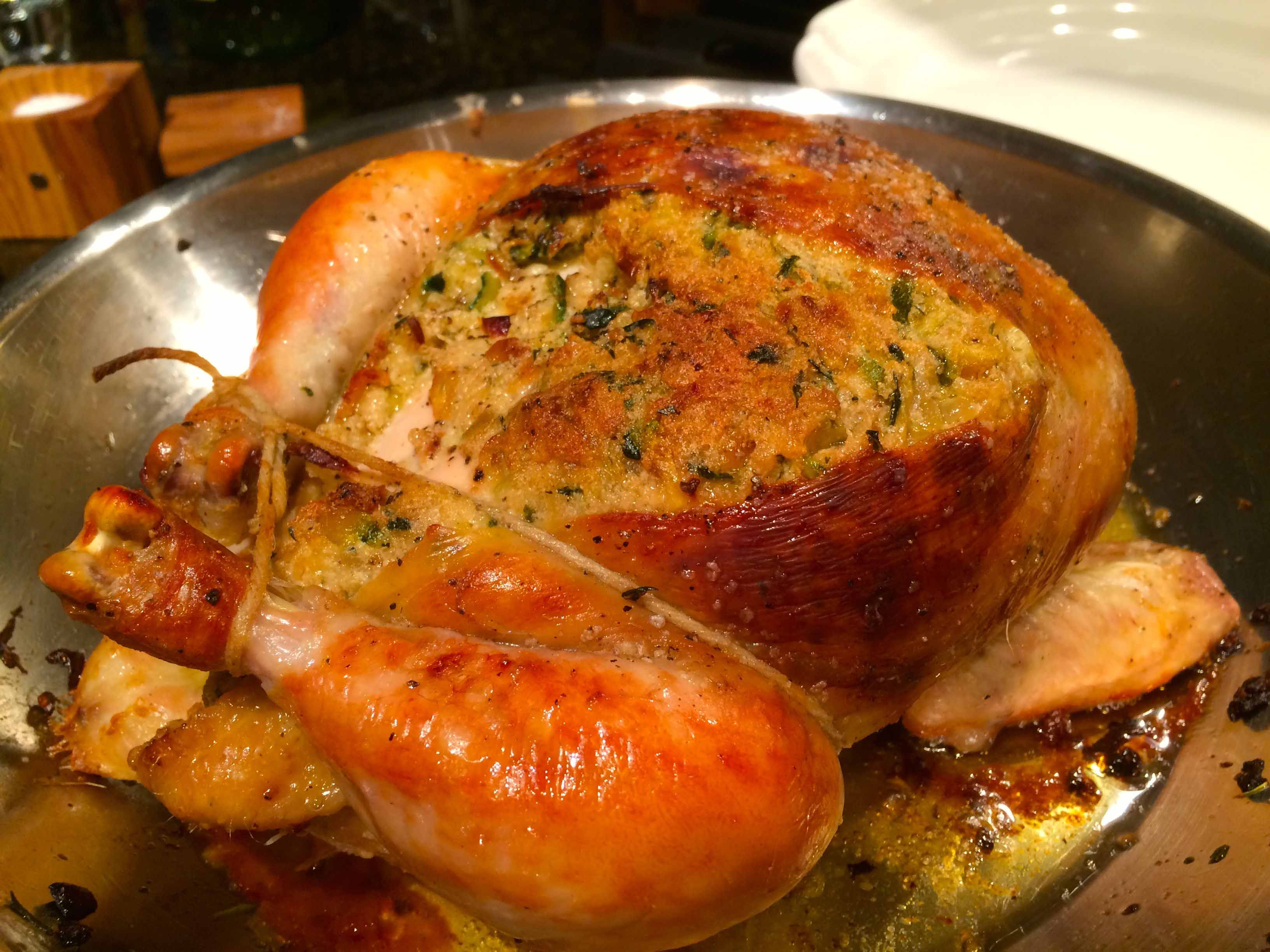
This past weekend, I was happy to discover that she has a new show on PBS, Sara’s Weeknight Meals. I watched her prepare a roast chicken stuffed under the skin with zucchini and cheese with such nonchalance that I had to make it myself. I thought it would be perfect for supper on Rosh Hashanah, the start of the Jewish New Year.
Roast Chicken Stuffed with Zucchini and Cheese Adapted from Sara’s Weeknight Meals
1 medium zucchini (about 1/2 pound), grated coarsely, about 2 cups
Kosher salt
1/2 medium onion, chopped fine (about 1/2 cup)
2 tablespoon extra virgin olive oil
1 garlic clove, chopped fine (about 1 teaspoon)
1 teaspoon fresh thyme, chopped fine
1 1/2 oz Parmigiano-Reggiano, grated
2 slices firm white bread, pulsed in food processor or blender to make 1 cup of fine crumbs
1/4 cup whole milk ricotta
Freshly ground black pepper
One 3 1/2 pound chicken
Directions
1. Position a rack in the middle of the oven and preheat the oven to 450°F.
2. Toss the zucchini with ¼ teaspoon salt and set it aside in a strainer to drain for 15 minutes.
3. Heat 1 tablespoon olive oil in a large skillet over medium heat until hot. Add the onion and cook for 6 to 8 minutes, or until it is golden. Add the garlic and cook for 1 minute more.
The zucchini with the onions
4. Squeeze the zucchini by small handfuls to remove excess liquid. Discard the liquid and set the zucchini aside.
5. Stir the thyme and well-drained zucchini into the skillet and sauté for 2 minutes over medium heat; transfer the mixture to a medium bowl and set aside.
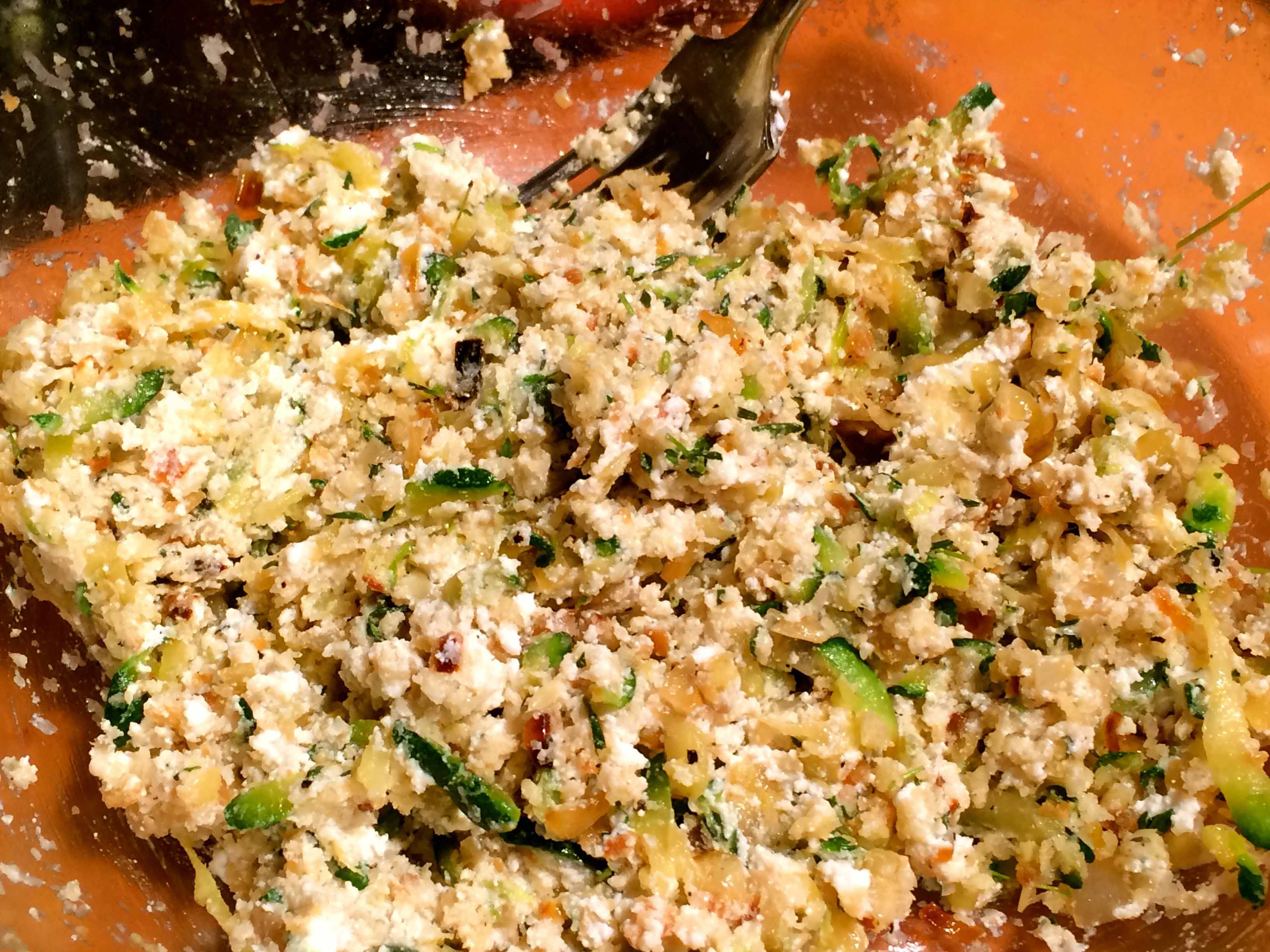
6. Add the bread crumbs, the Parmigiano-Reggiano, the ricotta, and 1/4 teaspoon pepper to the zucchini mixture. Add salt to taste.
The finished stuffing
7. Place the chicken, breast-side up in a shallow roasting pan or skillet. Gently slide your fingers under the breast skin and loosen the skin on the breasts and thighs. Do this slowly to avoid tearing it. Rub the skin with the remaining 1 tablespoon olive oil and season with salt and pepper.
8. Using your fingers, stuff and spread the zucchini mixture evenly under the loosened skin of the chicken.
9. Truss the legs of the chicken loosely with kitchen string.
Trussed and stuffed
10. Roast the chicken for 10 minutes. Reduce the oven temperature to 375°F and roast the chicken for 20 minutes. Cover the chicken loosely with foil and roast for 25 to 30 minutes more, or until a meat thermometer inserted into an inner thigh registers 165°F.
11. Remove the chicken from the oven and set it aside for 10 minutes before carving.
I’m often asked which is my favorite Italian regional cuisine. And although my heritage is Neapolitan and Sicilian, and I love the hearty cooking of Tuscany, the exquisite dishes of the Veneto, and the aromatic braises of Piemonte, Lazio is my first choice. There’s something of about the earthiness of Roman cooking, its subtle use of spice and herbs, its tantalizing fried plates, and incomparable pastas that bring be back for visits either by traveling or by cooking.
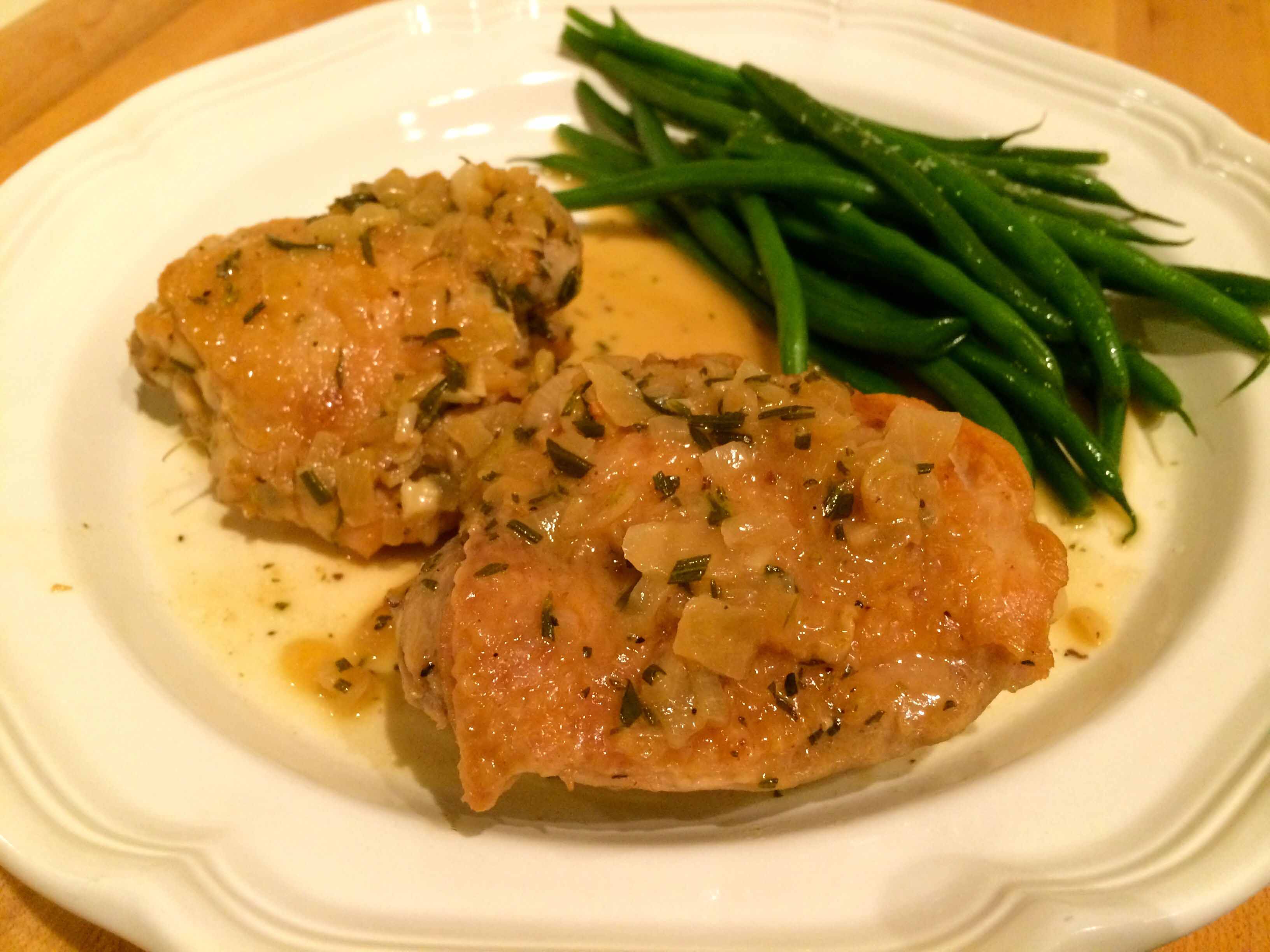
Indeed, when I cook Roman more often than not I feel like I’m back in the Eternal City at one of my favorite trattorias or al fresco cafes. That’s how I felt last night, as we dined on a delectable pollo in padella, literally “chicken in a frying pan.” This simply prepared dish uses a minimum of ingredients to yield a sauté of chicken so aromatic with fresh bay and rosemary and coated with a silky sauce flavored with onions, garlic, and white wine.
My source for the recipe was one of my go to books for Italian cuisine, Cooking the Roman Wayby David Downie. Although sadly out of print, it’s still widely available online and even as an ebook. In fact, the Kindle version on Amazon is 99 cents, a small price to pay for book that’s not only a source for authentic recipes but for guided tour of Rome and its culinary traditions.
Pollo in PadellaAdapted from Cooking the Roman Way
3 pounds skin on-bone in chicken thighs
5 tablespoons extra-virgin olive oil
Kosher salt
Freshly ground black pepper
1 large onion, chopped fine
2 cloves garlic, minced
4 whole fresh bay leaves
3 heaping tablespoons fresh rosemary leaves, minced
3/4 cup Italian dry white wine, preferably Frascati
Pat the chicken dry and trim off and discard any excess fat.
Heat 3 tablespoons of oil over medium-high heat in a heavy sauté pan large enough to accommodate the chicken in a single layer. When the oil is hot, add the chicken thighs skin-side down and season the exposed side with salt and pepper. Over medium-high heat, brown the chicken well on both sides, about 8 to 10 minutes.
Chicken browning
Transfer the chicken to a bowl with a slotted spoon and pour off all the fat and oil from the pan.
Return the pan to the stove and add the remaining 2 tablespoons of oil and the onion. Over medium heat, sauté the onions, stirring often, until the onions become translucent, about 3 to 4 minutes. Add the garlic and sauté stirring for 1 more minute stirring to avoid the garlic getting brown.
Stir in the bay leaves and 2 tablespoons of the rosemary.
The onion, garlic, and herbs
Add the chicken, one piece at a time, along with any remaining juices, turning them to coat with the oil and the herbs. Sauté over medium heat for one minute. Add the wine, and bring to a boil to evaporate it for 1 to 2 minutes, scraping up any browned bits on the bottom of the pan.
Add the remaining 1 tablespoon of rosemary, lower the heat to medium-low, and simmer covered for 45 minutes. Turn the chicken once or twice during this time.
Remove the bay leaves and serve immediately with the pan sauce.


 by New York based food maven, Arthur Schwartz. The book is a veritable tome of authentic recipes gathered by the author during his travels in Campania, a region in southern Italy, the capital of which is Naples.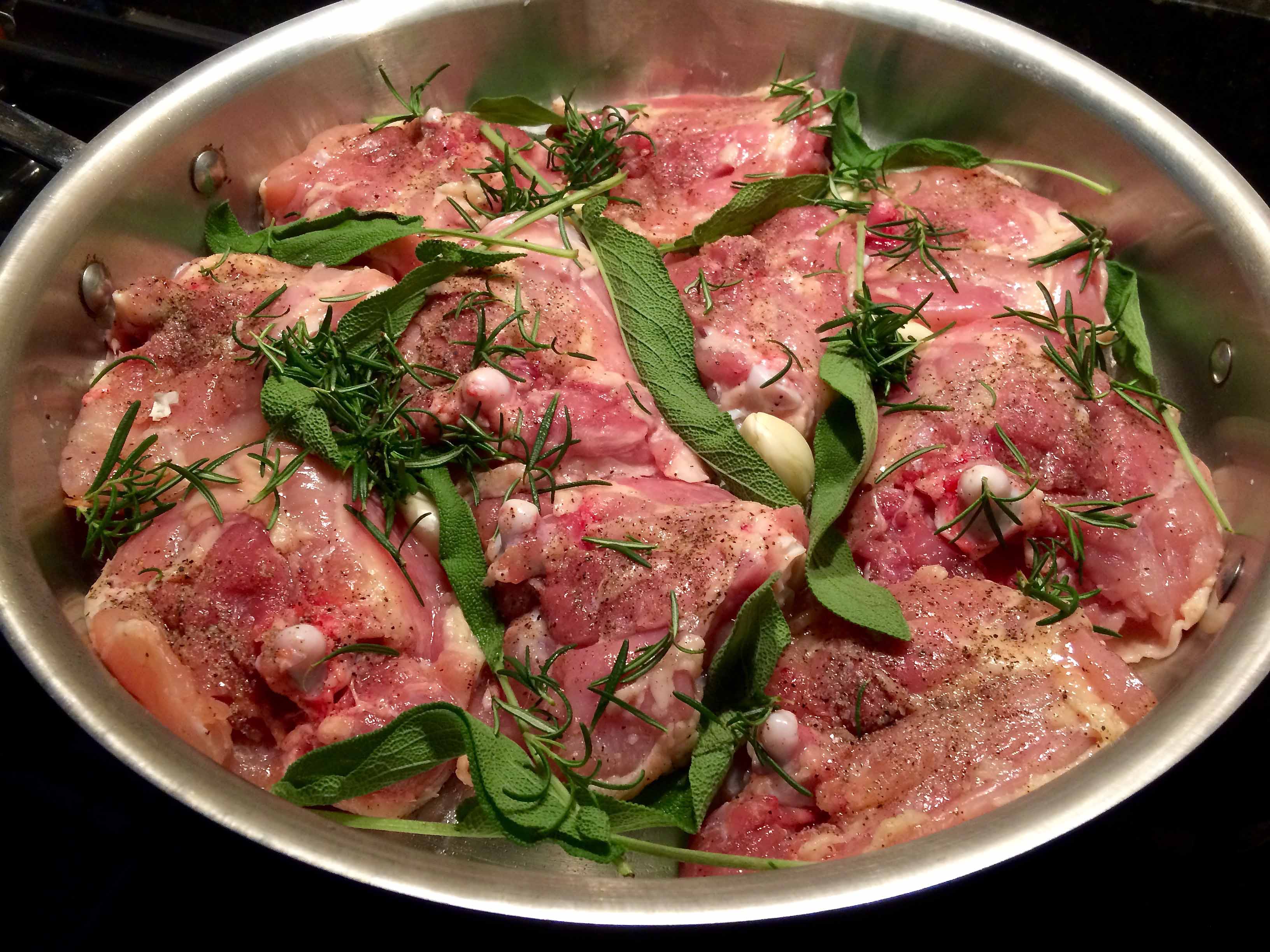








 and can be found here



 by David Downie. Although sadly out of print, it’s still widely available online and even as an ebook. In fact, the Kindle version on Amazon is 99 cents, a small price to pay for book that’s not only a source for authentic recipes but for guided tour of Rome and its culinary traditions.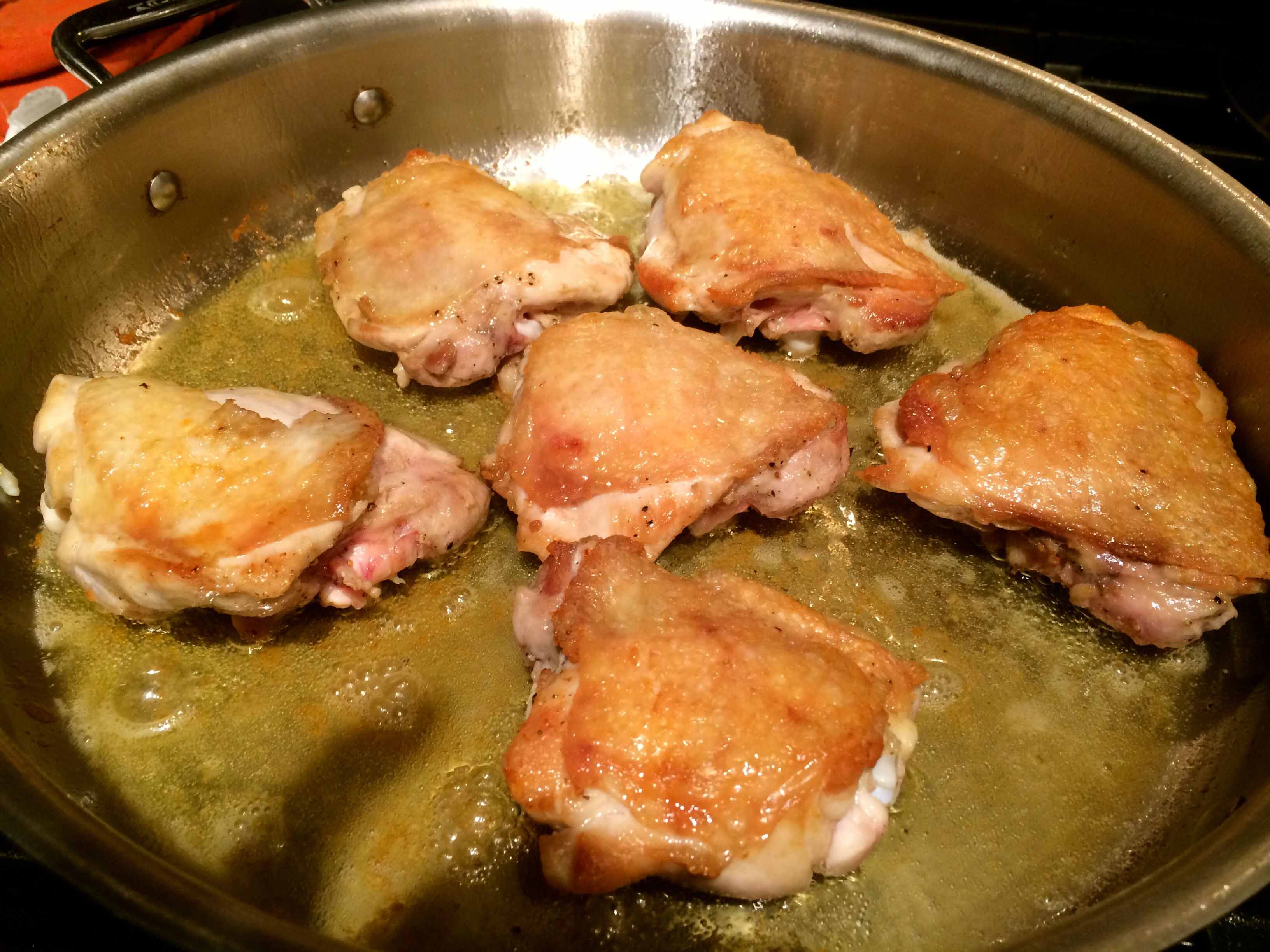

 Cooking from Books