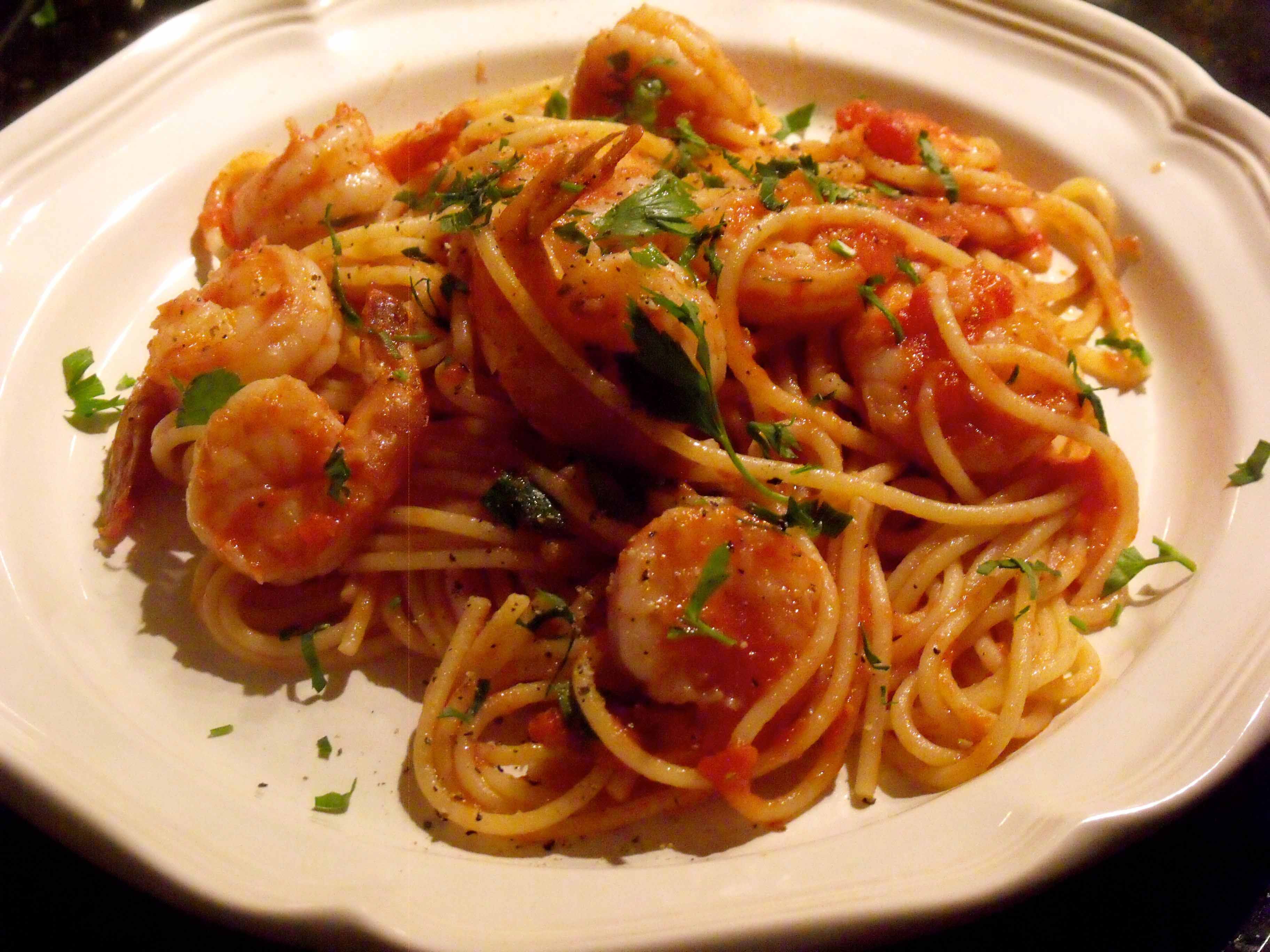
Shrimp Marinara with Spaghetti

shrimpmplatedsmall

As of late, quick-fix dishes seem to be dominating our weeknight meals. More often than not, they’re dictated, not only by my schedule, but by what’s in the market and how many extra ingredients I’ll need to pick up. Having over five items kicks me off the express check-out line, so 4 is my maximum number of secondary ingredients.

Last night’s supper is a case in point. Peeled and deveined shrimp caught my eye at the market. I knew I already had half a can of chopped tomatoes sitting in our fridge, so I thought: shrimp marinara with some pasta. The shopping list evolved from there: parsley and spaghetti were the only other ingredients I needed to purchase as I already had plenty of olive oil, garlic, herbs and spices at home. I was out of the market in 10 minutes. (Pity anyone who stands in my way as I race through the aisles.)

If you start with putting up the water for your pasta and prep and cook as it comes to a boil, you can have shrimp marinara on the table in about 30 minutes. Here’s my recipe:

Shrimp Marinara with Spaghetti

2 small garlic cloves, sliced thin
1/4 cup extra-vigin olive oil
1/4 teaspoon Calabrian red-pepper flakes (Calabrian red pepper flakes have a lot of heat; you may need to use more or less depending on the type of pepper flakes you have and how spicy you like your sauce.)
16-ounce can chopped Italian tomatoes
1/2 teaspoon dried oregano
Salt to taste
Freshly ground black pepper to taste
1 pound shrimp, peeled and deveined
1/4 cup chopped parsley
8 ounces spaghetti (I recommend a spaghetti that has flavor and texture. Rustichella d’Abruzzo is my favorite.)

Prepped ingredients
Prepped ingredients

1. Put up the water for the pasta.

2. In a large skillet, over medium low heat sauté the garlic with the red-pepper flakes in olive oil. When they become fragrant and the garlic turns just a very pale gold, add the tomatoes, oregano, salt and pepper.

The garlic and red-pepper flakes

3. Continue to cook on medium low and after the tomatoes come to a slow simmer, cook for 15 minutes, string occasionally.

4. At this point, the water for the pasta should be at a boil. Add a handful of salt to the water and add the spaghetti. Cook, following package direction for al dente.

5. While the pasta is cooking, add the shrimp to the sauce, raise the heat to medium and cook until the first side turns pinks, around 3 minutes. Turn the shrimp and cook for another 2 to 3 minutes.
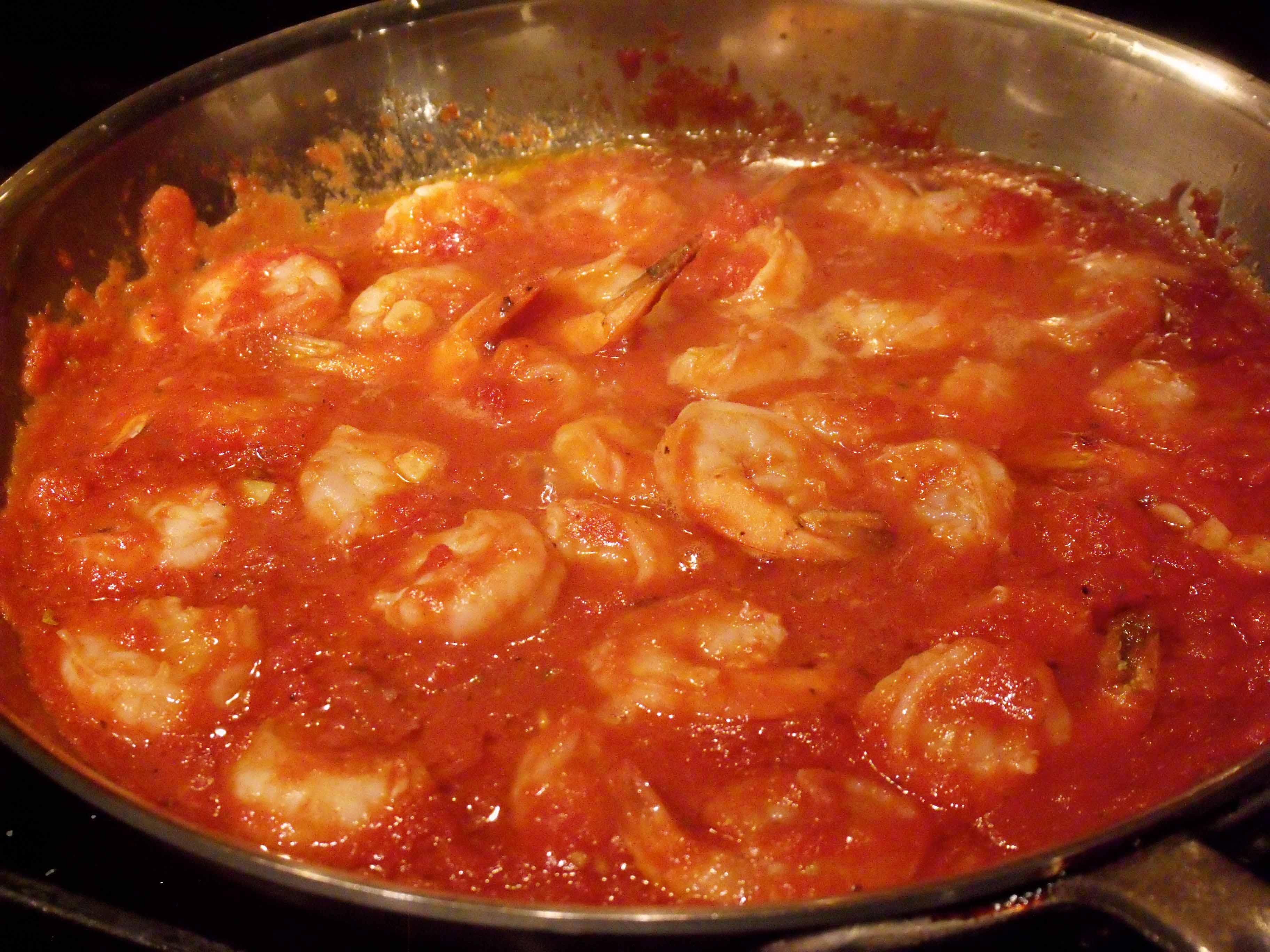
Shrimp cookiing
Shrimp cookiing

6. One minute before the prescribed time for al dente, using tongs, transfer the spaghetti to the skillet with the shrimp, reduce the flame to low, and toss the spaghetti to coat with the sauce. Off the heat, sprinkle with the chopped parsley and serve.

shrimpmarinarasmall
The spaghetti coated with the sauce

Wine Pairing: Pecorino, Vernaccia di San Gimignano, Sauvignon Blanc
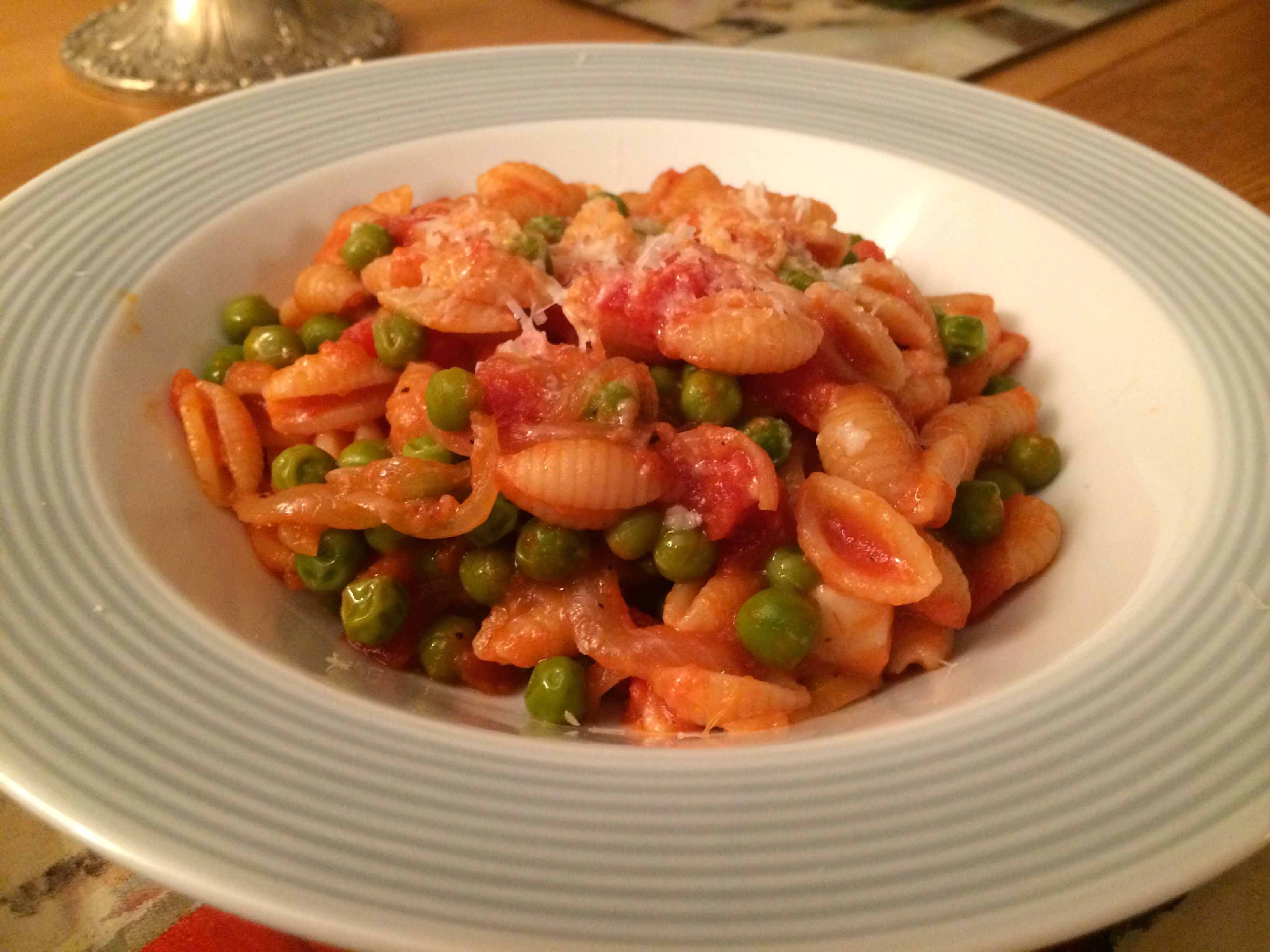
Pasta Piselli

ppplatedsmall

When my brother left home for college, my mother, while proud of her first born’s academic accomplishment, was sad to see him go. (I, however, was glad to finally have a bedroom to myself.) From that first September until his return for Thanksgiving, a day never went by when mom didn’t say how much she missed him. So when he came home for the holiday weekend, that first night she prepared his favorite dish, pasta piselli, pasta with peas, a recipe that reflected her own Sicilian heritage.

The extreme pleasure he exhibited when she brought it to the table—and consumed multiple portions—is probably why she continued to prepare this pasta every time he returned home not only from college and graduate school but even after he entered the Foreign Service and came back from posts abroad. It was always the first course for his first night back.

My brother has been asking me to re-create this dish, so last night I decided to give it a go.I must admit, I came pretty close. My only disappointment was that I was unable to find ditali, the only pasta shape my mother would use for her pasta piselli.

Our Mother’s Pasta Piselli

2 tablespoons extra virgin olive oil
1 small onion, sliced thin vertically
Salt
Freshly ground black pepper
1 16-ounce can crushed San Marzano tomatoes
1.5 cups frozen peas
8 ounces ditali or other small pasta
Pecorino-Romano

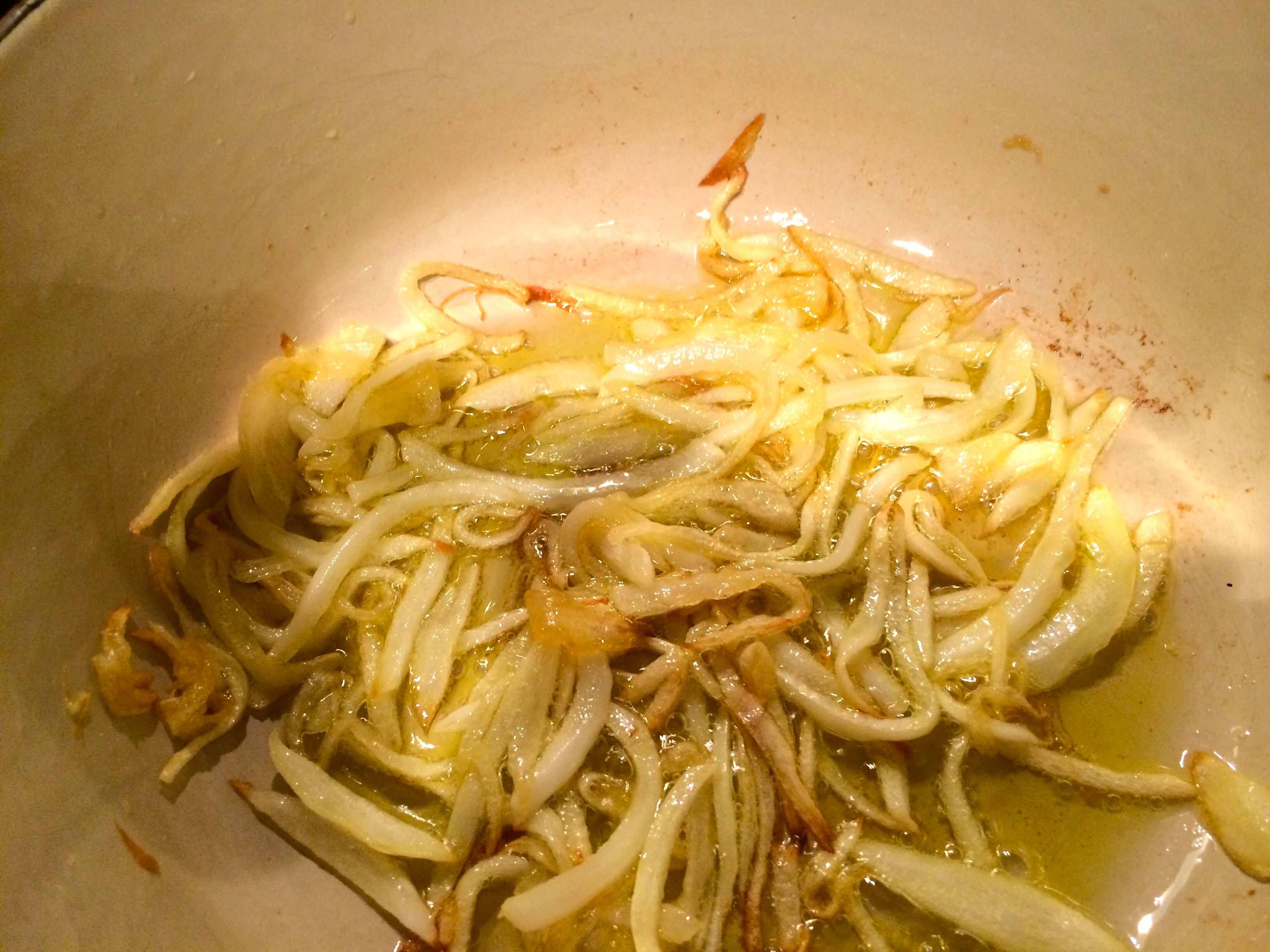
In a 3-quart heavy-bottomed sauce pan with a lid, place the olive oil and onion with a pinch of salt and cook uncovered over medium-low heat until the onions are softened and turn a pale gold.

The cooked onions
The cooked onions

Add the tomatoes with their juice, salt and pepper to taste, and cook uncovered for about 10 minutes, until slightly thickened.

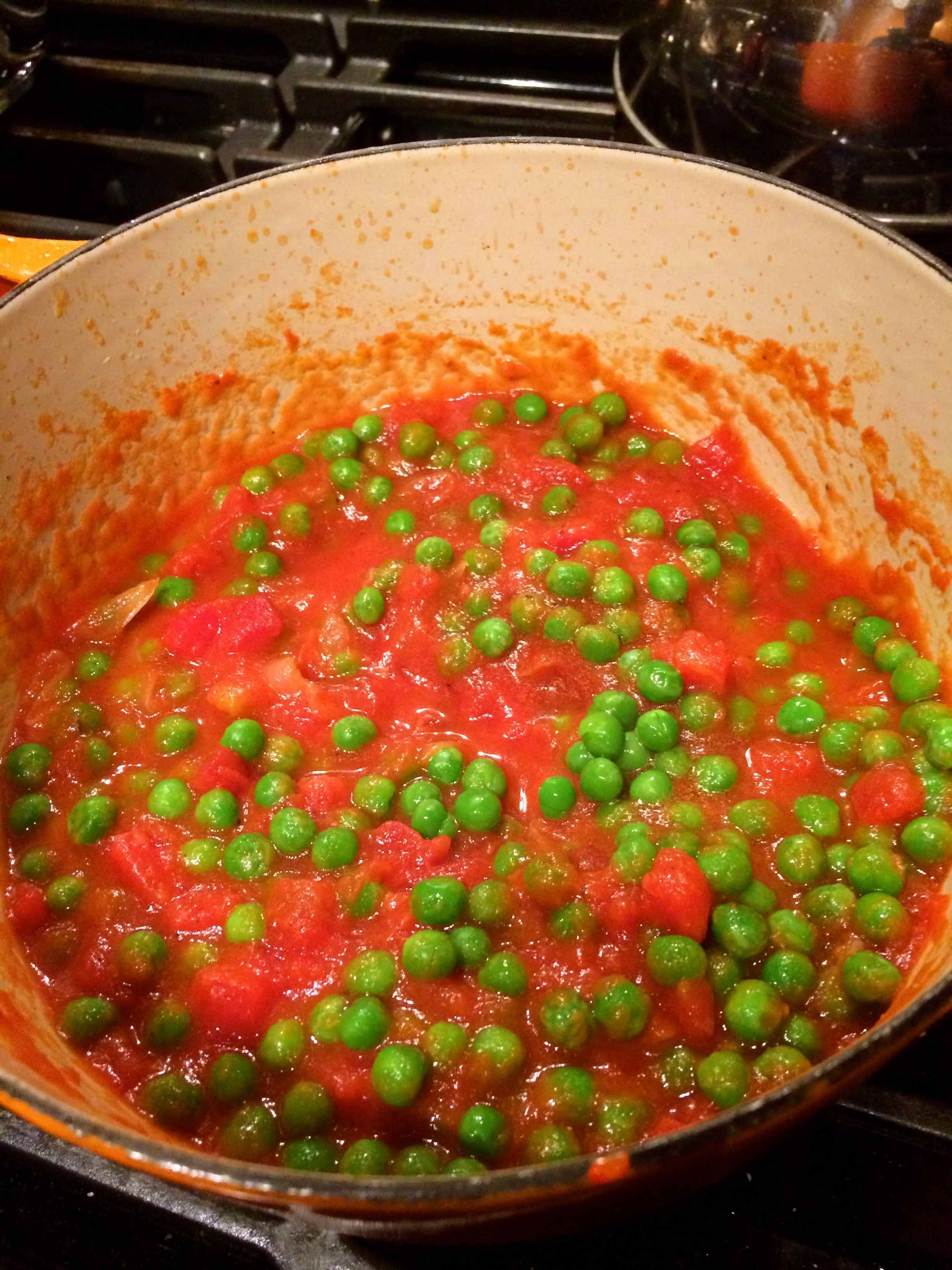
Add the peas, stir, and bring to a simmer. Cover the pan and continue to cook over low heat for 20 minutes, stirring occasionally. The peas should be well cooked, but not mushy.

The peas added to the sauce

Meanwhile, cook the pasta in well salted water, following package directions for al dente. Cook for one minute less than indicated. Reserve one cup of the pasta water and set aside. Drain the pasta and transfer it to the pan with the sauce. Cook for 1 minute, stirring to coat the pasta with the sauce. If too thick add some of the reserved pasta water.

Transfer to a warmed serving bowl and sprinkle with grated pecorino cheese.

Serve with additional cheese on the side.

Wine Pairing: Negro Amaro

Chicken Tetrazzini

ctet4small

Last week, I was saddened by the death of one of the Met’s divas, Licia Albanese. She was 105 when she died, a long life indeed. Yet her longevity does not diminish the sense of loss I feel. She was, after all, the first soprano in the first opera I ever heard at the Metropolitan Opera. It was at the old house, and she was singing the role of Violetta in Verdi’s La Traviata. Granted, her voice was not in its prime; and probably nearing 50, she may have been a little too old for the role of a Parisian courtesan. Nevertheless, she commanded the Met’s stage with a presence that only true divas possess.

Now, you might be asking, what does this have to do with food? Well, last night I prepared Chicken Tetrazzini, a dish named for another great diva of the past, Luisa Tetrazzini, who actually made her famous debut in 1907 at London’s Covent Garden as Violetta.

Most sources date the origin of the dish, perhaps originally prepared with turkey, between 1908 -1910 and attribute its creation to Ernest Arbogast, who was chef at the Palace Hotel in San Francisco, a city where Tetrazzini resided for quite some time.

Last night, as we sat down to dinner, we raised a glass to Licia Albanese and were reminded to be grateful for the exceptional sopranos we have today who follow in her footsteps at the Met.

My recipe for Chicken Tetrazzini is from the Food Network’s Giada de Laurentiis. Although the list of ingredients is rather long, it’s a relatively simple dish to prepare. It’s also decadently rich with loads of butter, cream, and cheese. But like all indulgent fare, it can be enjoyed guilt free—when consumed in moderation.

Rather than using the recipe’s called for skinless breasts, I skipped the cooking and used the meat I pulled from 1/2 of a left-over rotisserie chicken. I think you could do the same with leftover turkey.

Chicken Tetrazzini Adapted from Giada de Laurentiis

Ingredients

9 tablespoons butter
2 tablespoons olive oil
4 boneless skinless chicken breasts (I substituted the meat from a half of a rotisserie chicken.)
2 1/4 teaspoons salt
1 1/4 teaspoons freshly ground black pepper
1 pound white mushrooms, sliced
1 large onion, finely chopped
5 cloves garlic, minced
1 tablespoon chopped fresh thyme leaves
1/2 cup dry white wine
1/3 cup all-purpose flour
4 cups whole milk, room temperature
1 cup heavy whipping cream, room temperature
1 cup chicken broth
1/8 teaspoon ground nutmeg (I used at least a 1/4 teaspoon.)
12 ounces linguine
3/4 cup frozen peas
1/4 cup chopped fresh Italian parsley leaves
1 cup grated Parmesan
1/4 cup dried Italian-style breadcrumbs

Directions

Preheat the oven to 450 degrees F.

Spread 1 tablespoon of butter over a 13 by 9 by 2-inch baking dish. (I did not grease the baking dish and nothing stuck to it.)

Melt 1 tablespoon each of butter and oil in a deep large nonstick frying pan over medium-high heat. Sprinkle the chicken with 1/2 teaspoon each of salt and pepper. Add the chicken to the hot pan and cook until pale golden and just cooked through, about 4 minutes per side. Transfer the chicken to a plate to cool slightly. Coarsely shred the chicken into bite-size pieces and into a large bowl. (As I mentioned earlier, you can make this dish with leftover chicken or turkey pulled or shredded into bite-size pieces.)

The shredded chicken

Meanwhile, add 1 tablespoon each of butter and oil to the same pan. Add the mushrooms and sauté over medium-high heat until the liquid from the mushrooms evaporates and the mushrooms become pale golden, about 1-2 minutes. Add the onion, garlic, and thyme, and sauté until the onion is translucent, about 8 minutes. Add the wine and simmer until it evaporates, about 2 minutes. Transfer the mushroom mixture to the bowl with the chicken. (It took me much longer to brown the mushrooms, at least 10 minutes. I also cooked the onions for about 6 minutes before adding the garlic to cook for the final 2 minutes.)

The mushrooms, onion, garlic, and thyme

Melt 3 more tablespoons butter in the same pan over medium-low heat. Add the flour and whisk for 2 minutes. Whisk in the milk, cream, broth, nutmeg, remaining 1 3/4 teaspoons salt, and remaining 3/4 teaspoon pepper. Increase the heat to high. Cover and bring to a boil. Simmer, uncovered, until the sauce thickens slightly, whisking often, about 10 minutes. (I added a 1/4 of the cheese (1/4 cup) to the sauce during the last two minutes of cooking.)

Bring a large pot of salted water to a boil. Add the linguine and cook until it is tender but still firm to the bite, stirring occasionally, about 9 minutes. Drain. Add the linguine, sauce, peas, and parsley to the chicken mixture. Toss until the sauce coats the pasta and the mixture is well blended. (The linguine should be cooked a minute or two less than the package’s recommended time for al dente. Remember the pasta will continue to cook during baking.)

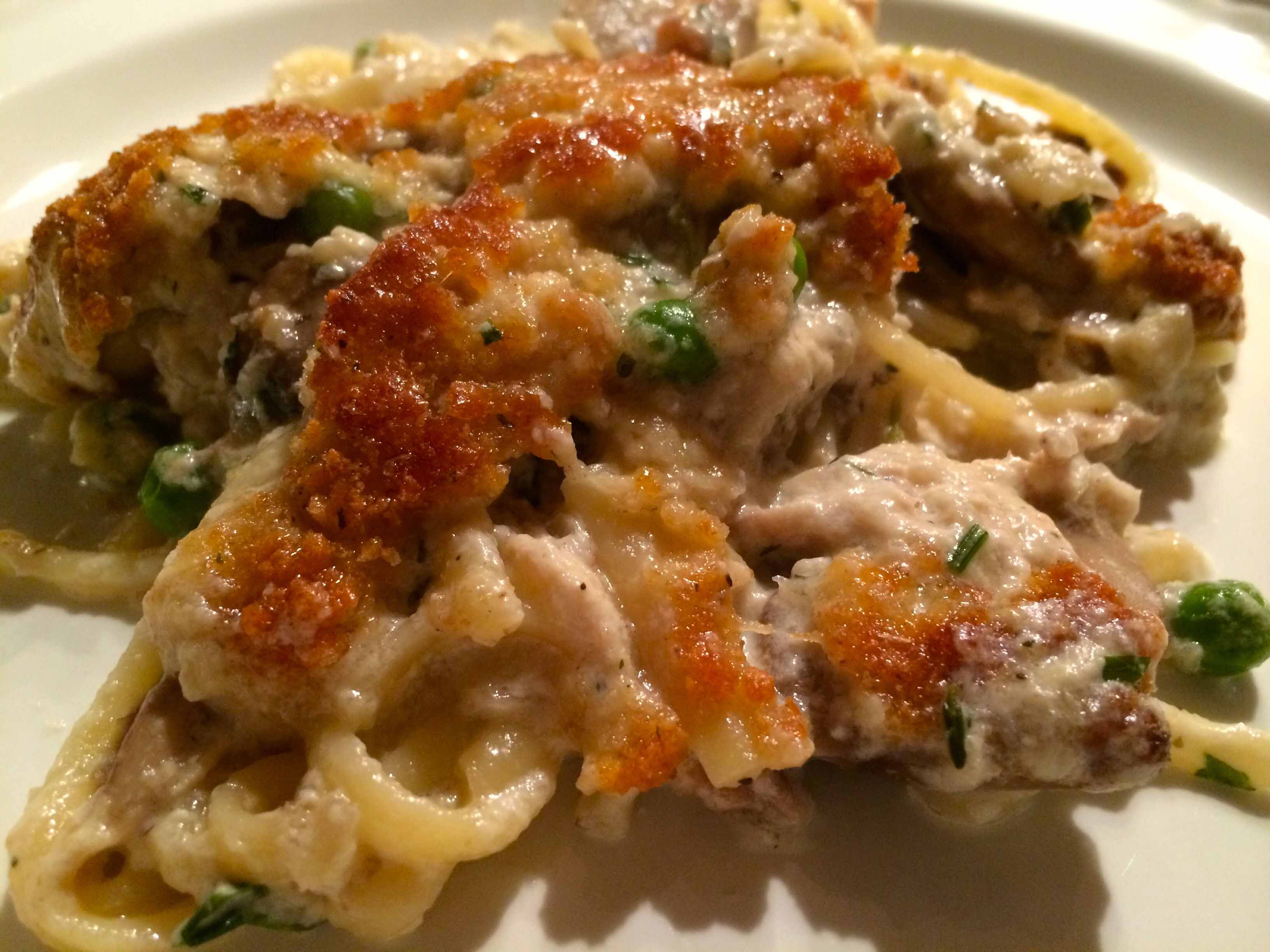
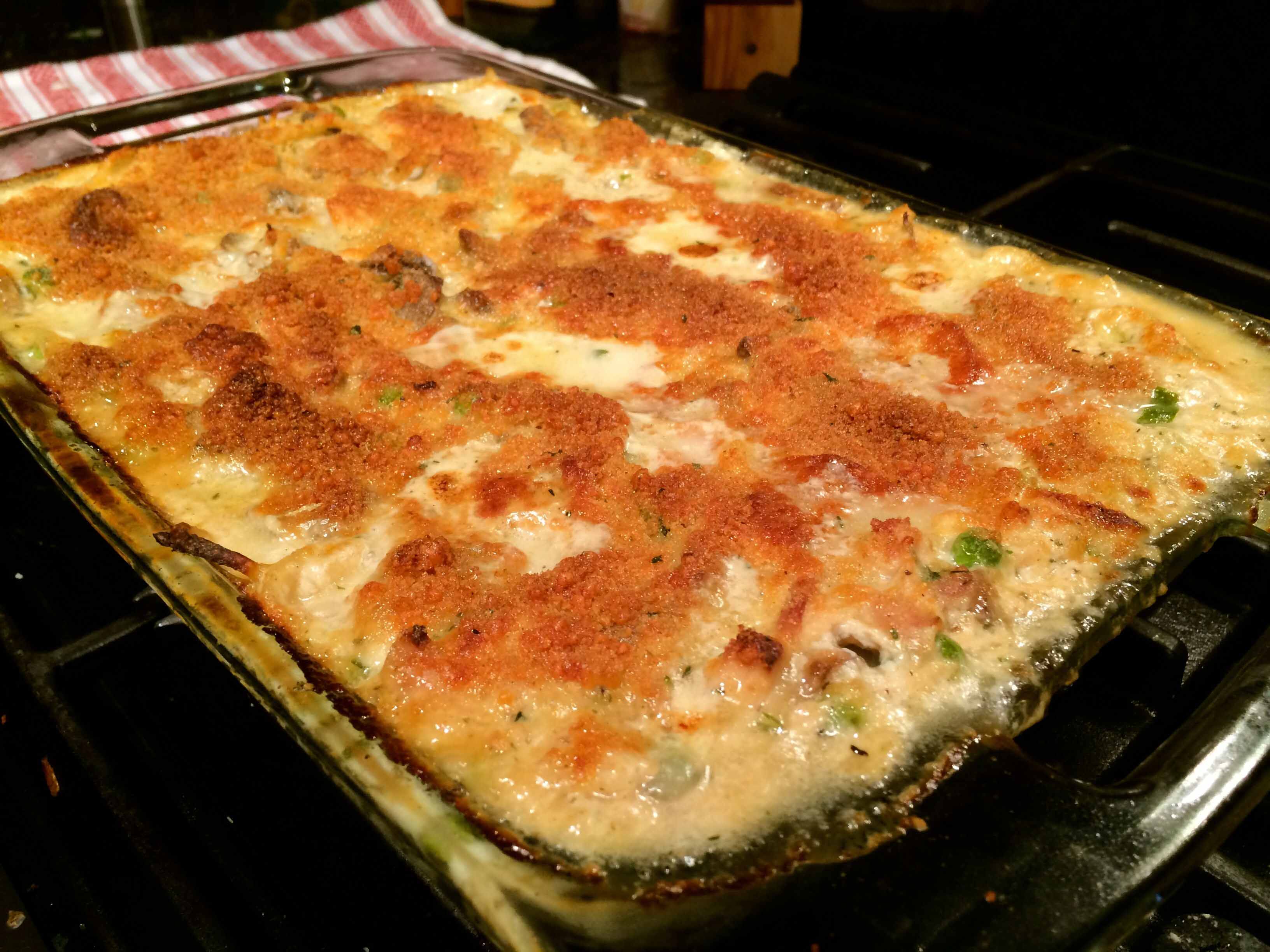
Transfer the pasta mixture to the prepared baking dish. Stir the cheese and breadcrumbs in a small bowl to blend. Sprinkle the cheese mixture over the pasta. Dot with the remaining 3 tablespoons of butter. Bake, uncovered, until golden brown on top and the sauce bubbles, about 25 minutes.

From the oven
From the oven

Read more and view a video of the preparation at:

http://www.foodnetwork.com/recipes/giada-de-laurentiis/chicken-tetrazzini-recipe.html

Wine Pairing: Chardonnay

Spaghetti with Anchovy Sauce

asauceplatedsmall

Another trip down memory lane. As a child asking “What’s for dinner?”, I used to dread hearing the words “pasta acciughe,” Italian for “anchovy pasta.” But unlike many kids today, my brother and I had to eat, or at least try, whatever was put in front of us. “It’s an acquired taste,” my dad would say.

Well, I must admit it took me a few years to acquire that taste, but now I’m happy I did. Pasta acciughe was frequently served in our home as a first course on Friday nights, as well as during Lent, when we weren’t allowed to have meat. For the longest time, I thought having to eat it was a kind of penance for misbehaving.

Anchovy sauce is both simple to prepare and cooks in about the same time it takes to make the pasta. There are many variations of this dish, but mine is among the most straightforward. It has 4 ingredients: olive oil, garlic, anchovies, and fresh parsley. What I like most about it is that nothing interferes with the pungent, slaty, savory flavor of the anchovies. And although this dish is sometimes served sprinkled with toasted breadcrumbs, I prefer to enjoy mine plain. For me, the breadcrumbs detract from the unctuous texture and briny flavor of the sauce.

For this recipe, I like to use canned salt-cured fillets packed in oil. My favorite brand is Agostino Recca.

Spaghetti with Anchovy Sauce
1/4 cup extra-virgin olive oil
1 clove garlic, minced fine
10 anchovy fillets packed in oil, drained
8 oz spaghetti
Kosher salt
2 tablespoons of chopped flat-leaf parsley
Freshly ground black pepper

In a 10” heavy bottomed skillet, poach the garlic in the olive oil over low heat for approximately 10 to 15 minutes. The garlic should take on only a minimum of color.

Mid-way through the poaching, start cooking the pasta in well salted water. Try to time the cooking of the pasta so that it will be al dente when the sauce if finished.

When the garlic is finished poaching, place the anchovies in the pan and continue to cook mashing them with the back of a wooden spoon until they dissolve into the oil. (About 2 minutes.) When they have dissolved, add the parsley and continue to cook still over low heat for about 2 minutes.

Sauce waiting for the pasta

Using tongs or a spaghetti fork, transfer the cooked pasta to the skillet. Take off the heat and toss the pasta with the sauce until nicely coated. If the sauce is too thick, add a tablespoon of the pasta water to loosen it up.

Sprinkle, if desired, with some freshly ground black pepper and serve.

Wine Pairing: Pecorino, Falanghina.

Pasta Ceci

ceciplatedsmall

Having survived the Great Depression, my Sicilian mother often spoke of those days when her family didn’t have much and had to make the most of what they could afford. Pasta Ceci, a simple mix of pasta and chick peas, was one of those dishes from my mother’s past that she continued to make frequently, even after her fortune improved.

Because it was so inexpensive and easy to prepare, I too made it many times when I was in grad school. I still remember when I first called my mother up for the recipe and how surprised and happy she was to share it with me. Although I have tried and enjoyed other recipes for this dish, it’s the one my mother shared with me that remains my favorite.

Pasta Ceci
For the chick peas:
1/4 cup water
3 tablespoons olive oil
1 garlic clove smashed and peeled
1 bay leaf
1 can (15.5 oz) chick peas, rinsed and drained
Salt, to taste.

For the topping:
1 tablespoon olive oil
1/2 cup fine breadcrumbs

For the finishing oil:
3 tablespoons olive oil
1/2 garlic clove minced fine
1/8 teaspoon crushed red-pepper flakes

8oz farfalle, bow-tie, pasta

To prepare the beans, place the water, olive oil, garlic, and bay leaf in a small sauce pan and cook covered, over medium-low heat for 5 to 7 minutes.

Add the chick peas, cover, and cook over low heat for about 10 minutes. When finished, remove the bay leaf and taste for salt. Keep warm.

Chick peas cooked
Chick peas cooked

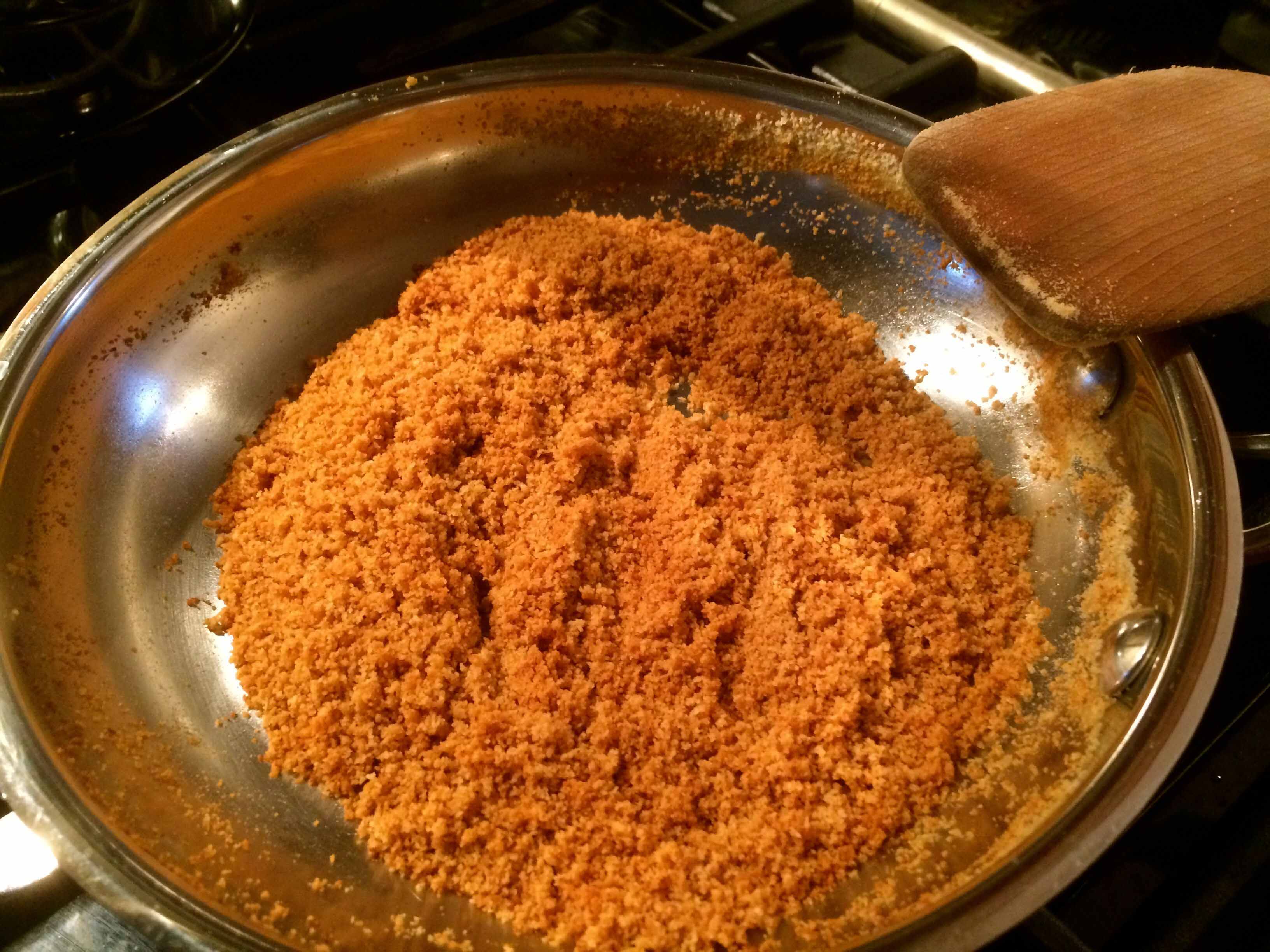
While the chick peas are cooking, prepare the the topping. In a small skillet, heat the olive oil over low heat for one or two minutes. Add the breadcrumbs and toast until light brown. Stir often, to avoid burning the crumbs. When toasted, place aside.

Breadcrumbs toasted
Breadcrumbs toasted

At the same time, prepare the finishing oil. In a small skillet, heat the oil, minced garlic, and pepper flakes over low heat for about 10 minutes. The garlic should become fragrant and take on only a minimum of color. When finished, place aside.

Finishing oil
Finishing oil

Meanwhile, in plenty of boiling, well-salted water, cook the pasta, according to package directions, until al dente. Before draining, reserve a cup of the pasta water.

After draining, place the pasta in a warmed serving bowl, add the chick peas and their cooking liquid. Toss lightly; if too dry, add a tablespoon or two of the pasta water. Add the finishing oil, followed by half of the bread crumbs. Toss lightly and serve. Sprinkle the remaining breadcrumbs on the individual portions of the pasta.

Wine Pairing: Grillo, Falanghina, Torrontes

Pasta alla Checca

chplatedsmall

Returning from a weekend of wedding revelry and, needless to say, over indulgence, we chose to make one of our favorite summertime pastas for dinner last night. It is also one of the simplest to prepare, Pasta alla Checca. It requires a minimum of preparation and, except for the pasta itself, no cooking. It’s also quintessentially seasonal, using summer tomatoes and fresh basil.

If you decide to make this dish, I suggest that you only do so when you can find the best tomatoes of the season and that they are perfectly ripe as they constitute the soul of this pasta. The extra-virgin olive oil should also be the finest and the mozzarella the creamiest you can find.

There are many variations on this dish. My recipe is for the Roman version of Pasta alla Checca from 1,000 Italian Recipesby Italian-food authority Michelle Scicolone. Her recipes are always authentic and, I might add, never-fail.

Pasta alla Checca Adapted from 1,000 Italian Recipes

3 medium size ripe tomatoes
1/3 cup extra-virgin olive oil
1 small garlic clove, minced (I used a large clove, grated on a Microplane rasp.)
Salt and freshly ground pepper
20 basil leaves
1 pound tubetti or ditalini (I used the slightly larger ditali pasta.)
8 ounces fresh mozzarella, cut into small dice (Be sure to us “fresh” as opposed to “low-moisture” mozzarella.)

1. Cut the tomatoes in half and remove the cores, Squeeze out the tomato seeds. Chop the tomatoes and place them in a bowl large enough to hold all of the ingredients. (Rather than squeezing our the seeds, I used a small spoon to remove most of them to avoid loosing too much of the juice.)

2. Stir in the oil, garlic, and salt and pepper to taste. Stack the basil leaves and cut them crosswise into thin ribbons. Stir the basil into the tomatoes. Cover and leave at room temperature up to 1 hour. (Be sure to taste carefully for adequate salt.)

The chopped tomatoes, basil, and olive oil

3. Bring at least 4 quarts of salted water to a boil in a large pot. Add the pasta and stir well. Cook over high heat, stirring frequently, until the pasta is al dente, tender yet still firm to the bite. Drain the pasta and add it to the bowl with the pasta. Add the mozzarella and toss again. Serve immediately. (Be sure to toss the pasta until the mozzarella just begins to melt.)

With the pasta and mozzarella

Wine Pairing: Cerasuola d’Abruzzo, Dry Rose

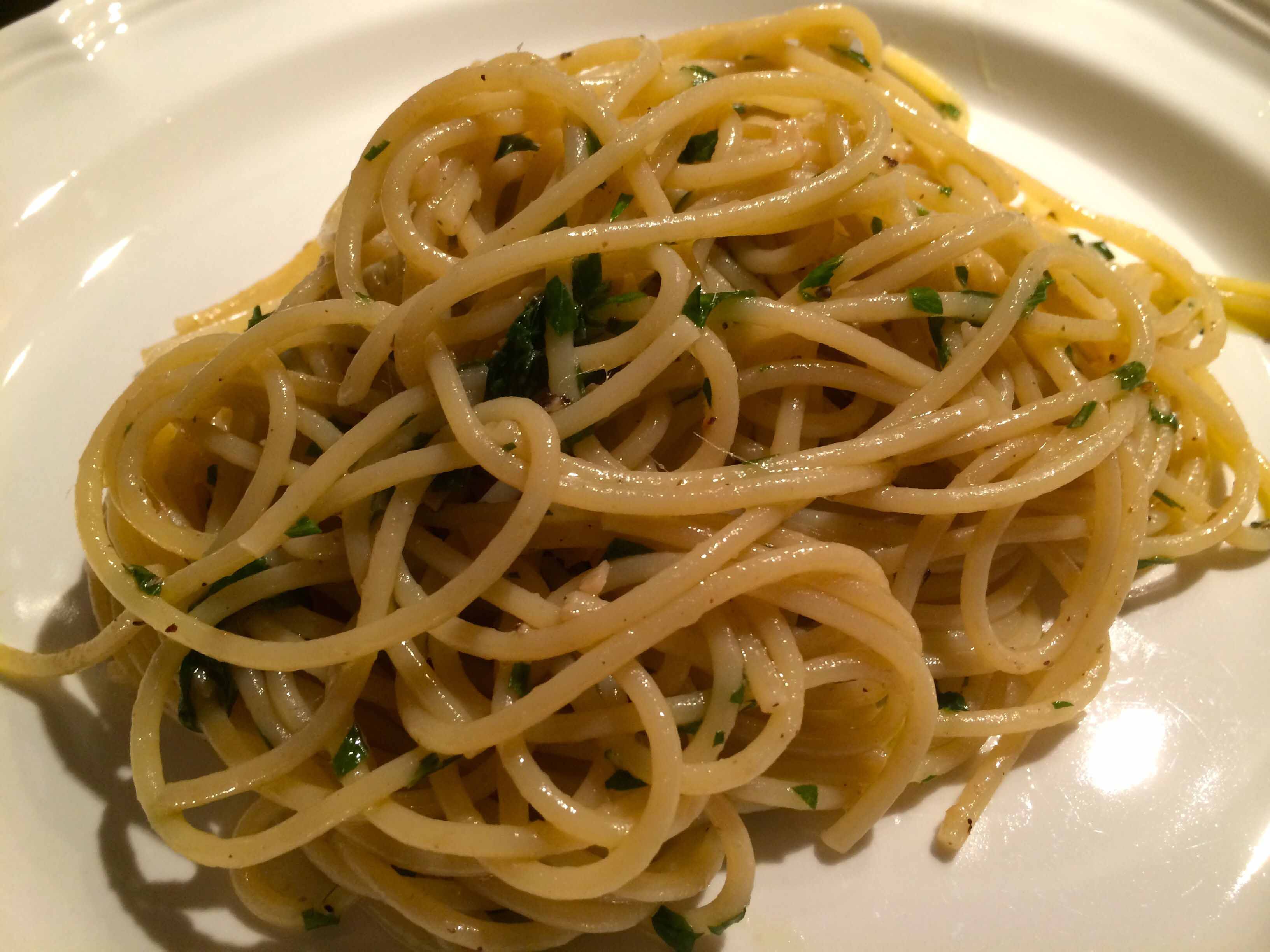
Spaghetti with Zucchini and ‘Nduja

ndujaplatedsmall

Despite the noise, crowds, traffic, costs and other negatives of living in New York City, there are plenty of positives and, for me, one of the best is the ready availability of almost any culinary ingredient for most ethnic cuisines.

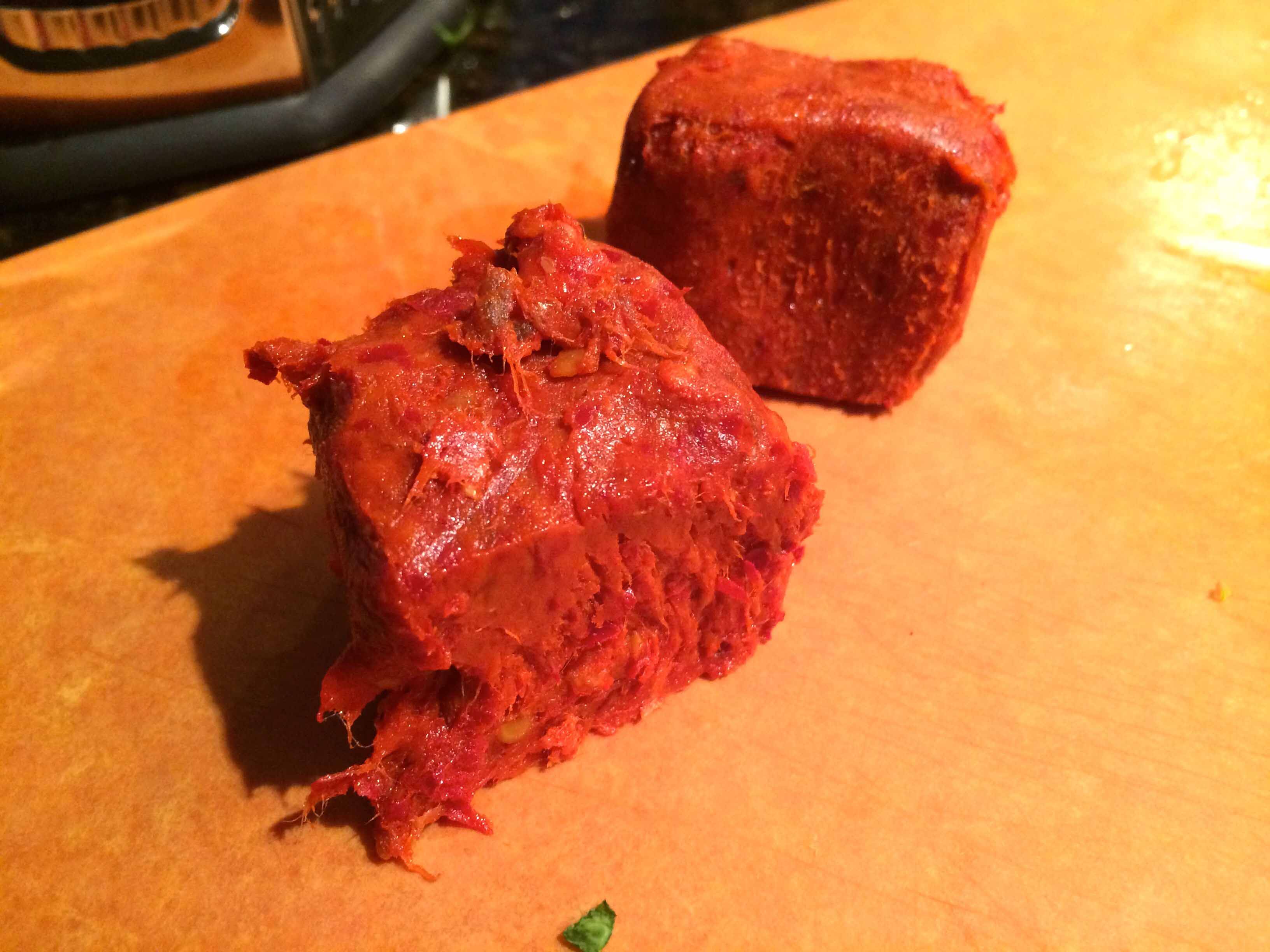
I was reminded of this yesterday when, paging through an old copy of the now sadly defunct American edition of La Cucina Italiana, I came across a recipe for spaghetti prepared with ‘nduja, a spreadable spicy salume from Calabria. Not at all familiar with this ingredient, a Google search provided me with plenty of background and within minutes I found a source for it a few blocks from home.

This highly spiced, fiery red Calabrian sausage is packed with plenty of flavor and so much red pepper that it’s thought by some to be an aphrodisiac. And given yesterday’s sweltering 90° F temperatures, I thought spicy spaghetti with zucchini and ‘nduja was the perfect dish. The delicately flavored zucchini provide a moderating counterpoint to the raw heat of the sausage.

Spaghetti with Zucchini and ‘Nduja
Fine sea salt (I used Kosher salt.)
1/4 cup extra-virgin olive oil
1 1/2 pounds zucchini, grated using the larger holes of a box grater
3 1/2 ounces ’nduja, removed from casing (scant 1/2 cup packed)
1 pound spaghetti

Bring a large pot of salted water to a boil.

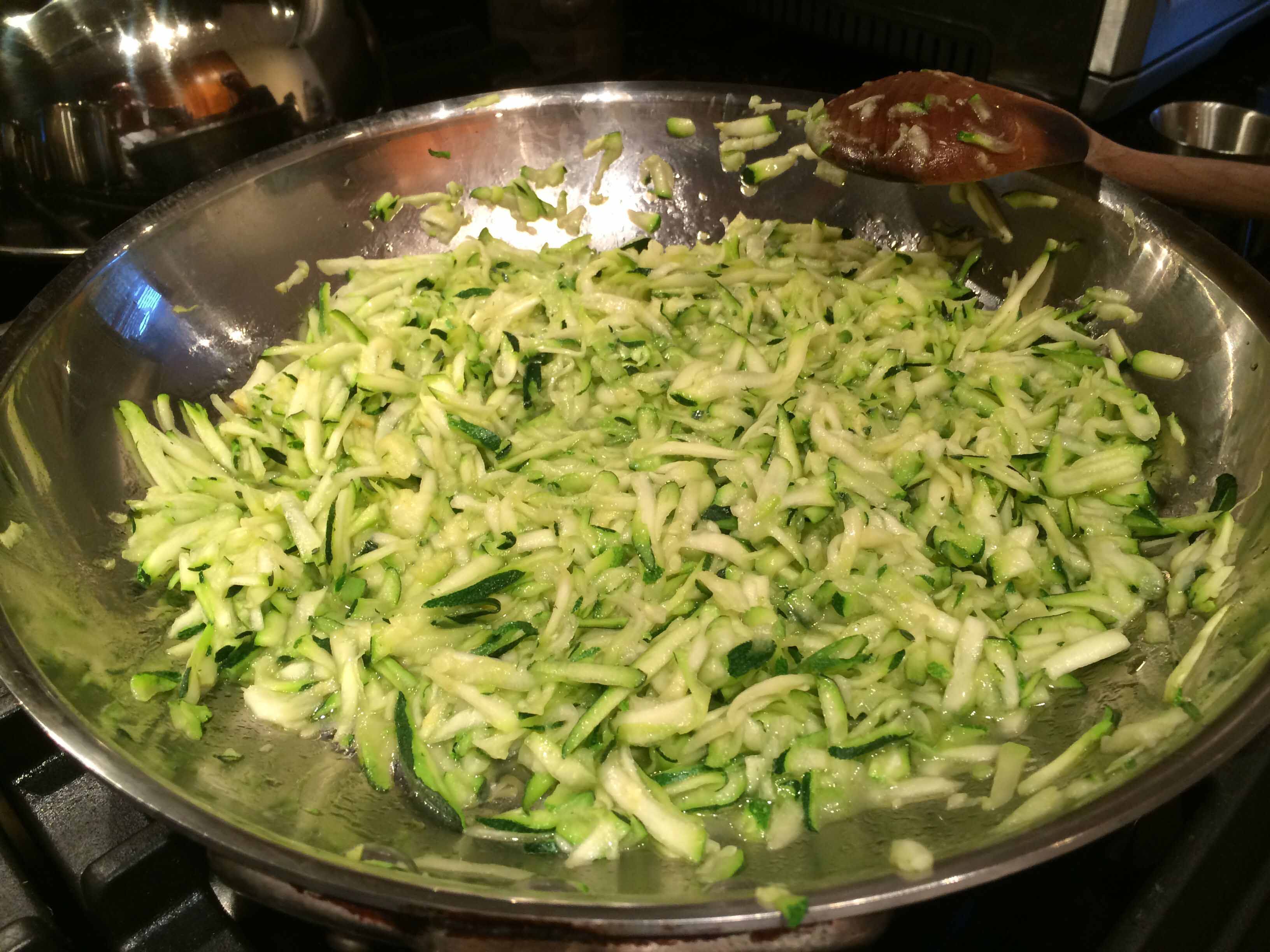
Meanwhile, in a large nonstick skillet, heat the oil over medium-high heat until shimmering. Add zucchini, 1/4 teaspoon salt, and 1 tablespoon water. Reduce heat to medium; cook, stirring occasionally, until tender, about 10 minutes. (Rather than a non-stick, I used a stainless-steel skillet.)

ndujazucchinismall
Sauteing the zucchini

Add half of the ’nduja; stir with a wooden spoon, breaking up the meat, until it has melted into the sauce. Remove from heat.

After adding the 'nduja
After adding the ‘nduja

Boil pasta until al dente. Reserving 1/4 cup of the pasta cooking liquid, drain pasta, and then transfer to a large serving bowl. Add zucchini mixture and pasta cooking liquid; toss to combine. Divide pasta among serving bowls. Serve immediately, topped with the remaining ’nduja. (Add the pasta cooking liquid judiciously; you may not need the full amount.)

'Nduja out of casing
‘Nduja out of casing

Note: An internet search for ’nduja should provide sources for purchasing it. In New York City, it is available at Buon Italia in Chelsea Market and I believe at Murray’s Cheese and possibly at Eataly.

Wine Pairing: Copertino, Zinfandel

Gemelli with Tuna and Tomatoes: Act II

tunapastasaladsmall

Raised in a family who suffered through the Great Depression, I was often reminded how important it was to save money and never let good food go to waste. My mother never let me forget that “people were starving in other parts of the world.” Her words made a lasting impression.

Indeed, using one night’s leftovers for the next day’s meal helps me justify spending so much for top quality ingredients. Tuesday’s gemelli with tuna and cherry tomatoes is a perfect example. The pasta’s main ingredient, Italian tuna packed in olive oil, was quite expensive—close to $25 for the two six-ounce jars—add to this the cost of the other ingredients and we’re looking at almost$40.

The pasta was wonderful the first night; however, I’m not a fan of reheated pasta, especially when it was prepared with fish. So I thought I would serve it last night as a salad. I took the pasta from the fridge two hours before dinner so that it would come to room temperature. I then made a light vinaigrette with some extra-virgin olive oil and a little balsamic vinegar. After tossing the past in the dressing, I added the juice of one lemon, a finely minced clove of garlic, a few more quartered cherry tomatoes, a good pinch of salt (cold dishes always seem to require more salt) and some freshly ground black pepper.

I served the pasta on a bed of wild arugula dressed with a drizzle of olive oil, some lemon zest, and a pinch of slat.

Paired with a dry rosé from Provence, this repurposed pasta was the perfect dish for dining al fresco on a humid summer’s night.

Would enjoy hearing from others their thoughts about using leftovers.

Gemelli with Tuna and Cherry Tomatoes

tunapastastep3small

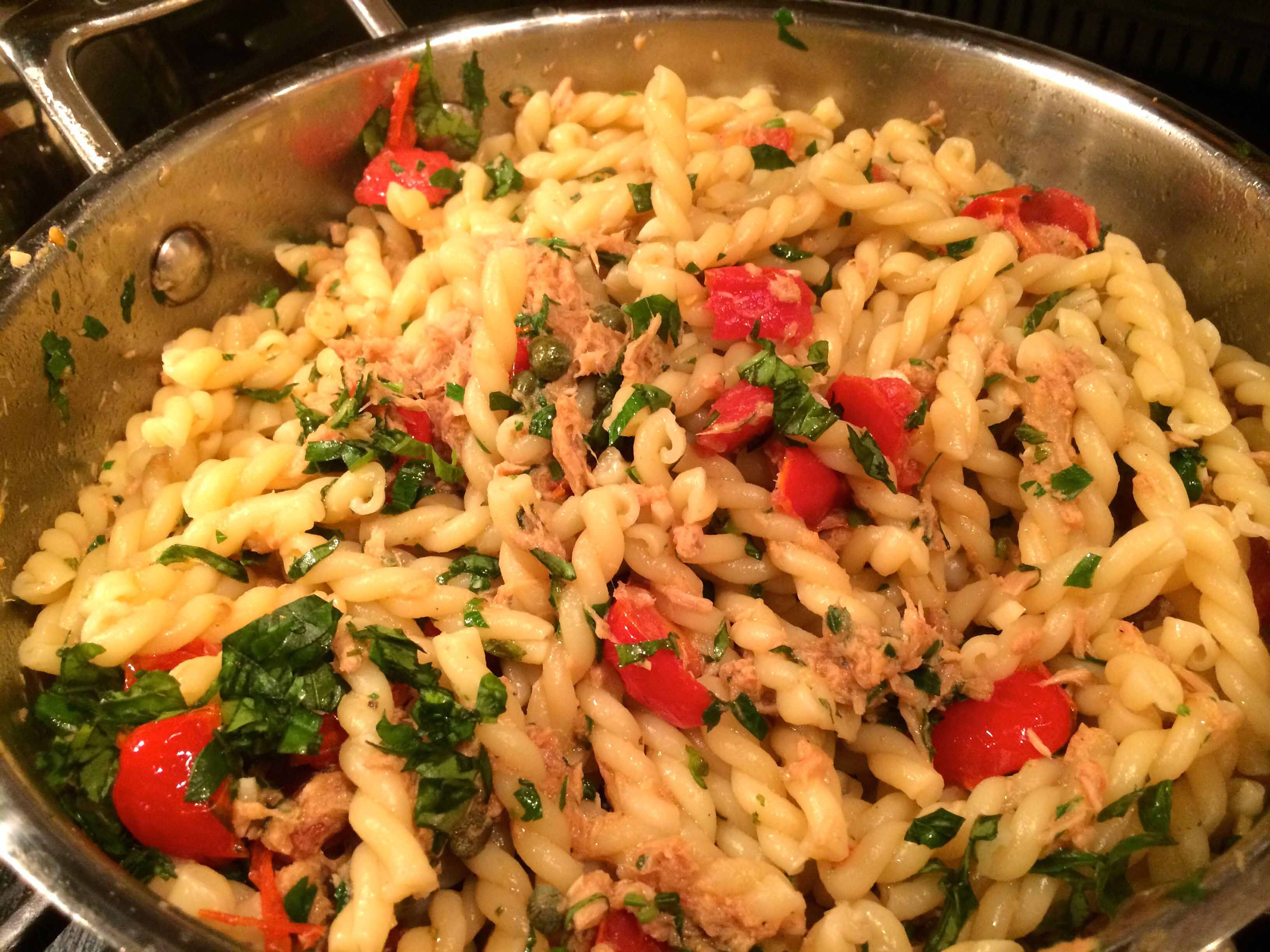
Last night we enjoyed one of our favorite weeknight pasta dishes: Gemelli with Tuna and Cherry Tomatoes. The source, a seven-year old recipe from Rachael Ray. The counterpoint between the unctuous, savory tuna and the fresh, sweet cherry tomatoes makes for a wonderful sauce for the twisted-twin strands of pasta.

Over the years, I’ve modified the recipe to meet our own palates, boosting the savory side with some capers, adding a little heat with some crushed red-pepper flakes, and using a touch of vinegar to brighten the dish with some acidity. If you would like to view the original recipe, here’s a link: Rachael Ray’s Original.

INGREDIENTS
3 tablespoons extra virgin olive oil
6 cloves garlic, finely chopped
pinch of crushed red-pepper flakes
2 jars solid Italian tuna in olive oil (6 ounces each), drained
1/4 cup dry white wine
3/4 pint small cherry or grape tomatoes, quartered
1/2 teaspoon sherry vinegar
2 tablespoons small capers packed in brined, rinsed and drained
Coarse salt and black pepper
1 pound gemelli pasta – short braids of pasta or other short-cut pastas, such as penne rigate, can be substituted, cooked to al dente in salted water
1/3 cup flat leaf parsley, chopped (about 3 handfuls)
20 leaves fresh basil leaves, shredded
Serves 4

PREPARATION
Add olive oil and garlic to a large, deep skillet. Place over low heat and slowly poach the garlic to extract as much flavor as possible, about 5 to 6 minutes. Do not let the garlic to take on any color.

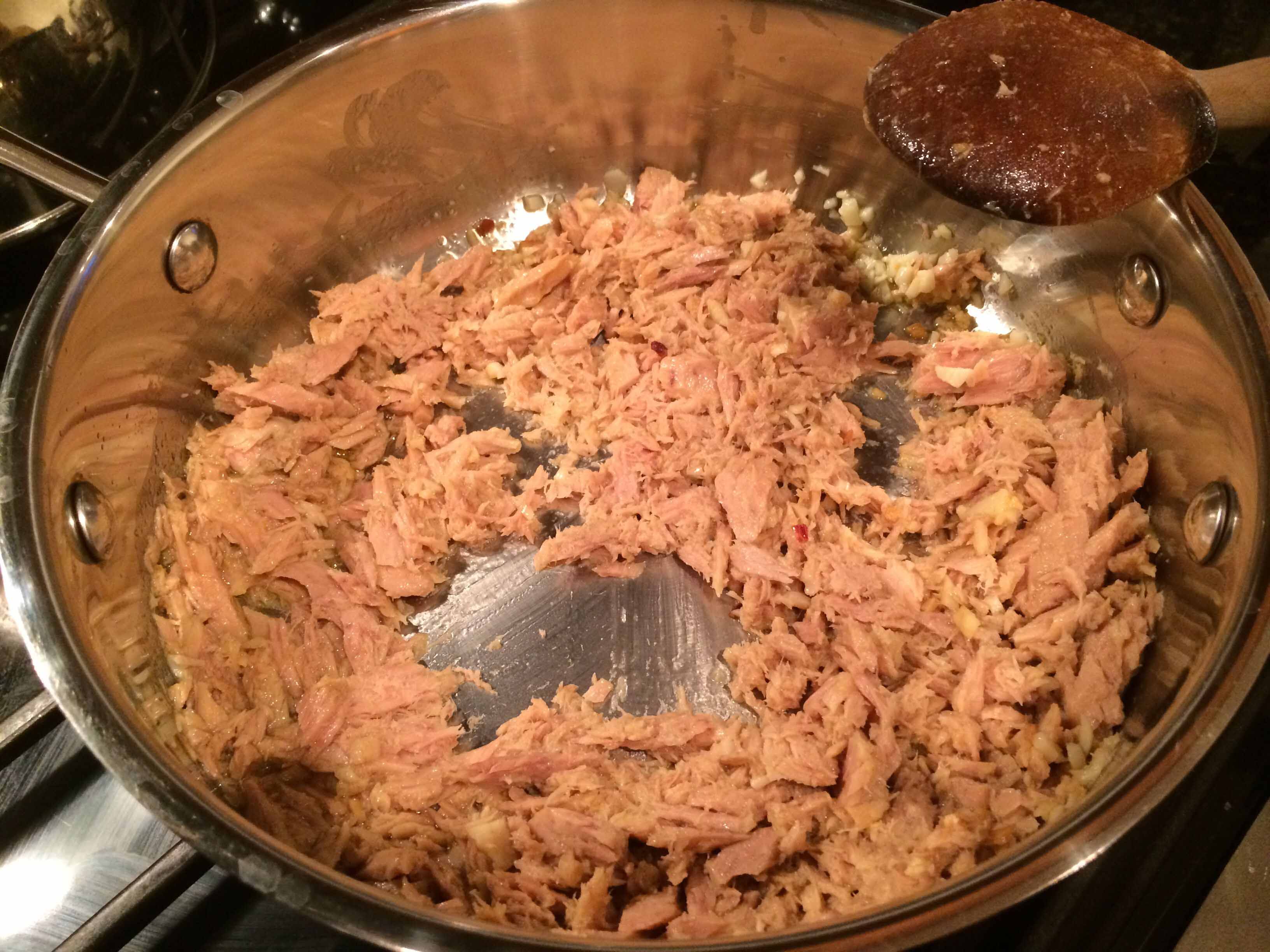
Raise the heat to medium and when garlic starts to sizzle, add tuna and mash into oil with the back of a wooden spoon. Reduce the heat to low and let the tuna sit in the oil for about 5 minute to infuse the fish flavor into the oil and to give the tuna time to break down. Add the wine to help break down the tuna so that it almost melts into the oil. If necessary, add a little of the pasta water.

Tuna being mashed in oil and garlic

When the tuna is like a thick pasty sauce, raise the flame a bit and add the quartered tomatoes, vinegar, and capers. Season with salt and pepper. Heat the tomatoes through until they start to break down, 3 to 4 minutes, then add hot, drained pasta that has been cooked to al dente.

Tuna with tomatoes and capers added

Add the parsley to the tuna and pasta and toss to combine well and evenly coat pasta. Adjust seasonings. Top pasta with shredded basil and serve on heated plates.

Pasta plated
Pasta plated

Wine Pairing: Trebbiano d’Abruzzo, Frascati


Linguine alle Vongole

clams platedsmall

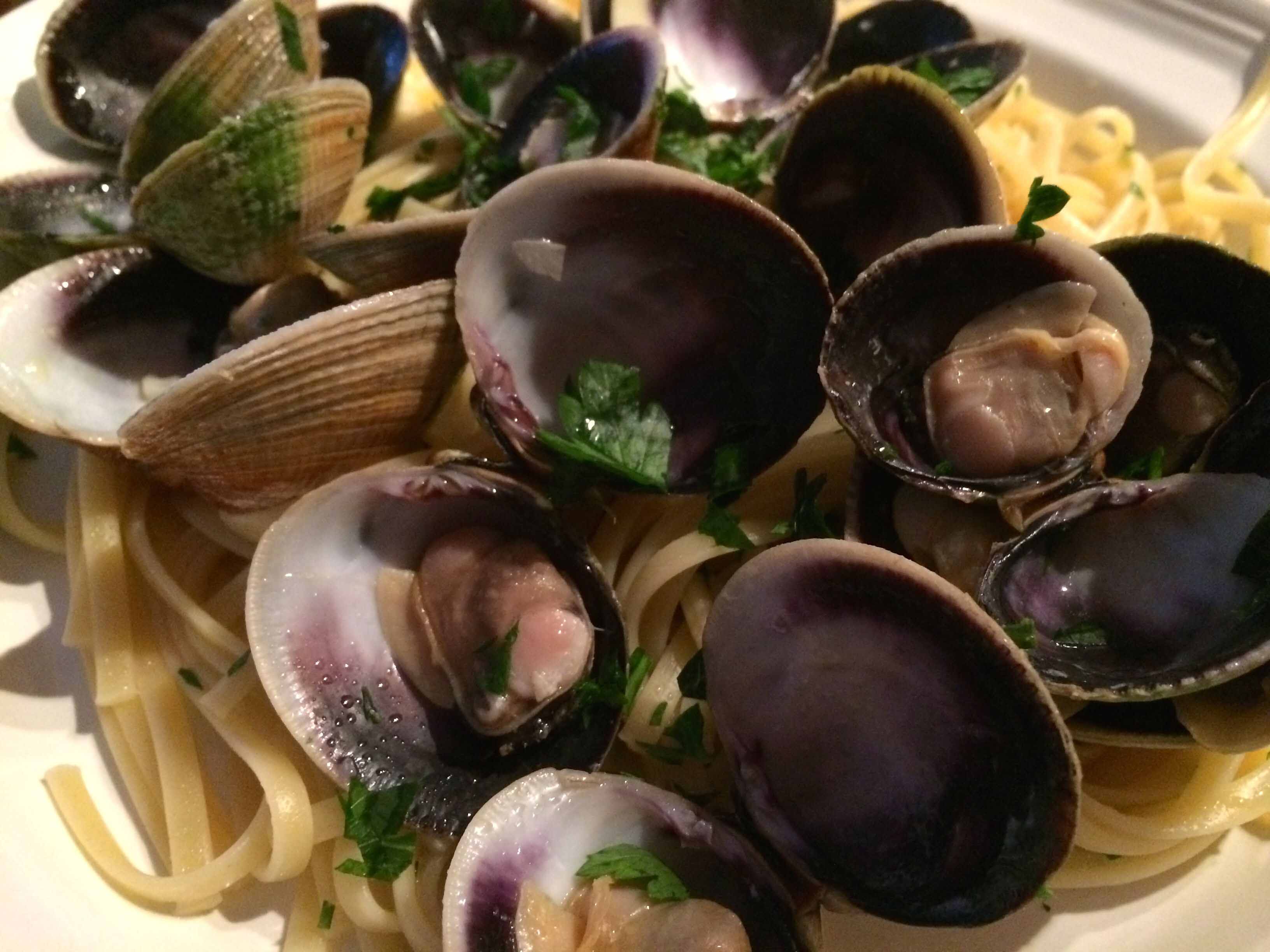
Last night, we enjoyed our favorite seafood pasta: linguine alle vongole, linguine with white clam sauce. It’s a relatively quick and easy dish to prepare, but it does require attention to detail: slow poaching of the garlic in the olive oil to extract optimal flavor, just a pinch of Calabrian red pepper flakes, a final addition of finely minced fresh garlic and lemon zest at the end to add brightness.

As with most Italian cooking, the primary ingredients must be of the highest quality. For this reason, sometimes you have to adjust a recipe by what’s available in the market. Such was the case yesterday. Typically I use either Manila or small littlenecks for this dish. However, yesterday, there were none of the former and the latter were just too big. But I did find some wonderfully fresh cockles, which I find a tad sweeter than clams.

2 large cloves of garlic, minced
1/4 cup olive oil
1/8 teaspoon Calabrian red pepper flakes
2 pounds small clams (littleneck, Manila, or cockles), scrubbed if necessary and rinsed. Inspect the clams discarding any that are cracked or that are open and do not close when pinched.
1/3 cup of dry white wine
1/2 cup Italian (flat leaf) parsley, chopped fine
8 oz linguine
zest of 1/2 lemon
1 tablespoon, unsalted butter
Freshly ground black pepper

In a large pot, bring 6 quarts of water to a boil.

Meanwhile, in a large sauté pan, starting from room temperature, poach 3/4 of the garlic and the pepper flakes in the olive oil over a low flame until aromatic. Add a pinch of the parsley for the final minute of sautéing. The garlic should take on only the lightest hint of gold color.

Sautéed garlic awaiting the clams

At this point, liberally salt the water (add the salt slowly to avoid boiling over) and start cooking the pasta. Cook the pasta following package directions for 1 minute less than al dente

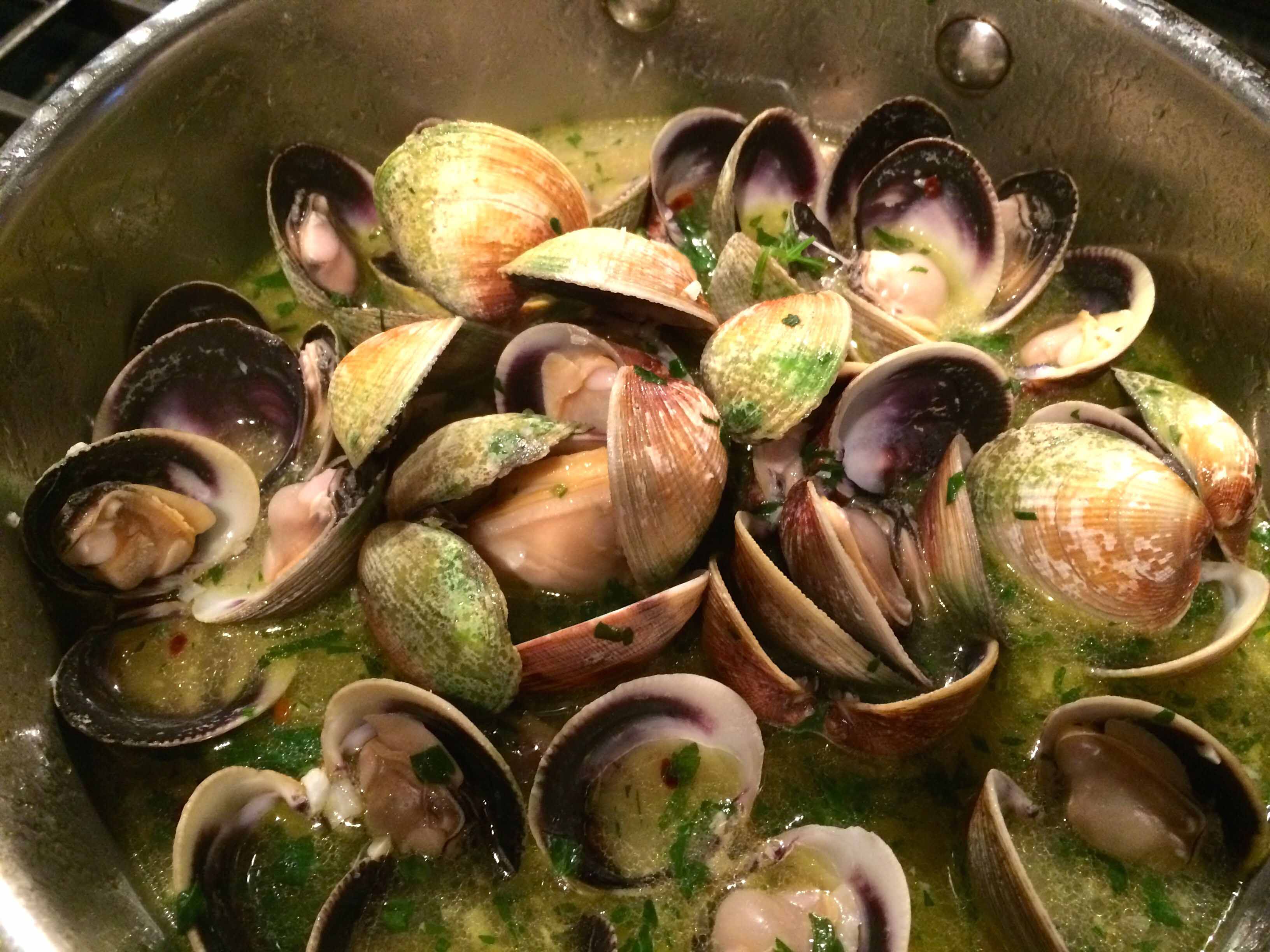
Add the clams, wine, and 3/4 of the parsley to the sauté pan, raise the heat and bring to a high simmer over medium high heat. Cover the pan tightly and shaking occasionally, cook the clams until they open. About 6 minutes.

Clams just opened
Clams just opened

Remove the clams with a slotted spoon, discarding any that do not open, sprinkle them with the lemon zest. Raise the flame to high and bring the sauce remaining in the pan to a boil. Add the butter. Using tongs or a pasta fork, immediately transfer the cooked pasta to the sauté pan and toss for about a minute to coat the pasta. If too dry, add a couple of tablespoons of the pasta water. At this point, the pasta will be the perfect al dente

Transfer the pasta and sauce to a bowl, add the clams, the remaining 1/4 of the minced garlic, and sprinkle with the remaining parsley. Serve on warmed plates with a few grinds of fresh black pepper if desired.

Wine Pairing: Soave, Pinot Grigio, Sauvignon Blanc